EN Standards: European Norms for Pet Bag Sourcing
EN standards are a test pack, not a single certificate. For pet bags shipped to the EU, a professional buyer specifies 5 to 9 European Norms per colourway: EN 71-3 element migration, EN 14362 azo dyes, EN 1811 nickel release on hardware, EN ISO 14184-1 formaldehyde and a REACH Annex XVII screen, plus 3 or 4 physical EN ISO tests. Budget EUR 240 to 520 per material set and 6 to 12 working days in an accredited lab.
Executive Summary
European Norms (EN) are published by CEN and CENELEC and adopted identically by the national standards bodies of all 27 EU member states, so one EN test pack clears a wholesale pet bag for every EU shelf at once. The practical job for a sourcing team is not to chase a logo but to decide which norms apply to the actual bill of materials and to write those norms into the purchase order before sampling starts. Our production team works to a default EU pack of EN 71-3, EN 14362, EN 1811 with EN 12472 pre-treatment, EN ISO 14184-1 and REACH Annex XVII screening, with physical norms added according to fabric and end use.
Commercial terms stay stable regardless of the compliance load: MOQ 500 units per colourway, samples in 6-10 working days, bulk production 35-50 days after sample approval, T/T 30/70, FOB Xiamen. Finished goods are inspected to AQL 2.5 with critical defects at zero tolerance, and every inspection report is matched to the lab report number of the material set actually used, so the paperwork trail survives a retailer audit. Buyers consolidating two or three colourways on one fabric base can cut lab spend by roughly 30 percent by testing the base material once and adding only colour-specific migration tests.
Pet bag tiered pricing usually breaks at three quantity points, and Material & Technology determines which point is realistic for a first order. Cheap pet carriers wholesale quotes that ignore carton cubage tend to lose their advantage once freight is added, so pet bag unit cost wholesale is the only number worth comparing.
What EN Norms Actually Cover in a Pet Bag Program
There is no European Norm written specifically for pet bags. That single fact explains most of the confusion in EU-bound wholesale programs: a buyer asks a supplier for "EN certified pet bags", the supplier cannot produce such a certificate, and the negotiation stalls. In practice a European Norm is a published test method or a safety requirement, adopted word for word by each national standards body, and the buyer decides which of those norms a given product must meet. A canvas pet tote, a nylon pet travel bag and an insulated pet bag with a metal frame each trigger a different subset.
The efficient way to run this is to treat the norm list as part of the product specification, in the same document as the fabric weight, the hardware finish and the packing method. When the norm list is fixed before sampling, the first sample is already compliant and the approval cycle is one round instead of three. When the norm list arrives after sample approval, the material has to be re-sourced, the colour has to be re-dyed, and the program loses four to eight weeks plus a second round of sample freight.
EU market surveillance is not theoretical. Under Regulation (EU) 2019/1020, customs and market surveillance authorities share data and can demand technical documentation from an economic operator inside the Union, and non-compliant lots are published through the Safety Gate rapid alert system. A pet bag consignment blocked at Rotterdam or withdrawn from a German retail chain costs far more than the EUR 240-520 lab pack that would have prevented it, and the withdrawal is public.
- EN norms are adopted identically at national level, so one pack serves 27 markets.
- The buyer, not the supplier, defines which norms apply to the bill of materials.
- Fixing the list before sampling removes one to two sample rounds from the calendar.
- Safety Gate publication turns a compliance miss into a brand-level event.
The Chemical Test Pack Buyers Cite First
Chemical norms dominate EU acceptance because they protect the end user from substances that are invisible in a finished bag. EN 71-3 measures the migration of 19 elements from accessible materials under simulated stomach acid, and it is applied to pet bags whenever a retailer classifies the item next to children's or soft toy product. It is run per colour and per material, which is why the lab bill scales with the number of colourways rather than with order quantity. Expect the test to be split into migration categories, with scraped-off coating handled differently from base fabric.
EN 14362-1 and EN 14362-3 cover azo colorants that can release any of 22 listed aromatic amines above 30 mg/kg. This is the test that most often fails on deep red, navy and black dye lots, and it is the reason a production team should order dyestuff declarations from the mill rather than trusting a fabric swatch. EN ISO 14184-1 quantifies free and hydrolysed formaldehyde in textiles, and where leather trim is used, EN ISO 17226-1 is the equivalent method. Both are sensitive to resin finishes applied for crease resistance, so a wrinkle-free finish requested by a designer can push a fabric over the limit.
Metal hardware introduces EN 1811, the reference method for nickel release from items in direct and prolonged contact with skin, with EN 12472 used as the simulated wear and corrosion pre-treatment for coated parts. Buckles, D-rings, snap hooks, eyelets and zip pullers all fall in scope, and anodised or PVD-coated finishes are not automatically exempt. On top of the norms, REACH Annex XVII restrictions apply directly as law: entry 72 for CMR substances in textiles, entry 47 for chromium VI in leather, entry 50 for polycyclic aromatic hydrocarbons in rubber and plastic, and the phthalate entries for coated materials and soft PVC trim.
- EN 71-3: 19 element migration, run per colour and per material.
- EN 14362: azo dyes, 22 aromatic amines at 30 mg/kg.
- EN ISO 14184-1 / EN ISO 17226-1: formaldehyde in textile and leather.
- EN 1811 with EN 12472: nickel release from metal trim and coatings.
- REACH Annex XVII entries 47, 50, 51, 52, 72 as legal baselines.
Physical EN ISO Norms That Set Your Durability Claim
Physical norms do not decide whether a pet bag is legal, but they decide whether the buyer accepts the lot and whether the product survives the returns window. Colour fastness is the family most often written into a technical file: EN ISO 105-X12 for rubbing, EN ISO 105-C06 for domestic and commercial laundering, EN ISO 105-E04 for perspiration, and EN ISO 105-B02 for xenon arc light fastness on bags displayed in shop windows or used outdoors. A printed logo that fails X12 at grade 3 will generate customer complaints long before it generates a compliance issue.
Mechanical norms set the numbers behind the word "durable" on a spec sheet. EN ISO 12947-2 (Martindale) measures abrasion resistance in cycles, EN ISO 13934-1 gives maximum tensile force, EN ISO 13937-2 gives tear resistance, EN ISO 13938-1 covers bursting strength for knit or mesh panels, and EN ISO 13936-2 measures seam slippage, which is the most common failure point on lightweight linings. For outdoor or travel lines, EN ISO 811 hydrostatic head and EN ISO 4920 spray test support waterproof or water-repellent claims, and EN ISO 6330 plus EN ISO 3175 define washing and dry cleaning behaviour for the care label.
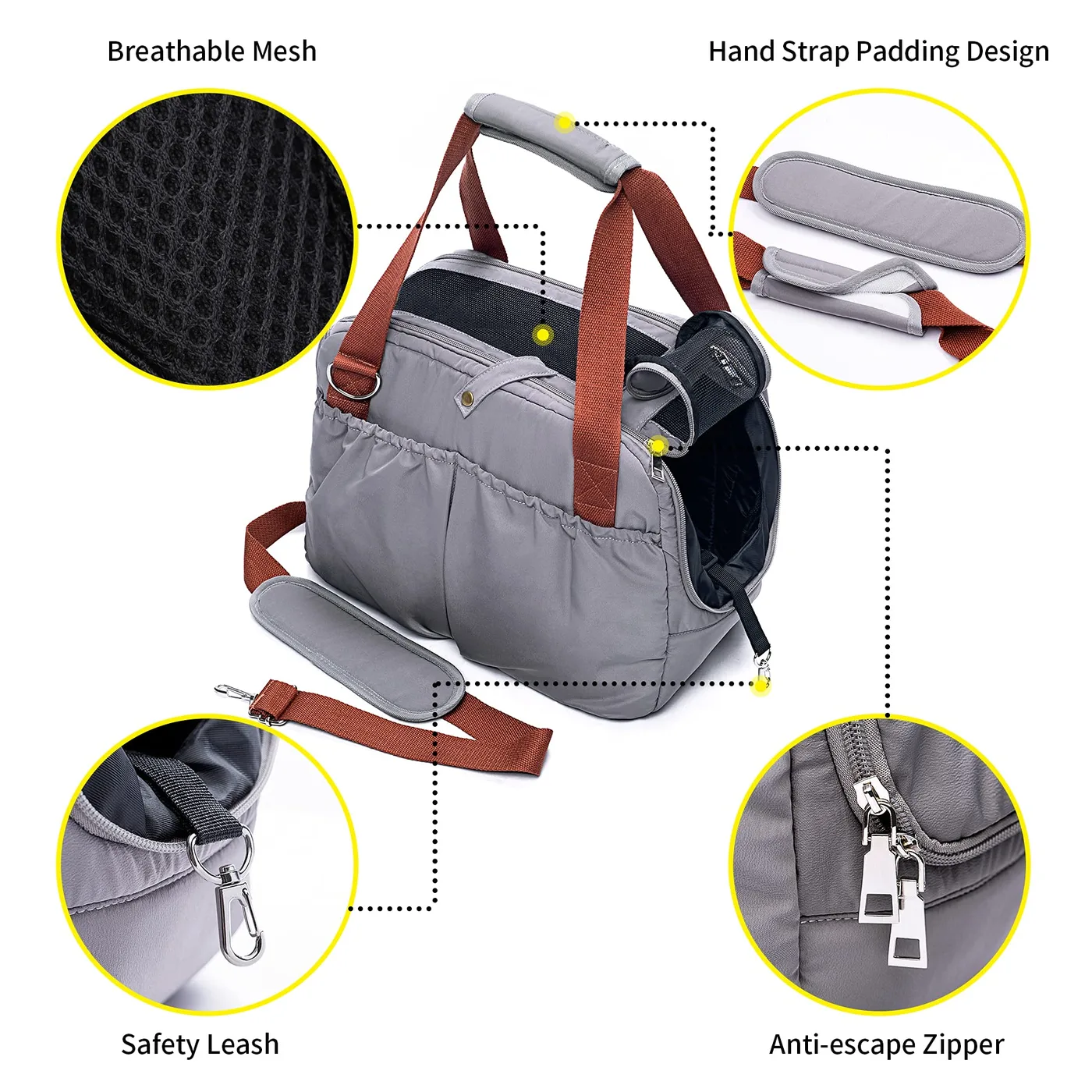
Mesh and ventilation panels deserve separate treatment. A pet bag is a product where airflow is part of the function, and the two numbers that matter are open area percentage and the abrasion behaviour of the mesh after laundering. Specify mesh by hole count and yarn denier rather than by name, require the same chemical pack on the mesh as on the body fabric, and add a dimensional stability check after EN ISO 6330 washing so a panel does not shrink into a distorted shape after the first clean. Airflow performance also interacts with structure: a bag that collapses under load can close off its own ventilation, so compression testing is worth adding for soft-sided designs.
The discipline here is to set a threshold per product tier instead of asking the lab for a pass or fail. A 600D polyester pet travel bag at a mid retail price point can be specified at 20,000 Martindale cycles, grade 4 rubbing and 30 N seam strength; a premium 900D or 1680D build at 40,000 cycles and grade 4-5. Publishing those thresholds in the purchase order means the AQL 2.5 final inspection and the lab report measure the same thing, and a dispute about quality becomes a discussion about numbers rather than opinions.
Hardware, Coatings and Corrosion Norms
Hardware causes more European test failures than fabric, mainly because it is sourced from a different vendor and rarely arrives with a full declaration. Every metal part that touches skin or can be mouthed by an animal should be covered by EN 1811, and every coated part should first be conditioned by EN 12472 so the coating is abraded and corroded before nickel release is measured. Black nickel, gunmetal and antique brass finishes are the usual offenders, and they are popular finishes on premium pet bags, so the conflict is structural rather than accidental.
Corrosion resistance is normally specified separately, using EN ISO 9227 neutral salt spray for plated parts and for the metal frame of a structured pet bag. A practical commercial benchmark is 24 to 48 hours of neutral salt spray without base metal corrosion for hardware on bags sold in coastal or high-humidity markets. Salt spray testing is cheap relative to its value: a full set of hardware can be screened for well under EUR 150, and it prevents the rust-spot returns that appear after a container has sat in a humid warehouse for a season.
Zips deserve their own line in the specification. The tape is a textile subject to the chemical pack, the slider and puller are metal subject to EN 1811, and the coating on a water-resistant zip is a material in its own right. Ask for a single declaration per zip model number rather than per shipment, because zip vendors change plating subcontractors without changing the part number, and the only way to catch it is periodic re-test tied to purchase date.
Documentation: Technical File, GPSR and Textile Labelling
Most pet bags are not CE marking products, because no harmonised EU directive covers them as such. They are, however, consumer products, and since the General Product Safety Regulation (EU) 2023/988 replaced the old directive, the documentation duty has become heavier: a risk assessment, a technical file, identification of the responsible economic operator, traceability labelling with manufacturer and importer details, and specific information in online listings. Buyers who still ask for a CE mark on a textile pet bag are asking for the wrong document, and a supplier who agrees to print one is creating a legal exposure for both sides.
The technical file should assemble the bill of materials with vendor names, the test reports with lab accreditation numbers, the risk assessment, the drawings or photos, and the instructions and warnings in the language of each destination market. Under Regulation (EU) 2019/1020, a manufacturer established outside the Union needs an authorised representative to hold that file, and marketplaces are increasingly verifying this before a listing goes live. Fibre composition labelling follows Regulation (EU) No 1007/2011, and care symbols follow ISO 3758; both are checked by retail compliance teams in Germany and the Netherlands with unusual thoroughness.
Packaging is moving in the same direction. Extended producer responsibility schemes for packaging already apply in most member states, separate collection of textiles is being phased in, and the Ecodesign for Sustainable Products Regulation (EU) 2024/1781 sets the framework for digital product passports. A wholesale program planned today should therefore capture material composition data at SKU level, because retrofitting that data across 200 SKUs later is a far larger project than capturing it during development. The European standards organisations CEN and CENELEC publish the current versions of the norms, and ECHA maintains the REACH restriction list that overrides any private standard.
What Compliance Costs and Where It Goes on the Calendar
Testing cost is driven by the number of distinct materials and colours, not by the number of bags. A pet bag built from one body fabric, one lining, one webbing and a single hardware finish in three colourways generates roughly 5 to 9 chemical test items plus 3 to 4 physical ones. In an accredited EU-facing laboratory that lands between EUR 240 and 520 per colourway set, with an average turnaround of 6 to 12 working days if no sample preparation is required. Rush slots exist at a premium, but they rarely help, because the mill declaration is usually the slow document rather than the test itself.
The calendar matters more than the invoice. Lab testing has to run in parallel with sample making, not after it, which is only possible when the fabric is already reserved. On a standard schedule, samples take 6-10 working days, the buyer approves in a week, bulk production takes 35-50 days, and sea freight to northern Europe adds 25-35 days. If testing starts after sample approval instead of during it, the whole program shifts by roughly three weeks, which on an autumn sell-in window can mean missing the season entirely.
| Work item | Typical duration | Typical cost | Owner |
|---|---|---|---|
| Material declaration collection | 3-6 working days | No direct cost | Supplier / mill |
| Chemical pack (EN 71-3, EN 14362, EN 1811, formaldehyde) | 6-12 working days | EUR 180-340 per colourway | Accredited lab |
| Physical pack (abrasion, tensile, colour fastness) | 5-9 working days | EUR 90-180 per material | Accredited lab |
| Sample making and courier | 6-10 working days | USD 60-140 per sample | Production team |
| Bulk production | 35-50 days | Per unit price | Production team |
| Final random inspection, AQL 2.5 | 1-2 days | USD 220-320 per man-day | Third party or in-house QC |
Reading the table commercially: the lab spend on a 3-colourway program is usually under 1.5 percent of the FOB value of a 3,000-unit order, while a single failed delivery window can wipe out 20 percent of the season margin. Compliance is cheap insurance bought early, or an expensive rescue bought late.
Building an EN-Aligned QC Plan Around AQL 2.5
A laboratory report proves the material was compliant on the day it was tested. An inspection plan proves the shipped lot was made from that material. The two have to be linked, and the link is a lot number. Every fabric roll, hardware batch and zip delivery should carry a received date and a supplier lot reference, and the packing list for the finished order should state which lots were consumed. Without that chain, a buyer cannot defend a compliant shipment if a market authority questions one unit.
Final random inspection on a wholesale pet bag order normally runs to AQL 2.5 for major defects with critical defects at zero and minor defects at AQL 4.0. Critical defects in this category include broken or sharp hardware, missing ventilation panels, and any structural failure of a load-bearing handle or strap. Major defects include visible shade variation beyond the approved tolerance, stitching defects on load paths, and incorrect or missing compliance labelling. The inspection should also verify that the sewn-in label carries the required fibre composition, care symbols and economic operator identification for the destination market.
Inspection should also sample the packaging and documentation, not only the bag. A missing language variant on a warning label, an incorrect fibre percentage, or a care symbol that contradicts the tested wash behaviour are all defects that a marketplace compliance team will flag, and all of them are cheaper to fix before loading than after a listing suspension. Build a one-page compliance checklist into the inspection worksheet covering label text, symbol set, economic operator details, batch code legibility and carton marking, and require photographic evidence of each item in the inspection report.
Re-test frequency is a commercial decision. A defensible policy for a running program is full chemical re-test once per colourway per year plus a physical re-test every 20,000 units or every quarter, whichever arrives first, with an immediate re-test after any change of mill, dye house or plating vendor. This keeps annual lab spend predictable while still catching the silent substitutions that cause most compliance surprises. Our production team issues the material declaration set with each repeat order so the buyer's compliance file is updated without a fresh round of questions.
Reading an EN Test Report Like a Buyer
A test report is a commercial document before it is a technical one, and buyers who read only the pass or fail line leave value on the table. The first thing to check is accreditation scope: the laboratory must be accredited to ISO/IEC 17025 for the specific method, and the report should carry the accreditation mark and the method version year, because an outdated method version can be rejected by a retail compliance team even when the result is valid. The second is sample description, which must match the actual production material including colour, coating and finish, not a generic fabric name.
The third item is the result table itself. Element migration, azo amines and formaldehyde are all reported as numeric values against limits, and the distance to the limit is useful information. A fabric reporting formaldehyde at 65 percent of the limit will probably pass again next season; one sitting at 92 percent of the limit is a re-test waiting to happen after a change of finishing batch. Buyers who track these margins can pre-empt failures instead of absorbing them, and can negotiate a mill to change a finishing recipe before a bulk order is committed rather than after a container is loaded.
Reports should also be matched to the production calendar. A report raised against a pre-production sample is evidence for that sample, not for the bulk lot, which is why the inspection record and the lot traceability matter. Where a buyer runs several seasons on the same material, it is worth paying for a slightly broader initial pack that includes a second colour and the lining, because extending an existing report is materially cheaper than opening a new file. In practice a well-managed compliance file for a pet bag range is a handful of linked documents, not a stack of unrelated certificates.
Selecting a Pet Bag Supplier That Can Hold EN Compliance
Capability questions beat certificate questions. Instead of asking whether a factory is EN certified, ask which laboratory it uses, whether that laboratory holds ISO/IEC 17025 accreditation for the specific methods, how it tracks mill declarations, and what happens when a test fails. A credible partner can show a recent report with a report number that the buyer can verify with the issuing lab, and can name the dye house that produced the fabric. A partner that cannot answer these questions will not hold compliance across a multi-season program, whatever logos appear on its profile.
Social and management system audits run alongside product compliance in most EU retail onboarding: BSCI or equivalent for social compliance, ISO 9001 for quality management. These are reviewed together with the product test pack, and the audit evidence should be dated within its validity window. Working with an SGS-verified production base simplifies this, because the audit evidence and the product testing can be coordinated through the same verification cycle instead of two separate projects.
Finally, match the compliance plan to the order structure. A 500-unit first colourway can carry a full test pack economically only if the same fabric base is reused across later colourways, which is an argument for building a material library rather than a style library. Buyers planning a wholesale pet bag range should fix three fabric bases first, then add silhouettes and colours on top, because every new fabric base restarts the chemical pack while a new colour on an approved base costs one additional migration test.
Why brands source here
- Pet bag programmes run since 2014; founding team in sewn goods since 2004
- SGS-verified production floor of 4,950 m² with 137 workers across 7 lines
- Monthly capacity of 200,000 units, audited to BSCI and ISO 9001
People Also Ask
What are EN standards in simple terms?
EN standards are European Norms published by CEN and CENELEC and adopted identically by the national standards bodies of EU member states, so a single test result is accepted across the whole single market.
Is EN 71-3 required for pet products?
Not by law for pet products specifically, but EU retailers frequently apply EN 71-3 element migration to pet bags when the item sits next to children's or soft toy ranges in their compliance system.
How much does EN testing cost per colourway?
Expect EUR 240 to 520 for a chemical and physical pack per colourway set in an accredited laboratory, with the total driven by the number of distinct materials rather than by order quantity.
Do EN standards replace ISO standards?
No. Many European Norms are ISO methods adopted as EN ISO, such as EN ISO 105 for colour fastness and EN ISO 12947 for abrasion. The two systems are aligned rather than competing.
Can a supplier reuse an old EN test report?
Reports are generally accepted for 12 months provided the material, mill and colour are unchanged. Any change of mill, dye house or hardware plating vendor invalidates the prior report for that component.
Which EN norm covers waterproof fabric claims?
EN ISO 811 measures resistance to water penetration under hydrostatic head and EN ISO 4920 measures surface water repellency by spray test. Both are used together to substantiate a waterproof or water-repellent claim.
Frequently Asked Questions
Are pet bags required to carry CE marking under EN rules?
No. A textile pet bag is normally not covered by a CE marking directive, so the correct documentation is a technical file and risk assessment under the General Product Safety Regulation rather than a declaration of conformity. Printing a CE mark on a product that is out of scope is itself a compliance risk.
Which EN standard applies to metal buckles on a pet bag?
EN 1811 is the reference method for nickel release, with EN 12472 as the simulated wear pre-treatment for coated parts. Buckles, D-rings, snap hooks and zip pullers should all be covered, and the release limit is tighter for parts in prolonged skin contact.
How many tests does one colourway need for the EU?
Typically 5 to 9 chemical items plus 3 to 4 physical items per colourway: element migration, azo dyes, formaldehyde, nickel release on hardware and a REACH Annex XVII screen, with abrasion, tensile and colour fastness added according to the fabric.
Can one test report cover several colours of the same fabric?
Partly. Physical tests cover the base fabric for all colours, but migration and azo tests are colour specific, so additional colours add only those items. Consolidating colours on one approved base fabric typically reduces lab spend by about 30 percent.
How long does EN testing take and does it delay bulk?
Laboratory turnaround is usually 6-12 working days. It only delays bulk if it starts after sample approval; run in parallel with the 6-10 working day sample window, it does not extend the 35-50 day bulk schedule.
What is the difference between EN and EN ISO standards?
An EN standard originates in CEN or CENELEC, while an EN ISO standard is an ISO standard adopted into the European system with identical text. For test purposes they are used the same way, and the current version year should always be quoted in the purchase order.
Does REACH apply if the product already passes EN tests?
Yes. REACH restrictions are law and apply independently of any voluntary norm, covering entries such as chromium VI in leather, PAH in rubber and plastic, phthalates in coatings and CMR substances in textiles. EN testing and REACH screening are complementary, not interchangeable.
Who pays for compliance testing on a bulk order?
It is negotiable, and the common split is that the buyer pays for the first development pack while the supplier maintains periodic re-test for running materials. For own-brand programs the buyer usually owns the report because the report carries its brand name.
What documents should an EU importer keep on file?
A risk assessment, technical file with bill of materials and vendor list, accredited test reports, drawings or product photos, labelling artwork and instructions in the destination languages, plus traceability records linking lots to shipments.
Does an EU authorised representative need to be appointed?
Where the manufacturer is established outside the Union, Regulation (EU) 2019/1020 requires an authorised representative or other responsible economic operator to hold technical documentation and cooperate with authorities. Many marketplaces verify this before activating a listing.
How often should a running program be re-tested?
A defensible cadence is full chemical re-test once per colourway per year, physical re-test every 20,000 units or per quarter, and immediate re-test after any change of mill, dye house or plating vendor.
What is the fastest way to fail an EU compliance check?
Missing or undocumented economic operator identification and unverifiable test reports are the two most common causes. Both are documentation failures rather than product failures, and both are avoidable during development rather than at inspection.
Talk to QUANZHOU JUNYUAN BAGS about a wholesale pet bag order: MOQ 500 pieces per colourway, samples in 6-10 working days, bulk production in 35-50 days under AQL 2.5 inspection.
Get a free quote Request a sample