Market & Business Strategy programmes run at MOQ 500 pieces per colourway with samples in 6-10 working days and bulk production in 35-50 days. Pricing, channels, compliance and order economics for buyers sourcing pet bags at wholesale scale.
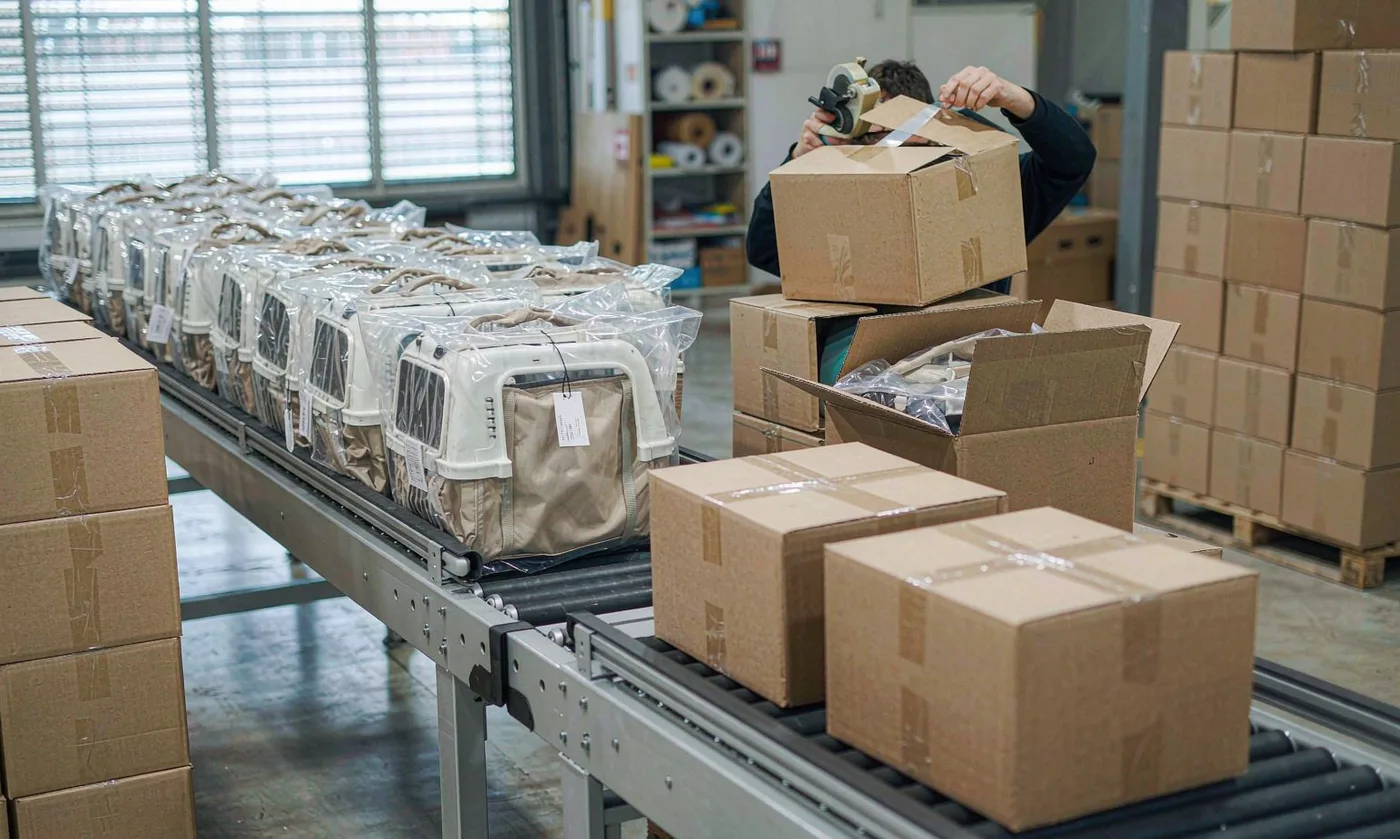
Specification baseline
| Item | Figure | Note |
|---|---|---|
| Price bands | Entry / mid / premium | Set by fabric and hardware tier |
| Order economics | MOQ 500, 6-10 day samples, 35-50 day bulk | AQL 2.5 pre-shipment |
| Terms | T/T 30/70, FOB Xiamen, DDP available | Letters of credit case by case |
| Channels | Marketplace, retail chain, specialty, DTC | Packing and labelling differ |
| Compliance | REACH, CPSIA, Prop 65, EN standards | Scope set by destination market |
| Documentation | Test reports, BSCI and ISO 9001 records | Tied to dye lot and batch |
What sets the unit price
Four variables decide a pet bag quote, and only one of them is negotiable without changing the product. Material is the largest - moving from 300D to 900D Oxford or adding TPU lamination moves the fabric line by 40-70%. Hardware is second: a named reverse-coil zipper costs several times an unnamed equivalent and is the single most common cause of field returns. Base construction is third, because moulded frames cost real money while die-cut boards do not. Packaging is fourth and is frequently overlooked - a retail box raises both unit cost and carton count, and therefore freight.
| Price band | Landed unit | Typical specification | Packing | Where it sells |
|---|---|---|---|---|
| Entry band | USD 4-8 | 300D PU, unbranded hardware | Bulk polybag | Marketplace and discounters |
| Mid band | USD 8-16 | 600D PU, named zipper | Header card or box | Specialty retail, DTC |
| Premium band | USD 16-30 | 900D or TPU, branded hardware | Printed retail box | Department and boutique |
| Programme band | USD 30+ | Custom material and tooling | Custom packaging set | Own-brand launches |
Order economics and channel requirements
A first wholesale order usually lands at 1,500-5,000 pieces spread over two or three colourways, which clears the 500-per-colourway threshold without over-committing inventory. Marketplace sellers start smaller and reorder faster, which is why stock materials on existing patterns matter to them. Retail chains order against a delivery window and a compliance manual, so the work is scheduling and documentation rather than specification.
Terms are T/T 30/70 with FOB Xiamen as the default and DDP available on request. Pre-shipment inspection runs to AQL 2.5 and buyers or their nominated agency may attend. Carton efficiency is quoted alongside unit price, because a bag that folds flat can change the landed cost more than a small material downgrade.
Destination compliance map: CPSIA and Proposition 65, REACH and EN, UKCA, Japan and Australia
Compliance is not one certificate that travels with the container. It is a file per destination market, and the file changes shape depending on who sells the product. The efficient approach is to build one master technical file for the product, then maintain thin market overlays that add the declarations, warnings and test reports each destination requires. The map covers five destinations.
| Destination | Core instruments | Typical file set | Practical traps |
|---|---|---|---|
| United States | CPSIA limits for lead and phthalates; California Proposition 65 | Childrens product certificate where applicable, tracking label, third-party laboratory report | Proposition 65 warnings are claim driven, so a warning can become a sales problem before it becomes a legal one |
| European Union | REACH Annex XVII; EN 71-3 used by retailers as a migration benchmark; general product safety rules | REACH statement, EN 71-3 migration report, technical file, EU responsible person | SVHC list updates during a programme and invalidates a report that was valid at booking |
| United Kingdom | UKCA marking; UK REACH | UKCA declaration, UK REACH statement, separate technical file | Assuming the EU file covers the UK; it does not |
| Japan | Household goods quality labelling law; JIS textile methods used by importers | Labelling in Japanese, composition declaration, importer identification | Label artwork is checked at import, so artwork errors delay clearance |
| Australia | Consumer law safety and recall duties; voluntary standards used by major chains | Safety assessment, recall procedure, labelling in English | Recall obligations sit with the local supplier, so the procedure must exist before launch |
The material risk concentrates in a small part of the product. Coatings, inks, printed labels, plastic trims and adhesives are where restricted substances are found, while the base cloth is usually low risk once it is sourced with documentation. That is why OEKO-TEX Standard 100 on textile inputs and a restricted substance statement from the coating supplier remove most of the exposure cheaply.
Timing is the part buyers underestimate. Laboratory slots, particularly for phthalate and heavy metal screening, need to be booked before bulk production rather than after, because a failed report discovered at the end of a 35-50 day production window has no cheap remedy. Build the compliance calendar backwards from the vessel date: book testing at the same time as the first sample, which takes 6-10 working days.
Social compliance is a separate file and is increasingly requested by European and British chains. Audit reports such as BSCI are reviewed alongside the product file, and they are checked at the site that makes the goods. Our SGS-verified production base covers 4,950 square metres with 137 people, and audit documentation is maintained for review during a supplier approval visit rather than produced on request.
The practical routine that works is a single master file, one page per market overlay, and a named owner for each. When a coating or trim changes, the change is recorded under ISO 9001 change control and the affected overlays are re-tested, so a substitution never silently invalidates a declaration. Minimum order quantity is 500 pcs per colourway and terms are T/T 30/70 FOB Xiamen, so a compliance failure found late is also a cash problem.
Landed-cost model: building the number from FOB Xiamen to warehouse and FBA inbound
A factory price is an input, not a decision. The number that governs margin is landed cost per unit at the point the goods are sellable: factory price plus freight, duty, clearance, inland handling, storage, marketplace inbound fees and the cost of money tied up during transit. The model below is a worked example using planning ranges, and it should be rebuilt with the buyer own rates before it is used for a decision.
| Line item | Basis | Worked example per unit | Note |
|---|---|---|---|
| FOB Xiamen unit price | Planning range by type and specification | 8.40 USD, within a 6.80 to 11.50 planning range | Fixed by fabric, hardware and process tier |
| Ocean freight allocation | Container cost divided by units loaded | 0.55 USD | Driven by packed cube, not by unit price |
| Import duty | Classification specific rate, illustrative | 0.55 USD at an illustrative 6.5 per cent | Confirm the classification before quoting |
| Customs clearance and filing | Per shipment, divided by units | 0.08 USD | Includes entry filing and broker fee |
| Inland drayage and unloading | Per container, divided by units | 0.12 USD | Rises sharply with appointment delays |
| Pre-shipment inspection | AQL 2.5 per ISO 2859-1 sampling | 0.05 USD | Cheap relative to a rejected receipt |
| Warehousing and pick | Per unit received and picked | 0.30 USD | Depends on dwell time |
| FBA or marketplace inbound | Per unit processing fee | 0.45 USD | Varies with size tier |
| Landed cost per unit | Sum of the above | 10.50 USD | Roughly 1.25 times FOB in this example |
Two ratios are worth tracking because they expose problems early. The first is landed cost divided by FOB price, which in this example is about 1.25 and typically sits in a 1.20 to 1.45 planning range for sea freight into a major port. The second is freight per unit divided by FOB price, because it tells a buyer whether a redesign that reduces packed volume is worth more than a price negotiation.
Packed cube deserves its own line in the specification. A carrier that folds flat can halve the freight allocation on the same product, and on low-unit-price programmes that saving exceeds any realistic material saving. The same logic applies to carton count: a stronger carton that allows a higher stack can reduce warehouse cost per unit more than it adds in material.
The lines buyers forget are the ones that appear after arrival: relabelling when the marketplace label format changes, carton re-packing to meet a receiving centre rule, and long-term storage charges on slow movers. Add a contingency line of 3 to 5 per cent of landed cost as a planning range for these items, and add a line for the cost of capital during a 35-50 day production window.
Run the model three times: at the target volume, at 60 per cent of it, and at 150 per cent. Freight allocation, inspection cost per unit and duty all move with volume. Once the model exists, it becomes the basis for a sensible RFQ: a buyer can state the landed cost target and let the specification be engineered to hit it, with FOB Xiamen as the quoting basis and AQL 2.5 pre-shipment as the release gate.
Supplier scorecard, sample gates, second-source policy and an RFQ that returns a real price
Switching suppliers is expensive, and most of the cost is invisible: re-tooling, colour re-matching, repeat laboratory testing, and the safety stock needed to cover the overlap. The scorecard below is the format we recommend buyers use, with weights that can be adjusted by category.
| Dimension | Suggested weight | What to verify | Evidence to request |
|---|---|---|---|
| Technical capability | 25 per cent | Tech pack depth, tooling, board and hardware engineering | Engineering drawings, prototype history, change records |
| Quality system | 20 per cent | ISO 9001 system, AQL 2.5 release gate under ISO 2859-1 | Inspection reports, corrective action closure times |
| Compliance readiness | 15 per cent | CPSIA, REACH and Proposition 65 file readiness; BSCI audit status | Laboratory reports with dates, audit report validity |
| Capacity and lead time | 15 per cent | Line allocation, monthly capacity, on-time record | Capacity statement, production schedule extract |
| Communication and engineering response | 10 per cent | Speed and accuracy of technical answers | Time to first technical response on a real query |
| Commercial terms | 15 per cent | MOQ, payment structure, price stability | Quotation validity, raw material price clause |
Run every programme through three sample gates and do not compress them. The first is a prototype sample, produced in 6-10 working days, used to confirm geometry, materials and hand feel. The second is a pre-production sample built on production tooling with the confirmed fabric and hardware, which becomes the sealed gold reference. The third is the pre-shipment sample drawn during AQL 2.5 inspection under ISO 2859-1, checked against that gold reference. Skipping the second gate is the single most common cause of a bulk run that does not match the approved sample.
A second-source policy is prudent for the top one or two SKUs by volume, not for the whole range. Keep the drawings, the material specification and the sealed sample under the buyer control, so a second source can be qualified without re-developing the product. Our production team works with partner facilities on overflow and contingency capacity, and we document the arrangement so a buyer knows which site is running which order.
An RFQ that returns a real price contains nine items: dimensioned drawing or reference sample photographs from several angles; target quantity per colourway and annual volume; material specification with denier, coating and hardware gauge; the list of test standards required and the destination market; packaging specification including carton and label format; target delivery window; inspection requirement, normally AQL 2.5 pre-shipment; payment and Incoterm confirmation, typically T/T 30/70 FOB Xiamen.
The most expensive RFQ error is asking for the best price without a specification, because the number that comes back is meaningless and the comparison it enables is false. The second most expensive is omitting the destination market, which removes compliance cost from the quote entirely. A complete RFQ is answered faster and more accurately: with 137 people and 7 assembly lines at our SGS-verified production base, and capacity of 200,000 units per month, a fully specified enquiry can be quoted and scheduled against a real production window of 35-50 days rather than against a placeholder.
Specification and engineering guides
All Market & Business Strategy articles
- Pet Bag Market Size: Industry Overview for Bulk Buyers
- Pet Bag Industry Growth: 2026 Trends for Wholesale Buyers
- Pet Bag Consumer Demographics: Who Buys in Bulk 2026
- Pet Bag Buying Behavior: The Wholesale Purchase Journey
- Pet Bag Price Points: Premium vs Budget Tiers
- Pet Bag Margin Analysis: Wholesale Profitability
- Pet Bag Top Brands: Wholesale Market Leaders
- Pet Bag Own-Brand: Wholesale Brand Strategy
- Pet Bag White Label: Retail Branding Guide
- Pet Bag OEM: Contract Manufacturing Guide
- Pet Bag ODM: Original Design Manufacturing for Bulk Buyers
- Pet Bag Bulk Order: Minimum Order Quantities and Cost
- Pet Bag Sample: Lead Time, Cost and Approval Rounds
- Pet Bag Production Time: Bulk Lead Time Planning
- Pet Bag FOB: Shipping Terms, Cost Split and Risk
- Pet Bag CIF: Cost, Insurance and Freight Explained
- Pet Bag DDP: Delivered Duty Paid Costs and Risks
- Pet Bag Shipping: Freight Options Compared by Cost
- Pet Bag Air Freight: Fast Delivery Cost Break-Even
- Pet Bag Sea Freight: Cost Effective Bulk Shipping
- Pet Bag Express: Door-to-Door Shipping Costs and Transit Times
- Pet Bag Payment Terms: A B2B Buyer's Guide to Secure Orders
- Pet Bag Trade Assurance on Alibaba: What It Covers and Costs
- Pet Bag Letter of Credit: When L/C Beats T/T on Bulk Orders
- Pet Bag T/T Payments: Deposit Structure, Fees and Risk Control
- Pet Bag PayPal Payments: Fees, Limits and Buyer Protection
- Pet Bag Western Union Transfers: Fast Payment, Real Risks
- Pet Bag Escrow Payments: Milestone Terms That Protect Buyers
- Pet Bag Manufacturing Agreement: Clauses Every Buyer Needs
- Pet Bag NDA: Protecting Designs Before You Share Specifications
- Pet Bag IP Protection: Design Patent Guide for Buyers
- Pet Bag Trademark: Brand Registration for Wholesale
- Pet Bag Copyright: Design Protection for Importers
- Pet Bag Patent: Utility Patent Strategy for Buyers
- Pet Bag Design Registration: Industrial Design Guide
- Pet Bag Customs: Import Duties and Clearance Costs
- Pet Bag Tariff: Import Tax Planning for Importers
- Pet Bag HS Code: Classification Guide for Importers
- Pet Bag Import License: Regulatory Requirements
- Pet Bag FDA Registration: Food Contact Compliance
- Pet Bag CPSC Rules: Product Safety for Wholesale Buyers
- Pet Bag CPSIA: Children's Product Rules for Importers
- Pet Bag Prop 65: California Warning Requirements
- Pet Bag REACH: EU Chemical Compliance for Buyers
- Pet Bag RoHS: Hazardous Substance Limits Explained
- Pet Bag WEEE: Electronic Waste Rules for Smart Bags
- Pet Bag Packaging: Retail Box Specs for Wholesale
- Pet Bag Labeling: Country of Origin Requirements
- Pet Bag Barcode: UPC and EAN Rules for Retail Buyers
- Pet Bag QR Code: Digital Link Specs for Packaging
- Pet Bag Hang Tag: Product Tag Specs, Cost and Lead Time
- Pet Bag Instruction Manual: User Guide Specs and Cost
- Pet Bag Warranty: Guarantee Terms for Wholesale Buyers
- Pet Bag Return Policy: B2B Returns That Protect Margin
- Pet Bag Defect Rate: Quality Standard for Bulk Orders
- Pet Bag AQL: Acceptance Quality Limit for Bulk Orders
- Pet Bag Inspection: Pre-Shipment Checklist and Cost
- Pet Bag QC: Quality Control System for Bulk Orders
- Pet Bag QA: Quality Assurance System for Wholesale
- Pet Bag SOP: Standard Operating Procedure for Buyers
- Pet Bag Kaizen: Continuous Improvement in Bulk Production
- Pet Bag Lean Manufacturing: Efficiency for Wholesale Orders
- Pet Bag Six Sigma: Quality Management for Bulk Pet Bags
- Pet Bag ISO: Quality System for Wholesale Pet Bag Supply
- Pet Bag 5S: Workplace Organization in Pet Bag Production
- Pet Bag 7S: Extended 5S Discipline for Pet Bag Supply
- Pet Bag TPM: Total Productive Maintenance for Bulk Supply
- Pet Bag TQM: Total Quality Management for Wholesale Bags
- Pet Bag QMS: Quality Management System for Bulk Orders
- Pet Bag ERP: Enterprise Resource Planning for Wholesale Supply
- Pet Bag MRP: Material Requirements Planning for Bulk Orders
- Pet Bag CRM: Customer Relationship Management for Buyers
- Pet Bag WMS: Warehouse Management for Bulk Pet Bag Stock
- Pet Bag TMS: Transportation Planning for Bulk Shipments
- Pet Bag CMS: Content Management for Pet Bag Listings
- Pet Bag SEO: Search Optimization for Wholesale Pet Bags
- Pet Bag SEM: Search Marketing for Wholesale Pet Bag Leads
- Pet Bag SMM: Social Media Marketing for Pet Bag Brands
- Pet Bag Email Marketing: Lead Nurture for B2B Buyers
- Pet Bag Content Marketing: Blog Strategy for Pet Bag Brands
- Pet Bag Influencer Marketing: Unit Cost and Brief
- Pet Bag Affiliate Marketing: Commission and Margin
- Pet Bag Amazon FBA: Prep, Carton and Cost Specs
- Pet Bag Shopify DTC: Shipping and Packaging Specs
- Pet Bag WooCommerce: Catalogue Data and Shipping
- Pet Bag BigCommerce: Wholesale Pricing and Data
- Pet Bag Magento: Catalogue Scale and Ownership Cost
- Pet Bag Etsy: Small Batch Specs and Handmade Proof
- Pet Bag eBay: Listing Format, Grading and Claims
- Pet Bag Walmart: Supplier Compliance and Cost
- Pet Bag Target: Chain Store Supplier Requirements
- Pet Bag Petco: Pet Specialty Channel Sourcing
- Pet Bag Petsmart: Big Box Retail Requirements
- Pet Bag Chewy: Online Pet Store Supply Guide
- Pet Bag Amazon: Marketplace Volume Planning
- Pet Bag AliExpress: Global Sourcing Reality
- Pet Bag Alibaba: B2B Platform Sourcing Guide
- Pet Bag DHgate: Wholesale Portal Buying Guide
- Pet Bag TikTok Shop: Social Commerce Supply
- Pet Bag Shopify: DTC Store Setup Essentials
- Pet Bag Wholesale Distributor: Channel Strategy
- Pet Bag Trade Show: Sourcing Fairs
- Pet Bag Launch: Own-Brand Go-to-Market Plan
- Pet Bag Market Sizing: Demand Forecast
- Bulk Pet Carriers: Ordering by Carton Volume
- Buy Pet Carriers Wholesale: First Order Checklist
- Pet Carrier Wholesale: Payment and Title Terms
- Bulk Dog Carriers: Mixed-Size Container Loading
- Buy Dog Carriers in Bulk: Deposit and Balance Terms
- Source Pet Bags From China: A Buyer's Sequence
- Pet Bag Wholesale Suppliers: How to Shortlist
- China Pet Bag Production: Reading a Factory Audit
- Import Pet Carriers From China: Duty and Documents
- Pet Bag Wholesale Vendors: Reading a Price List
- Bulk Pet Bag Orders: Consolidating Mixed Styles
- Pet Bag MOQ: How Minimums Are Actually Calculated
- Pet Bag Wholesale Price: What Moves the Number
- Pet Carrier Wholesale Price: Tiered Breakpoints
- Cheap Pet Carriers Wholesale: Where Cost Comes From
- Sample Rounds: What Each Revision Costs to Change
- Wholesale Pet Bag Demand: Seasonality Planning
- Start a Pet Bag Business: Sourcing First Steps
- Pet Bag Wholesale Business: Cash Cycle Planning
- Pet Bag Buyer Guide: Questions to Ask First
- Pet Bag Procurement: Building a Supplier Scorecard
- Wholesale Pet Bags USA: Compliance File Preparation
- Pet Bags Wholesale China: FOB Terms and Loading
Frequently asked questions
What are the payment and shipping terms?
T/T 30/70 as standard, FOB Xiamen, with DDP available on request. Letters of credit are handled case by case.
How long does a wholesale order take?
Samples in 6-10 working days and bulk production in 35-50 days after approval, plus transit.
Can you support marketplace and retail packing?
Yes. Bulk polybag with in-line barcodes for fulfilment, or printed retail box and header card for shelf.
How long does sampling take?
First prototypes ship in 6-10 working days after the tech pack is confirmed; revisions typically add 3-5 working days per round.
What about bulk lead time?
35-50 days after sample approval, depending on material availability and order size.
Planning a market & business strategy programme? MOQ 500 pieces per colourway, samples in 6-10 working days, bulk production in 35-50 days under AQL 2.5 inspection.
Request a quote Ask for samples