GRS Recycled Pet Bags: What Wholesale Buyers Verify
GRS certification on a pet bag programme verifies the recycled content of the material and tracks it through every certified processing stage, with additional environmental and social criteria attached. Wholesale pet bags in recycled polyester are normally specified above the 50 percent threshold, which is the level most retail channels treat as a meaningful claim. Our production team quotes GRS programmes at MOQ 500 pieces per colourway, with construction samples turned around in 6-10 working days.
Recycled content has moved from a marketing option to a sourcing requirement in several channels, and buyers now need to understand the mechanics rather than accept a logo. GRS is the standard most frequently cited in recycled textile programmes, and it is a chain-of-custody standard: it governs how recycled material is identified, tracked and documented from input through to finished product.
The verification question for a buyer is always the same three parts. How much recycled content is actually in the product, is it documented through transaction certificates that reconcile, and does the recycled material perform adequately in the intended construction. Our production team addresses all three at quotation because each one can change the specification. Commercial terms are MOQ 500 pieces per colourway, samples in 6-10 working days after tech pack confirmation, bulk production 35-50 days, inspection at AQL 2.5, FOB Xiamen and T/T 30/70.
Three specification questions shape the whole programme and should be answered at quotation rather than at sampling: the target recycled percentage on assembled weight, whether recycled webbing and zipper tape are required to reach it, and how many colourways certified dyeing capacity can absorb inside the delivery window.
How to source pet bags is mostly a question of sequence - spec, sample, test, then price - and Material & Technology sits in the second step. Pet bag sourcing that begins with a photograph rather than a technical pack tends to add two rounds before anyone can quote.
What GRS Certifies in a Recycled Pet Bag Programme
The Global Recycled Standard is a chain-of-custody standard with three parts: a recycled content requirement, a set of environmental and social criteria applicable to certified processors, and a labelling framework. It applies to the recycled input and to the products made from it, and it requires that every entity handling the certified material holds its own scope certificate covering the relevant processing stage.
For a pet bag, that chain typically runs from a recycled feedstock supplier through a fibre or filament producer, a weaving mill, a dyeing and finishing operation, and finally the assembly operation. Each link must be certified, and each handover must be supported by a transaction certificate. A single uncertified link breaks the claim, regardless of how much recycled material is physically present in the finished bag.
The standard sets a minimum recycled content for a product to qualify and a higher threshold for use of the recognised label. It also requires that recycled content be verified rather than declared, which is the substantive difference between a certified claim and a marketing statement. Verification is by documentation review and, at the fibre production stage, by input sourcing records.
Buyers should be precise about what the certification does not establish. GRS does not certify that a recycled pet bag is stronger, lighter, or more durable than a virgin-material equivalent. Recycled polyester yarn can perform equivalently, but that equivalence must be demonstrated by physical testing, not inferred from the certificate. Performance remains a separate specification line.
Nor does GRS certify the safety of the recycled material in chemical terms. Recycled feedstock can carry contaminants from its previous life, and the standard's environmental criteria address processing inputs and emissions rather than the finished-article restricted substance picture. Buyers shipping into regulated markets should pair the recycled certification with an article-level chemical test, a point covered further below.
Recycled Content Thresholds and How the Percentage Is Calculated
The percentage is calculated on the weight of the product, and this is where most specifications go wrong. A pet bag is not a fabric rectangle. It contains hardware, webbing, foam, zippers, binding and labels, and each of those components contributes to the denominator. A shell made entirely from recycled polyester can still yield a finished-product percentage well below the fabric percentage once the trim weight is included.
The standard sets a minimum qualifying threshold and a higher threshold for use of the label mark. Buyers should decide at specification stage which threshold they are targeting, because the decision constrains hardware and trim choices. Reaching a higher finished-product percentage sometimes means selecting lighter hardware, reducing foam thickness, or specifying recycled webbing and zipper tape rather than conventional equivalents.
Recycled webbing and recycled zipper tape are the two components most often overlooked. Both are available from certified suppliers at a modest premium, and both carry meaningful weight in a typical pet bag. Specifying them is usually the cheapest route to lifting a finished-product percentage from a marginal figure to a comfortable one.
The calculation also has to account for coatings and laminates. A polyurethane coating applied to a recycled base cloth adds weight and is not recycled content, so a heavily coated fabric can reduce the finished percentage even though the substrate is fully recycled. Buyers specifying a coated construction should model the percentage on the coated weight rather than on the greige weight.
Our production team runs the calculation on the full bill of materials at quotation and issues a component weight breakdown alongside the quote. That breakdown is the document a retail compliance team will want to see, and producing it early prevents the awkward situation where a product is marketed at one percentage and certified at another. Buyers should keep it in the technical file and update it whenever a component is substituted.

rPET Fabric Quality: Consistency, Shade and Strength
Recycled polyester performs close to virgin polyester in most bag constructions, but the variance is wider, and variance is what creates production problems. The two sources of variance are feedstock consistency and polymer degradation through reprocessing. Both show up in ways a buyer can specify against.
Feedstock consistency affects shade. Post-consumer bottle flake varies by collection stream, and the resulting yarn can shift in base tone between lots. On a pale colour this is visible; on a dark colour it is usually absorbed. Buyers specifying light shades on recycled substrate should plan for tighter lot control, which in practice means buying enough cloth for the season in a single lot rather than ordering incrementally.
Reprocessing affects polymer properties, principally intrinsic viscosity, which governs the achievable yarn strength. Well-run recycling operations control this carefully and produce yarn that meets standard bag-fabric specifications. Poorly controlled material produces a fabric that passes incoming inspection but shows reduced tear strength or premature abrasion failure. The mitigation is specification: state the required yarn denier, the fabric construction, and the mechanical test thresholds, then test the finished cloth.
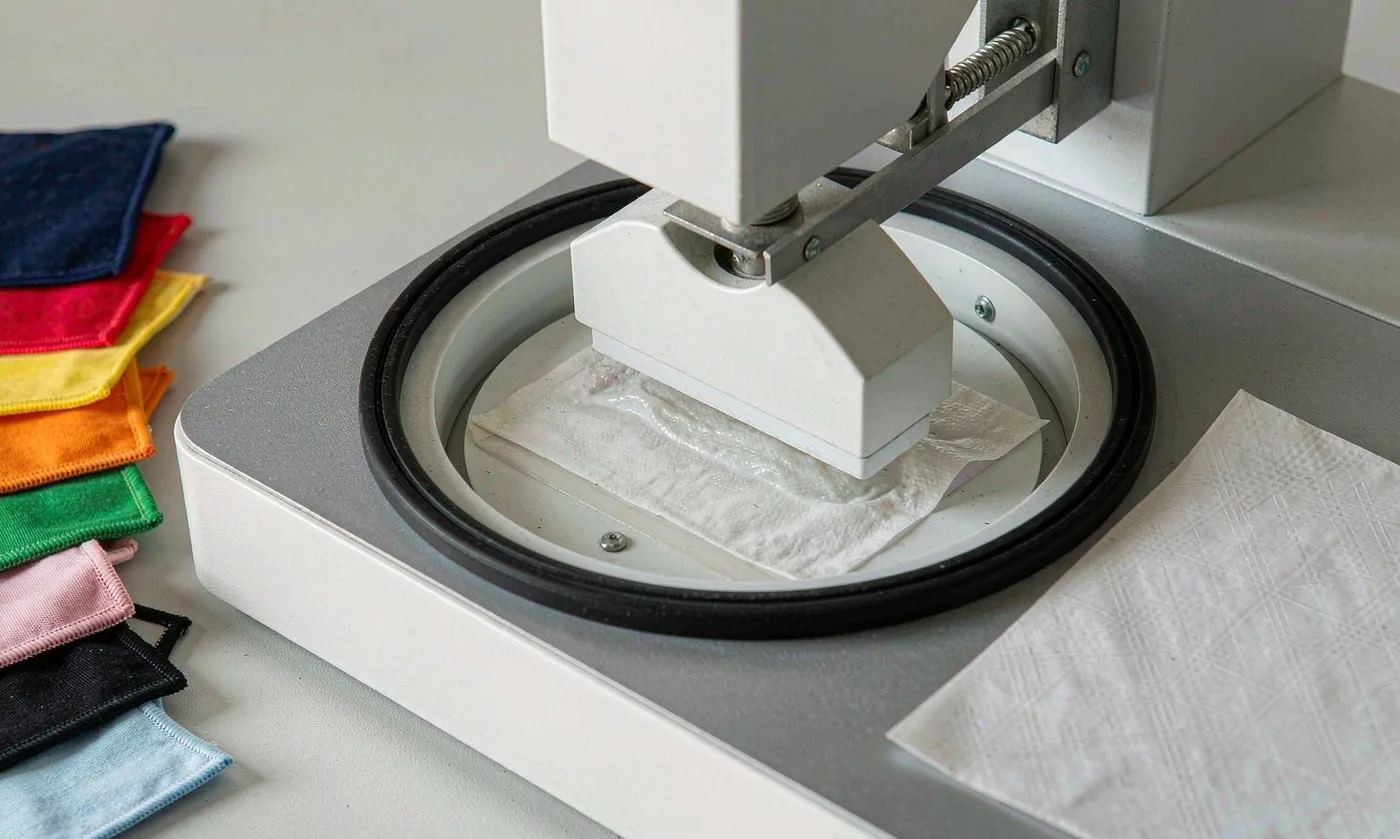
Mechanical testing should follow recognised methods rather than a supplier's internal standard. Buyers can reference test procedures published by AATCC and require tear, tensile and abrasion results on the actual production lot. Testing production cloth rather than a submitted swatch is important, because a swatch can be drawn from a better lot than the bulk.
Coating and finishing adhesion is a further consideration. A recycled substrate with slightly different surface energy can behave differently under a PU or TPU coating, and coating delamination is a failure mode that appears in the field rather than at inspection. Buyers specifying coated recycled fabric should require an adhesion test on the finished laminate and should confirm the result after any substrate lot change.
Transaction Certificates and Content Reconciliation
As with any chain-of-custody standard, the transaction certificate is the document that connects the claim to the goods. Each certified entity issues one when it ships certified material to the next certified entity, quoting both scope numbers and the shipped quantity. The retail buyer at the end of the chain is entitled to the set, and the set must reconcile.
Reconciliation is arithmetic and it is unforgiving. If a mill purchased 3,000 metres of certified yarn and shipped 3,000 metres of certified cloth, the finished goods certificate cannot support more product than that cloth can make, plus an allowance for cutting waste that the standard defines. Buyers placing a first order and then a much larger reorder frequently discover that the upstream transaction certificates only cover the first quantity.
The commercial fix is to plan fabric purchase against forecast volume rather than against the confirmed order. Buying certified cloth once for the full season costs less per metre, avoids a second certification transaction, and eliminates the risk of a lot-to-lot shade shift between the first and second delivery. Storage cost is minor against those benefits.
Document timing matters on the shipping schedule. Transaction certificates are requested after physical shipment and take time to issue, so the final document set is normally completed in the last week before loading. Buyers working to a hard retail intake date should confirm the document date with the goods date, because a delivery that arrives before its paperwork is still an incomplete delivery.
Internal record-keeping is the buyer's own responsibility. Someone should hold the scope certificates for each chain link, the transaction certificates for each transfer, and the weight breakdown, and should check them before each release. Independent verification through organisations such as SGS is a reasonable additional step on a first recycled programme.
Cost Comparison: Recycled Against Virgin Polyester
The recycled premium has narrowed considerably as supply capacity has grown, and for mainstream constructions it is now a modest surcharge rather than a step change. That said, the comparison is not always apples to apples, and buyers should understand which part of the difference is material and which part is structural.
Material cost is the smaller component. Certified recycled polyester yarn trades at a premium over virgin yarn, and the premium varies with feedstock availability and with demand from apparel and packaging buyers competing for the same flake. It is volatile in the same way any commodity input is volatile, so annual agreements should carry an adjustment clause.
The larger component is structural: certified production runs are smaller, segregation and documentation add fixed cost per run, and certification fees are annual. Those fixed costs amortise over volume, which means the per-unit premium on a small first run is materially higher than on a large one. Consolidating colourways and increasing run length is the most effective lever a buyer has.
There is also a yield effect. If recycled substrate shows slightly wider property variance, cutting waste can rise, and any coating or lamination step may run at a lower first-pass yield. Those effects are small in a well-run operation but they are real, and they should be reflected in the quotation rather than absorbed silently.
The comparison should be made per finished unit and against retail price, not per metre. A modest unit premium is frequently recoverable where the recycled claim supports a price point or secures a listing; it is rarely recoverable where the product competes purely on price. Buyers should decide which situation applies before specifying, and should note that a recycled claim without certification delivers little of the commercial value.
Buyers should also test the assumption that recycled content commands a price premium at the shelf before committing the whole assortment. A limited launch in one channel, at one price point, with the certified SKU alongside an otherwise identical conventional SKU, produces the answer in a season. Without that test the premium is an article of faith rather than a commercial judgement.
Finally, the premium should be reviewed annually against credit and certification fee movements rather than fixed in the sourcing agreement. Material premiums and certification overhead move independently, and a unit cost justified three years ago may no longer reflect either the material market or the administrative reality of running the programme.
Contamination Risk and Chemical Screening on Recycled Inputs
Recycled content and chemical safety are separate questions, and buyers who assume one implies the other take an unnecessary risk. Post-consumer feedstock has a previous life, and while modern recycling processes wash and re-polymerise effectively, the finished article still deserves the same restricted substance screening as any other textile product. This is especially true for pet bags, which sit close to an animal that will chew the fabric.
The screening should be article-level and should cover the same parameter set applied to conventional programmes: azo colorants, formaldehyde, heavy metals, phthalates, PFAS and nickel release among others. Where the destination market is the European Union, the relevant obligations sit under REACH, administered through the European Chemicals Agency at ECHA, and a declaration is normally required in addition to any voluntary certificate.
A practical approach used by experienced buyers is to hold two documents rather than one: the recycled chain-of-custody certification establishing content, and an article-level chemical test establishing safety. Several certification families can supply the second, and our production team routinely issues both for recycled programmes. Holding both removes the need to explain the gap to a retail compliance team later.
There is one further screening consideration specific to recycled material: residual monomers and processing aids from the original polymer life. These are rarely an issue with bottle-flake-derived polyester, but they are worth including in the test scope where feedstock provenance is mixed. Buyers should ask the fibre producer for feedstock provenance information at specification stage, since it is easier to obtain then than after production.
California Proposition 65 adds a separate consideration for US programmes. The regime is administered at state level and imposes a warning duty rather than a ban, with details published by the California environmental health authority at OEHHA. A recycled pet bag can pass a voluntary screening standard and still require assessment against the state list, so US-bound programmes should request both documents together.

Claim Language, Labels and Marketplace Rules
Recycled claims are enforced actively, and the enforcement is usually commercial rather than legal: a marketplace suppresses a listing, or a retailer raises a chargeback. The exposure sits with whoever publishes the claim, which for most wholesale arrangements is the brand owner rather than the manufacturer. Claim wording is therefore a compliance decision.
The first rule is specificity. A claim should state the certified recycled percentage and the material, rather than using an unqualified environmental adjective. General words such as eco, green and sustainable are not defined by the recycled standard and are restricted in several jurisdictions unless substantiated. A bag certified at a stated percentage can still attract a challenge for an unqualified claim printed beside it.
The second rule is scope matching. If the certificate covers the shell fabric and the recycled content is calculated at the finished-product level, the claim should reflect the finished-product number. Listing copy written from the product concept rather than from the certificate routinely overstates the position, and the overstatement is easy for a competitor to document.
Label use is governed by the standard's labelling rules, including requirements around the certification body reference and the circumstances in which the mark may appear. Reproducing a mark without the reference, or applying it to a product below the qualifying threshold, converts a marketing asset into a liability. Buyers should request the current label artwork and rules from the certification chain rather than copying a mark from a competitor's packaging.
A claim register per SKU is the simplest control. List every published statement, the document substantiating it and the expiry date of that document, then review ahead of each packaging reprint. See also our briefings on EU chemical compliance and textile safety screening for the accompanying document set.
Order Planning for Recycled Material Programmes
Recycled programmes are planned in the same way as conventional ones with one addition: certified material allocation. Certified yarn and cloth are produced in planned lots against forecast demand, and a buyer entering the market without a forecast may find the allocation already committed. Allocation, not manufacturing capacity, is the usual reason a recycled programme slips.
The mitigation is a rolling forecast shared with the supply chain. A stated annual volume, even approximate, allows cloth to be reserved in the correct production window. Our production team works on this basis with buyers running seasonal programmes, and it is the single most effective step available for protecting a delivery date.
Once allocation is confirmed, manufacturing behaves normally: samples in 6-10 working days after tech pack confirmation, bulk production 35-50 days after sample approval, pre-shipment inspection at AQL 2.5 before release. Buyers should confirm whether their base cloth is in stock or in production at quotation, because the answer determines whether those timelines or a longer material window apply.
Colourway planning interacts with allocation. Each colourway needs a dyeing run on the certified substrate, and certified dyeing capacity is more limited than conventional capacity. Buyers launching a wide palette should either consolidate to a core set for the first delivery or accept a phased launch with extension colours following in a second window.
Reorder planning deserves the same attention as it does for any certified material. Certified cloth bought for one run may not be available for the next, and a reorder placed against a new lot risks a shade shift against stock already on the shelf. Buying cloth for two or three runs at the outset is usually the cheaper and safer decision, particularly for programmes with pale or brand-critical colours.
Working With Recycled Fabric in the Cutting Room
Recycled substrate behaves like conventional polyester in most respects, but the differences appear in three specific places: coating adhesion, dimensional stability during cutting, and shade continuity across a roll. Buyers who specify recycled cloth on the assumption that nothing changes usually discover those differences in the first production run rather than at sampling, which is the wrong moment to find them.
Coating adhesion is the first. A recycled base cloth can present slightly different surface energy to a conventional one, and a polyurethane or thermoplastic coating applied to it may bond less uniformly. Delamination is a field failure rather than an inspection failure, so the only economical control is an adhesion test on the finished laminate, repeated whenever the substrate lot changes.
Dimensional stability is the second. Fabric that relaxes differently after spreading shifts pattern alignment, which shows up as print misregistration or as panels that assemble slightly out of tolerance. Requiring a relaxation period before cutting, and confirming the marker allowances on the actual cloth rather than on a nominal specification, removes most of this risk at negligible cost.
Shade continuity is the third and the most visible. Variation within a roll and between rolls is wider on recycled substrate, and it shows on large panels more than on small ones. Buyers should specify a shade band and should require the pre-shipment inspection at AQL 2.5 to include a shade check against a retained standard, because a shipment that passes on defects and fails on shade is still a rejected shipment.
| Factor | Recycled certified | Virgin conventional | Buyer action |
|---|---|---|---|
| Material price | Premium per metre | Baseline | Model per finished unit |
| Shade consistency | Wider variance | Tight | Buy the season in one lot |
| Mechanical properties | Equivalent, wider spread | Predictable | Test the production lot |
| Documentation | Scope plus transaction chain | None required | Request the set at quotation |
| On-pack claim | Permitted within scope | None available | Match claim to channel |
None of these differences argue against recycled material. They argue for specifying it as a distinct material with its own controls rather than as a drop-in substitute, and for testing the actual production lot rather than a submitted swatch. Programmes that do both run recycled and conventional cloth on the same line without incident.
Order and quality terms
- MOQ 500 pieces per colourway; samples in 6-10 working days
- Bulk production 35-50 days after approval; AQL 2.5 inspection standard
- T/T 30/70 terms, FOB Xiamen, full document set per shipment
People Also Ask
What does GRS certification verify?
It verifies recycled content and tracks it through certified processing stages, adding environmental and social criteria and a labelling framework. It does not certify strength or chemical safety.
How is recycled content calculated on a bag?
By weight of the finished product, including hardware, webbing, foam and coatings. A fully recycled shell fabric can still produce a modest finished percentage once component weight is included.
Is recycled polyester cheaper than virgin?
Generally no. It carries a material premium plus fixed certification and segregation costs, though the gap has narrowed as supply capacity has grown.
Does GRS require social audits?
Yes. Certified processors are assessed against environmental and social criteria, which overlaps with buyer-side social compliance audits and should be mapped to avoid duplicated cost.
Can recycled pet bags be dyed any colour?
Most colours are achievable, but feedstock variance affects base tone, so pale shades need tighter lot control. Buying the season's cloth in one lot is the usual mitigation.
Do recycled bags need separate chemical testing?
Yes. Article-level restricted substance screening should be held alongside the content certificate, because recycled status does not establish chemical safety.
Frequently Asked Questions
Is GRS the same as RCS?
They share the same chain-of-custody structure but differ in scope. RCS verifies recycled content only, while GRS adds environmental and social criteria plus a higher minimum content requirement. Buyers often start with RCS and move to GRS.
What recycled percentage should a pet bag target?
Above the label threshold is the usual commercial target, since that is the level most retail channels accept without negotiation. The percentage is calculated on finished product weight, so trim and hardware choices matter.
Does recycled polyester perform as well as virgin?
Usually close, with wider variance. Shade consistency and polymer degradation are the two risks, and both are managed by specifying mechanical test thresholds and testing the production lot rather than a swatch.
Is recycled material chemically safer?
Not automatically. Recycled status and chemical safety are separate questions. Buyers should hold the chain-of-custody certificate and an article-level restricted substance test as two distinct documents.
Why is the premium higher on a small first order?
Segregation, documentation and certification costs are largely fixed per run. Spread over a small quantity they raise the per-unit premium; consolidating colourways and lengthening runs is the most effective lever.
Can webbing and zippers count as recycled content?
Yes, if sourced from certified suppliers. Recycled webbing and zipper tape carry meaningful weight in a pet bag and are usually the cheapest way to lift a finished-product percentage.
Do coatings reduce the recycled percentage?
Yes. A coating adds weight that is not recycled content, so a heavily coated fabric lowers the finished percentage. Model the calculation on coated weight rather than greige weight.
How do transaction certificates work on reorders?
Each transfer of certified goods needs its own certificate with a stated quantity. Quantities must reconcile, so fabric bought for the first run may not support a larger reorder without a further upstream purchase.
Do I need REACH documentation for recycled pet bags?
For the EU market, yes. REACH obligations are separate from the recycled certification, and a declaration is normally requested by the importer or the retailer alongside the content certificate.
Will a recycled claim alone justify a higher retail price?
Only where the channel rewards it. Specialty and natural-positioned retail can pass the premium through; price-led marketplace listings generally cannot, in which case the spend is better directed at construction quality.
How long does certified recycled cloth take to source?
If allocated, normal manufacturing timelines apply. If not, material allocation governs the schedule, which is why a rolling annual forecast shared with the supply chain protects delivery dates.
Can the certification mark be printed on packaging?
Yes for qualifying products, subject to the labelling rules including the certification body reference. Buyers should request current artwork and rules rather than copying a mark from another brand.
Talk to QUANZHOU JUNYUAN BAGS about a wholesale pet bag order: MOQ 500 pieces per colourway, samples in 6-10 working days, bulk production in 35-50 days under AQL 2.5 inspection.
Get a free quote Request a sample