Medical Grade Pet Bags: Hospital Quality Sourcing Standards
Medical grade in pet bag procurement is not a regulated category; it is a buyer-defined specification built around cleanability, documented process control, and traceability. Practical requirements are wipe-clean interiors, sealed seams on fluid-contact surfaces, low-residue materials, and an ISO 9001 quality system behind production. Expect 12-28% above a consumer build, at MOQ 500 pieces per colourway.
Veterinary distributors and clinical accounts buy differently from pet retail: they ask for process evidence before they ask for price, and they reorder on consistency rather than on novelty. Our production team builds hospital-quality pet bag programs at MOQ 500 pieces per colourway, with samples in 6-10 working days and bulk production in 35-50 days after approval, inspected to AQL 2.5 under T/T 30/70 terms from FOB Xiamen. The specification work is what separates a clinical-grade program from a consumer one: cleanability targets written as measurable requirements, material choices that survive repeated disinfection, documented process control under an ISO 9001 system, and a documentation pack that a veterinary buyer can file. Because medical grade is not a regulated term for this product class, the buyer also carries the responsibility for claim wording, and the safe approach is to describe the build and the process rather than to imply clinical efficacy. The sections below set out the specification clauses, the material choices, the quality-system expectations, the documentation pack, and the order planning that make a clinical program repeatable across seasons.
Pet bag market trends point to two things a buyer can act on: lighter shells and stricter chemical files, both of which land on Material & Technology. Pet carrier market size forecasts are useful for range planning but not for pricing, and pet bag market analysis should be read as a channel question rather than a volume promise.
What Medical Grade Means in a Pet Bag Specification
Medical grade has no legal definition for sewn pet articles in any major market, which is the first thing a buyer should understand. The phrase is a commercial shorthand for a set of requirements that the buyer defines and the supplier builds to. That is not a weakness; it is an opportunity, because the buyer who writes a clear specification gets a product matched to the account, while the buyer who simply asks for medical grade gets whatever the supplier thinks the words mean.
In practice the requirements cluster into four groups. Cleanability comes first: surfaces that tolerate repeated disinfection without degrading. Documented process control comes second, usually evidenced by an ISO 9001 quality system rather than by a product certificate. Traceability comes third, meaning lot identification from fabric through finished carton. Consistency comes fourth, meaning that the thousandth unit behaves like the approved sample.
Buyers serving veterinary clinics, animal hospitals, and rehabilitation centres should translate those groups into clauses before requesting a quotation. A cleanability clause names the disinfectant class and the number of wipe cycles. A process clause names the quality system and the inspection level. A traceability clause names the lot numbering format. A consistency clause names the tolerances that matter, such as seam placement and closure function.
Procurement teams also need to be clear internally about who holds the claim. If the buyer's brand puts hospital-quality language on the packaging, the buyer owns the substantiation. That means the specification file has to be the buyer's document, reviewed and signed, rather than a supplier brochure kept on file.
Medical grade for pet bags is a buyer-defined specification covering cleanability, process control, traceability, and consistency, and it is only enforceable when those four requirements are written as measurable clauses.
Cleanability and Infection Control Requirements
Cleanability is the clause that most often separates a clinical program from a consumer one, and it must be written as a test rather than as an adjective. A workable statement names the disinfectant class the product will face, the number of wipe cycles it must survive, and what failure looks like: coating dulling, print loss, seam wicking, or hardware corrosion. Without those three elements the requirement cannot be quoted or inspected.
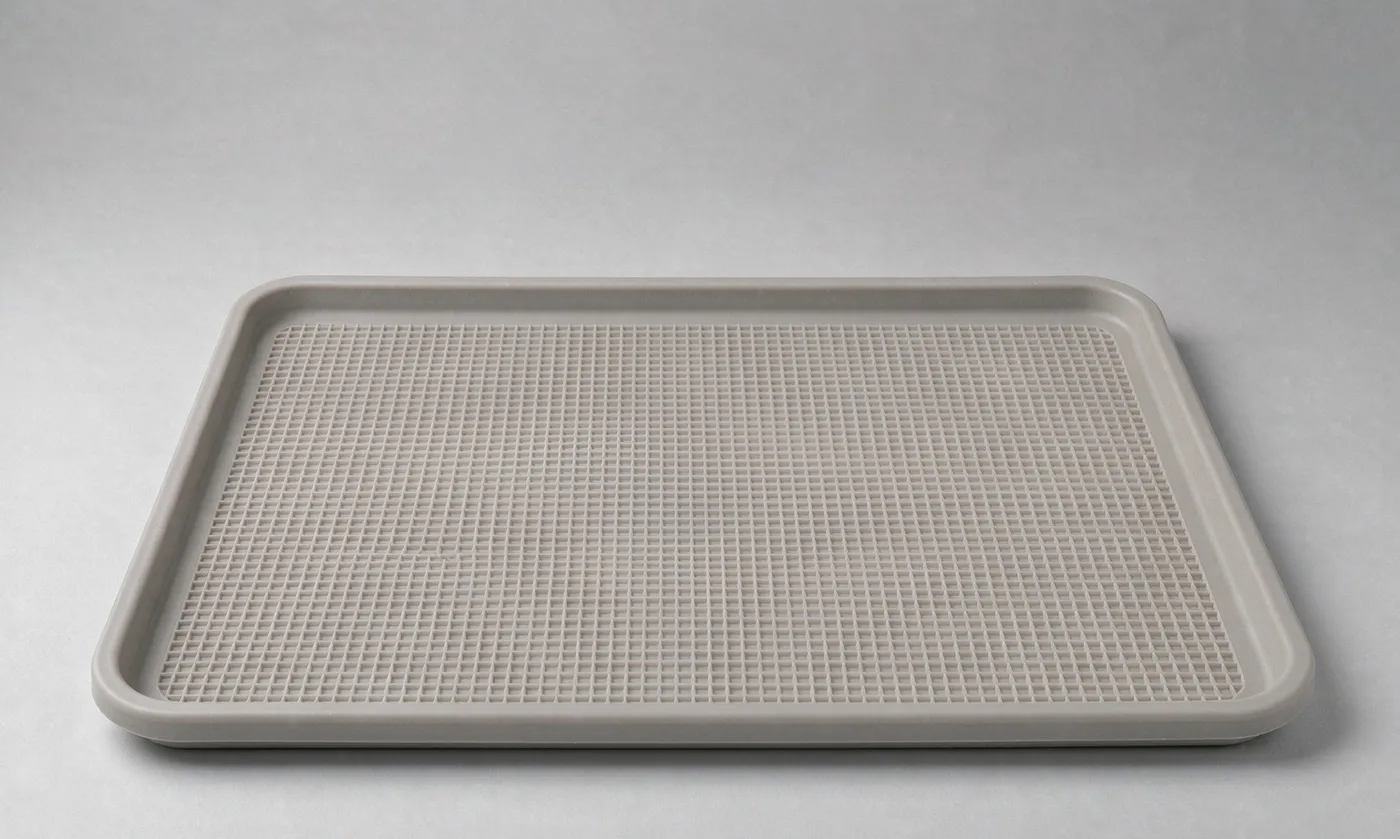
Surface selection follows from the clause. Coated shells with a non-porous face wipe clean and resist fluid ingress; uncoated woven shells absorb and stain. Interiors matter more than exteriors, because the interior is where fluids land. A welded or heat-sealed lining is the cleanest option and the most expensive; a sewn lining with sealed seam tape is the pragmatic middle; an untreated sewn lining is not suitable for clinical use.
Seams are the weak point. Needle holes in a fluid-contact surface wick liquid into the padding, and once fluid is inside the panel it cannot be wiped out. Seam sealing on interior surfaces is therefore a functional requirement in a clinical build, not a finishing nicety. Buyers should specify it explicitly and check it on the approval sample.
Hardware needs corrosion resistance because clinical disinfection is frequent and sometimes aggressive. Coated or stainless fittings survive; untreated plated fittings spot and stain within weeks. Closures should also be specified for gloved operation, since a clinical user frequently handles the bag with gloves on and small recessed fasteners are impractical in that context.
Drying behaviour is the clause buyers most often forget. A surface that wipes clean but stays damp becomes a microbial reservoir between uses, and in a clinic turnover is fast. Specifying a face finish that sheds liquid rather than holding it, and avoiding interior pockets that trap moisture, is a design-level control that costs nothing at the pattern stage and cannot be added later. Buyers should also state whether the interior must tolerate being left damp between shifts, because that single question determines whether sealed seams are sufficient or whether a fully welded lining is required.
Veterinary infection-control guidance published by the American Veterinary Medical Association is a useful reference point for the cleaning protocols a buyer should design against, and aligning the test clause to a published protocol makes the requirement easier for any supplier to quote.
Material and Construction Choices for Clinical Use
Material choice in a clinical build trades hand feel for service life. Coated polyester and TPU laminates dominate because they wipe clean, resist fluid, and tolerate repeated disinfection. Nylon with a durable face treatment is a secondary option where abrasion resistance matters more than chemical resistance. Neoprene and similar foams appear in support applications, but they need a sealed face to be cleanable.
Colour choice is functional rather than aesthetic in this channel. Clinical accounts favour light or mid tones because soiling is visible and therefore managed, and they favour colour coding because it separates clean from used zones inside a facility. Buyers should expect the colourway discussion to be about coding systems rather than about seasonal palettes.
| Requirement | Consumer build | Clinical build | Cost impact | Why it matters |
|---|---|---|---|---|
| Interior surface | Sewn lining, absorbent | Coated or welded, non-porous | +8-15% | Fluid cannot be wiped out of an absorbent panel |
| Interior seams | Stitched only | Sealed or welded | +4-9% | Needle holes wick fluid into padding |
| Hardware | Standard plated | Coated or stainless | +10-45% | Disinfection causes spotting and corrosion |
| Closures | Standard pullers | Glove-friendly oversized | +3-8% | Clinical users often work gloved |
| Process control | Inspection only | ISO 9001 documented system | +2-5% | Accounts buy evidence, not samples |
| Traceability | Carton level | Lot level through packing list | Neutral | Targeted holds instead of full withdrawal |
| Inspection | AQL 2.5 | AQL 2.5 plus named critical checks | Neutral | Seal integrity is a critical defect here |
Read the table as a specification checklist. Buyers rarely adopt every upgrade, and the usual clinical program takes coated interiors, sealed seams, and corrosion-resistant hardware while leaving closures and colourways to the account's preference. The two items that should never be dropped are interior surface and seam sealing, because they define whether the product is cleanable at all.
Durability expectations also shift. A clinical bag may be disinfected several times a day for a year, so abrasion and coating adhesion targets should be set for that duty cycle rather than for occasional consumer use. Specifying a higher cycle count in the abrasion requirement is a cheap way to align the build with real service conditions.
Quality System Expectations: ISO 9001 and Documented Process
Clinical accounts buy process evidence. The most efficient way to supply it is a quality management system certified to ISO 9001 quality management, because the certificate tells a procurement reviewer that material control, change control, and inspection records exist without the reviewer needing to audit them individually. For a buyer, asking whether the supplier's production base holds that certification is the single highest-yield question in the qualification stage.
Beyond the certificate, three process elements matter in practice. Material control means incoming fabric and trim are checked and identified before issue, so a confirmed lot can be traced into production. Change control means any substitution of material, component, or process requires documented approval. Inspection records mean the results of in-process and final checks are retained against the order.
Buyers should ask how each of those elements works in a specific sense rather than in principle. What is the format of the incoming material record? Who signs off a substitution? Where are the inspection records kept, and for how long? Suppliers operating a real system answer immediately; suppliers operating a certificate answer vaguely, and that difference is visible in the first meeting.
Social and ethical compliance often appears in the same questionnaire. Programs supplied through partner facilities audited to BSCI or equivalent satisfy that question, and buyers serving institutional accounts should expect it to be asked alongside ISO 9001 rather than instead of it.
In clinical programs the certificate opens the conversation and the process detail closes it, so buyers should test both: the ISO 9001 certificate for legitimacy and the material, change, and inspection records for reality.

Documentation Pack for Veterinary and Clinical Accounts
The clinical documentation pack is larger than a retail one and it serves a different audience. A retail compliance reviewer wants safety and labelling evidence; a clinical procurement reviewer wants process and service-life evidence. The pack should therefore contain both, organised so each audience can find its section quickly.
The core contents are the specification with signed approval sample reference, the material declaration for shell, lining, foam, and hardware, restricted-substance screening aligned to the destination market, the cleanability test result against the named disinfectant and cycle count, physical test results for abrasion and seam strength, and the inspection report for the shipped lot.
Traceability documents come next: lot numbers for fabric and hardware, a packing list mapping cartons to lots, and the production date range. These are the documents that make a targeted correction possible instead of a full withdrawal, and clinical accounts ask for them precisely because they have experienced the alternative.
- Signed specification and approval sample reference
- Material declarations for every component group
- Restricted-substance screening per market
- Cleanability result against the named disinfectant and cycle count
- Physical test summary: abrasion, seam strength, coating adhesion
- Lot numbering and carton mapping on the packing list
- Final inspection report at AQL 2.5
One organisational decision improves every subsequent order: assign a specification number and a version to the program and print both on the packing documents. Clinical procurement teams file by number, not by product name, and a receiving or quality issue raised months later will be referenced to that number. Without it, the buyer ends up reconstructing which version shipped to which account from email threads, which is slow and error-prone exactly when speed matters.
Buyers should also keep a version history. Clinical accounts reorder the same specification for years, and the ability to show what changed between version two and version three is worth more in a review meeting than any single certificate.
Cost Structure of a Clinical-Grade Build
A clinical-grade pet bag costs 12-28% more than a comparable consumer build, and the premium is dominated by construction rather than by material. Coated interiors, seam sealing, and corrosion-resistant hardware account for most of the delta; the fabric itself is often unchanged. That is a useful insight for buyers negotiating, because the expensive clauses are the ones that can be relaxed without affecting appearance, and the cheap clauses are the ones that protect the claim.
Process and documentation costs are real but smaller than buyers expect when amortised. Holding an ISO 9001 system and producing inspection records is overhead that spreads across every order, so a supplier running clinical programs routinely can quote them without a surcharge. The surcharges that do appear are for specific tests, such as a cleanability protocol run against a named disinfectant, and those are typically a few hundred dollars per program rather than per unit.
Revenue works differently in this channel. Clinical accounts buy on service life and consistency, and they are less price-sensitive than retail because the bag is a working tool rather than a discretionary purchase. A program that lasts two years in a clinic justifies a price well above a consumer equivalent, and reorder economics are stronger because the specification does not change seasonally.
One further cost is easy to miss: the evaluation samples themselves. Clinical accounts frequently want units placed in several locations before committing, which means a dozen or more samples across variants rather than the single approval sample a retail program needs. Those units are real product with real cost, and they should be budgeted line by line at quotation rather than absorbed silently by the supplier, because a supplier that absorbs them will recover the money somewhere in the bulk price.
The margin risk is in the first order. Clinical programs usually start with a small evaluation order, so fixed testing and documentation costs land on few units. Buyers should model the first drop as an investment and price the reorder as the profit centre, which is the pattern that works across institutional channels generally.
Claim Boundaries: What a Buyer Can and Cannot Say
The word medical creates legal exposure, and buyers should decide the wording before artwork begins. Pet bags are not medical devices in any major market, and describing them as medical grade implies a regulatory status they do not hold. The safer route is to describe the build and the process: designed for repeated disinfection, cleanable non-porous interior, produced under an ISO 9001 quality system. Those statements are true and evidenced.
Claims that imply clinical outcome should be avoided entirely. Statements about preventing infection, supporting recovery, or being approved by any health authority cannot be substantiated for this product class and create real regulatory risk. A competitor or a regulator does not need to prove the claim is false; the buyer has to prove it is true, and the evidence does not exist.
Where an account insists on medical-grade shorthand in internal documentation, that is acceptable, because internal purchasing language is not consumer-facing. The distinction to hold is between what the buyer says to a procurement officer in a specification and what appears on a hangtag or a listing page.
Buyers should also check marketplace rules before listing. Several platforms restrict medical-implying language regardless of national advertising rules, and a listing removed for claim wording costs more than a hangtag reprint. Approving the claim text per channel, in writing, is the cheapest control available.
Inspection Standards for Clinical Programs
Inspection for a clinical program uses the same AQL 2.5 baseline as any wholesale pet bag order, with the defect classification adjusted to the use case. Seam seal integrity, coating adhesion, and closure function belong in the critical or major list for this product, because a failure in any of them makes the unit unserviceable in a clinical setting rather than merely imperfect.
Buyers should write those classifications into the inspection worksheet rather than leaving them to the inspector's judgement. Naming seal integrity as a critical defect changes the acceptance outcome for a systematic sealing problem, which is exactly what the buyer wants when the failure mode is invisible in a showroom but decisive in a clinic.
Independent verification adds value on first orders. A pre-shipment inspection performed by a third party such as SGS inspection and verification services gives the clinical account an unbiased report, and accounts that buy on process evidence appreciate it. The cost is modest relative to the order and it shortens the qualification cycle for the next program.
Sampling risk deserves a note as well. A single approval sample cannot demonstrate consistency, and clinical accounts are buying consistency. Asking for a small pre-production run of five to ten units made on the production line rather than in the sample room gives the account a realistic reference and often surfaces a tolerance issue while it is still cheap to correct. Our production team treats that short run as the true approval reference for clinical programs.
Finally, inspection records should be retained and referenced in the reorder. A buyer who can show that the last four lots passed at the same level is making a consistency argument that no sample can make, and consistency is what clinical accounts actually purchase.
Order Planning and Channel Strategy for Clinical Accounts
Clinical programs follow a different calendar from retail ones. There is no seasonal reset; instead there is a qualification cycle followed by steady reorder. Buyers should plan for an evaluation order of 500 pieces, a review period at the account, and then a reorder that is often larger and less price-sensitive than the first. Modelling the first drop as qualification rather than as profit avoids the usual disappointment.
Production mechanics are unchanged: MOQ 500 pieces per colourway, samples in 6-10 working days, bulk in 35-50 days after approval, AQL 2.5 inspection, T/T 30/70 terms, FOB Xiamen. What changes is the sampling content, because a clinical sample should be evaluated under the disinfection protocol it will face rather than only on appearance. Running that evaluation during the 6-10 day sampling window keeps the calendar intact.
Channel strategy should treat clinical accounts and retail as separate programs even when the base product is similar. Different colourways, different documentation, different claim wording, and different reorder rhythms mean that a shared SKU creates more work than it saves. Separate specification numbers with a shared platform is the pattern that works.
Pack planning matters more here than in retail because clinical accounts receive goods into working storage rather than onto a shelf. Carton quantities that match a clinic's issue rate, inner labelling that identifies the lot without opening the master carton, and a packing list that a receiving clerk can reconcile in minutes all reduce friction at the account. These are free or near-free requests when made at order placement and expensive retrofits when discovered at delivery.
Buyers building adjacent programs should note where the requirements overlap. Cleanability and documented process control support institutional and professional channels generally, and our guides to ISO 9001 in production and AQL acceptance quality limits cover the two controls that clinical buyers ask about most.
Clinical accounts buy consistency over novelty, so the winning strategy is a stable specification, documented process control, and a reorder rhythm planned from the first evaluation order rather than discovered later.
Order and quality terms
- MOQ 500 pieces per colourway; samples in 6-10 working days
- Bulk production 35-50 days after approval; AQL 2.5 inspection standard
- T/T 30/70 terms, FOB Xiamen, full document set per shipment
People Also Ask
Is medical grade a regulated term for pet bags?
No. There is no legal definition or certification for medical grade pet bags in major markets. It is a buyer-defined specification, which means the buyer writes the clauses covering cleanability, process control, traceability, and consistency, and owns the claim wording used on packaging and listings.
What makes a pet bag suitable for veterinary use?
A non-porous coated interior, sealed or welded seams on fluid-contact surfaces, corrosion-resistant hardware, and closures that work with gloves on. Cleanability should be written as a test against a named disinfectant class and a stated number of wipe cycles.
How much does a clinical-grade pet bag cost compared with retail?
Typically 12-28% more at FOB. The premium comes mainly from coated interiors, seam sealing, and corrosion-resistant hardware rather than from the base fabric, so buyers can relax some clauses without changing appearance.
Do clinical buyers require ISO 9001?
Most ask for it. The certificate tells a procurement reviewer that material control, change control, and inspection records exist without auditing each one. Buyers should still test the detail by asking for the format of those records.
Can a pet bag be described as medical grade in marketing?
It is risky. Pet bags are not medical devices, so safer wording describes the build and process: designed for repeated disinfection, cleanable non-porous interior, produced under an ISO 9001 quality system. Outcome-implying claims should be avoided.
What inspection level suits clinical programs?
AQL 2.5 as the baseline, with seam seal integrity, coating adhesion, and closure function classified as critical or major defects. Writing those classifications into the worksheet changes the acceptance outcome for systematic failures.
How does the reorder pattern differ from retail?
Clinical accounts reorder on consistency rather than season. The first order is usually a small evaluation quantity with fixed costs landing on few units, and the profit comes from a stable multi-year reorder of an unchanged specification.
Frequently Asked Questions
Who owns the medical-grade claim?
The brand owner that puts the wording on packaging or listings. That is why the specification should be the buyer's signed document rather than a supplier brochure, so substantiation can be produced on request.
Should interiors be welded or sealed?
Welded is the cleanest and most expensive; sealed seam tape over stitching is the pragmatic middle. Untreated stitched linings are not suitable because needle holes wick fluid into padding where it cannot be removed.
Which disinfectant should the test clause name?
The class the account actually uses. Aligning the clause to a published veterinary infection-control protocol makes it easy for any supplier to quote and easy for the account to accept.
Does colour choice matter in clinical programs?
Yes, functionally. Light and mid tones make soiling visible and manageable, and colour coding separates clean from used zones inside a facility, so palette discussions are about coding systems rather than seasons.
Are stainless fittings required?
Not always. Coated fittings survive routine disinfection at lower cost; stainless suits high-frequency or aggressive protocols and premium price points. The decision should follow the duty cycle the account describes.
What is included in the clinical documentation pack?
Signed specification and approval sample, material declarations, restricted-substance screening, cleanability results, physical test summary, lot-to-carton mapping, and the final AQL 2.5 inspection report, plus a version history for reorders.
How long do clinical qualification cycles take?
Often one to two quarters from first sample to reorder, because the account evaluates under real conditions. Buyers should plan the calendar around the account's review rather than around a retail seasonal reset.
Can one specification serve both retail and clinical channels?
It is usually better to keep them separate. Colourways, documentation, claim wording, and reorder rhythm differ enough that a shared SKU creates more work than it saves; a shared platform with separate specifications works better.
What are the standard commercial terms?
MOQ 500 pieces per colourway, samples in 6-10 working days, bulk production in 35-50 days after approval, AQL 2.5 inspection, T/T 30/70, FOB Xiamen. Testing fees are normally billed as program costs.
Is third-party inspection worth it on clinical orders?
Yes on first orders. An unbiased pre-shipment report shortens the qualification cycle for the next program and gives the account the process evidence it is buying.
How should abrasion targets be set for clinical duty?
For the real duty cycle. A bag disinfected several times daily for a year needs a substantially higher cycle target than an occasionally used consumer product, and setting it correctly is a low-cost way to match service life.
What triggers a specification version change?
Any change to material, component, or process that affects cleanability, traceability, or performance. Recording version history lets an account see exactly what changed between reorders, which is valuable in review meetings.
Talk to QUANZHOU JUNYUAN BAGS about a wholesale pet bag order: MOQ 500 pieces per colourway, samples in 6-10 working days, bulk production in 35-50 days under AQL 2.5 inspection.
Get a free quote Request a sample