Pet Bag Wholesale Business: Cash Cycle Planning
The cash cycle on a wholesale pet bag programme runs 150-210 days from the first deposit to the last collection, roughly four times the 35-50 day production window. Cash leaves at deposit, at balance before shipment, and again at freight and duty, and it returns only after the goods are received, invoiced and collected. The gap, not the unit price, decides how large an order a buyer can actually place.
Working capital, not unit cost, is the binding constraint on most wholesale pet bag programmes, and it is the constraint buyers least often calculate. A buyer who knows that a unit costs nine dollars does not yet know whether they can afford the order, because the question is how long that nine dollars is committed before it comes back with margin attached. QUANZHOU JUNYUAN BAGS works to MOQ 500 per colourway, samples in 6-10 working days, bulk production 35-50 days from approval and release at AQL 2.5, and under T/T 30/70 with FOB Xiamen the cash profile that follows has five distinct outflows before a single inflow arrives. Mapping them on a day scale is the whole exercise, and it is worth doing once properly rather than estimating each season. The three findings that usually surprise buyers are that the balance payment falls well before the goods are sellable, that duty and freight land after the goods have already been paid for, and that customer terms, not supplier terms, are usually the largest single item in the cycle. Once the map exists, the levers become obvious and can be ranked: releasing against a trigger rather than buying in advance, negotiating the deposit split, compressing the receive-to-invoice interval, and tightening the terms given to customers. A pet bag wholesale business that shortens its cycle by thirty days can turn the same capital one extra time a year, which is worth more than two or three points of unit price.
Pet bag lead time is quoted from sample approval, not from enquiry, and Market & Business Strategy choices are the main variable inside that window. Pet bag production time stretches when a colourway is added late, so pet carrier lead time and pet bag wholesale cost should be agreed in the same email.
The Cash Cycle Is Longer Than the Production Cycle
Buyers model the production cycle and then discover the cash cycle by surprise, and the two differ by a factor of roughly four. Production is 35-50 days. The cash cycle is the period from the first outflow to the last inflow, which on a typical programme runs 150-210 days, and the difference is made up of sampling, transit, customs, warehousing, invoicing and collection.
The reason the gap matters is that it determines how many times a year the same capital can be used. A buyer with 50,000 dollars of working capital and a 200-day cycle can turn it under twice a year; the same buyer with a 140-day cycle can turn it two and a half times. That difference is margin created without selling anything, and it is usually easier to achieve than a price reduction of equivalent value.
A pet carrier wholesale price is only half of what a programme costs its buyer; the other half is the time that money is committed. The gap is also asymmetric in an unhelpful way. Outflows are concentrated early and inflows are concentrated late. A programme pays a deposit before anything exists, pays a balance before the goods can be sold, pays freight and duty before the goods can be invoiced, and only then begins to collect. For most of the cycle, the buyer is funding inventory that cannot yet generate revenue.
Three structural features make the cycle long in this category specifically. The product is bulky, so warehousing cost per unit is high and buyers hold less safety stock than they would like, which increases re-order frequency and therefore transaction count. The product is seasonal, so the cycle is condensed into a fraction of the year and the working capital requirement peaks sharply. And the product is specified, so a change late in the cycle costs more than the same change early, which pushes buyers to commit earlier than they would prefer.
The practical conclusion: calculate the cycle before calculating the order size, because the cycle is what determines the maximum order a given balance sheet can support. A buyer who inverts this discovers the limit after placing the order, which is the worst possible moment.
Mapping the Cash Events Day by Day
A cash map is a simple document and it is the most useful financial artefact in a wholesale programme. It lists every event that moves cash, the day on which it happens relative to a chosen day zero, the direction, and the variable that determines the amount. Building it once for a representative order produces a template that can be reused every season.
| Day | Event | Direction | What determines the amount |
|---|---|---|---|
| 0 | Sample fees and testing | Out | Number of rounds and test scope |
| 10-30 | Deposit, typically 30% | Out | Order value and the agreed split |
| 30-45 | Bulk production starts | None | Capital is committed, not spent |
| 65-95 | Balance, typically 70%, before shipment | Out | Final quantity and any approved variance |
| 70-100 | Freight and insurance | Out | Volumetric weight, mode and rate |
| 100-140 | Duty and customs clearance | Out | Classification, rate and declared value |
| 140-150 | Goods received and available | None | Inventory days begin here |
| 150-180 | Customer invoice issued | None | Invoicing interval after delivery |
| 180-210 | Collection against customer terms | In | Terms granted to the customer |
Three rows in that map deserve attention because they are the ones buyers mis-estimate. The balance payment at day 65-95 is the largest single outflow and it falls before the goods have any resale value, which means the buyer's capital is fully committed while the inventory is still on a vessel.
The duty and clearance row is the second, because it is the one most often omitted from a cash plan altogether. Duty is a real cash outflow, it is due at import rather than at sale, and on a bulky consignment it is a meaningful figure rather than a rounding error.
The collection row is the third, and it is usually the largest item in the whole cycle. A buyer who grants sixty-day terms to a retail customer has added sixty days to their own cycle, and that addition is frequently longer than the entire production and transit period combined. Suppliers get blamed for long cycles when the customer terms are the dominant term.
Put the map on one page with real dates for the coming season. Once it is visible, the levers are obvious and the argument about where to intervene becomes factual rather than instinctive.

What the Deposit Split Actually Does
A deposit is not a courtesy; it is the mechanism by which the two parties share the financing of a production run, and the split determines who funds what for how long. Understanding that is what makes the term negotiable rather than fixed.
Under T/T 30/70, the buyer funds 30% of the order at the start and 70% before shipment. The supplier is funding the material buy and the production cost through most of the run, and the buyer's exposure is limited until the goods exist. Under a 50/50 split the buyer funds half the run and has correspondingly more at risk for longer, in exchange for which a supplier will often concede something, typically on scheduling priority rather than on price.
The material buy is the reason the deposit exists at all. Under T/T telegraphic transfer the split is normally 30/70, with the balance falling before shipment. Fabric, hardware and trim for the order are purchased ahead of production, and that purchase is committed against the buyer's order. The deposit is what allows the supplier to commit it. A buyer asking to reduce a deposit is asking the supplier to finance a material purchase against an unconfirmed order, which is a real cost and should be traded for something rather than requested.
Cheap pet carriers wholesale programmes are the most exposed to this, because the absolute cash at stake is smaller but the margin available to absorb a delay is thinner still. Two variants are worth knowing. A cumulative programme with agreed annual volume often justifies a lower deposit, because the relationship and the committed volume reduce the supplier's risk. And a repeat order of an approved style carries less supplier risk than a first order, because the specification is settled and the material is known, which is a legitimate argument for a better split on the second season.
The balance-before-shipment convention is the part buyers should scrutinise most. It means capital is fully committed before the goods have been inspected in some cases, or inspected but not received in others. Where a relationship is established, paying the balance against a passed inspection rather than against a shipping notice is a meaningful improvement in the buyer's position and a reasonable request.
The standard structures are set out in B2B payment terms. One caution: a supplier who offers dramatically better terms than the field, such as a very low deposit or long credit, is either financing it through the unit price or is under-capitalised. Either way, the concession is not free.
Freight, Duty and the Timing of Landed Cost
Landed cost is a cash question as much as a costing question, because its components fall at different times and none of them fall at the moment of sale. A buyer modelling unit cost but not cash timing will fund the same order twice over the year without noticing.
Pet bag sample cost and testing fall earliest and are the smallest line, which is why they are usually ignored and occasionally the reason a first order is delayed. Freight is the first component and it is paid close to shipment. On a bulky consignment it is charged on volumetric weight, which means it scales with carton dimensions rather than with the number of units, and it is the reason a cheaper product can cost more to land. Freight also has a seasonal rate profile, and a programme that ships in a peak window pays a surcharge that arrives exactly when the buyer's cash is most stretched.
Duty is the second component and it is a classification outcome. Travel goods and textile articles can fall under different headings with different rates, and the rate applicable to the actual article is the one that applies regardless of what the invoice calls it. Classification should be settled before shipping rather than argued at entry, because a dispute at entry delays the goods while storage and demurrage accrue. Trade and tariff frameworks maintained by the World Trade Organization and economic data published by the OECD are the reference points for understanding how rates move over a programme's life.
Clearance and inland delivery form the third component, and they are the ones most often left out of a landed-cost model entirely. Customs handling, port charges and inland haulage are real cash, they are payable before the goods can be invoiced, and on a small first order they are a disproportionate share of the total.
The timing insight matters most here: all three components fall between the balance payment and the first collection. That interval is the most cash-hungry part of the whole cycle, and it is also the interval during which the goods are generating nothing.
Model landed cost with dates attached. A landed-cost figure without a date is a cost estimate, not a cash plan.
Inventory Days: The Carrying Cost of a Bulky Product
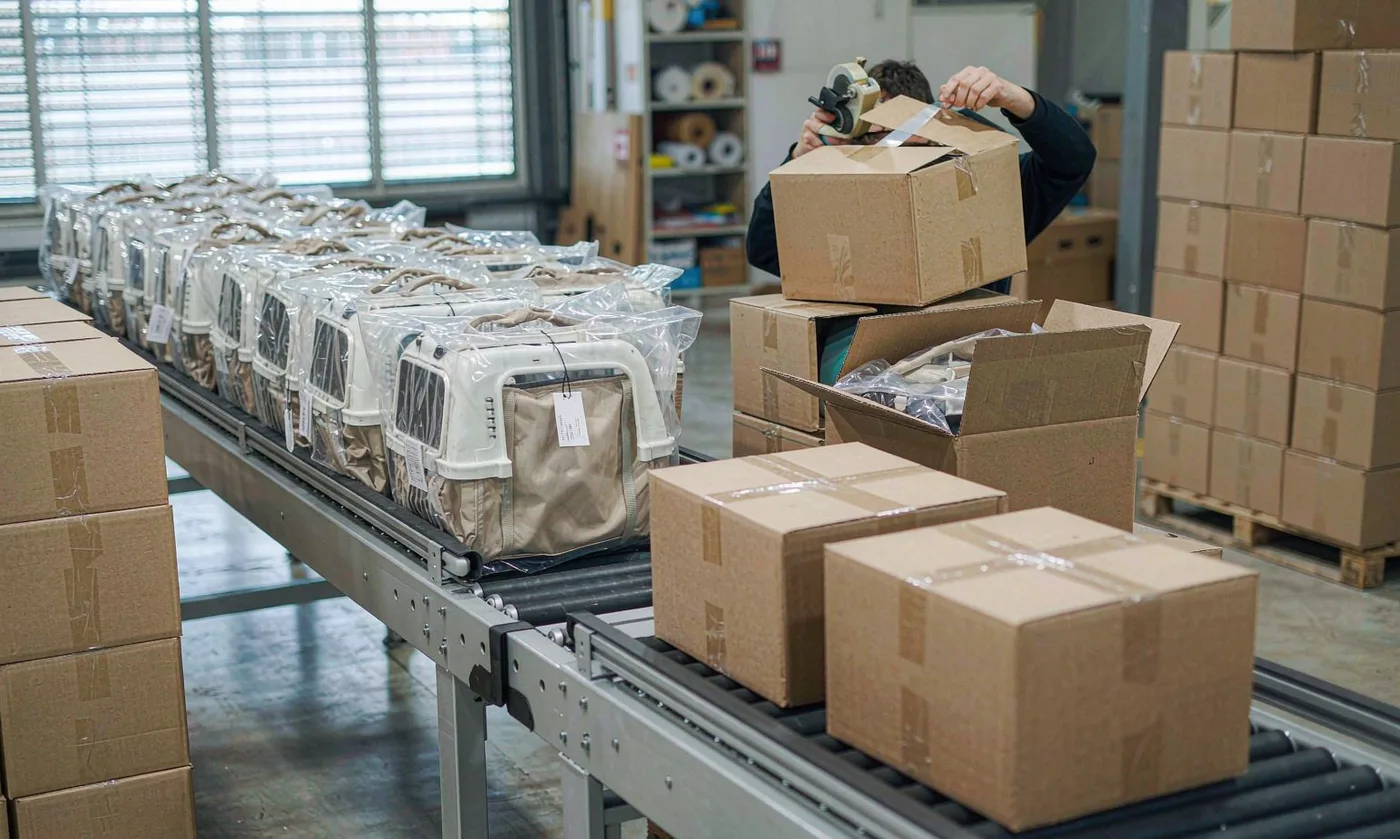
Inventory days are the period between receiving goods and converting them into cash, and on a bulky product they are expensive in a way that is easy to underestimate. A pet bag occupies warehouse volume disproportionate to its value, so the cost of holding it is driven by space rather than by capital, and space is often the harder constraint.
Three costs make up the carrying rate. The first is the cost of the capital tied up, which is the interest rate or the opportunity cost of the money. The second is warehousing, which for a bulky article is the dominant line and is usually charged by volume or by pallet position. The third is risk, meaning obsolescence, damage and the markdown eventually needed to clear slow colourways.
Seasonality interacts badly with all three. A seasonal programme receives the bulk of its annual volume in a short window and holds it through the selling peak, which means warehouse requirement peaks just as the cash position is weakest. Buyers who plan inventory on an average-month basis and discover the peak in the month it arrives are the ones who end up paying for overflow storage at spot rates.
Two structural answers exist. The first is releasing against a trigger rather than receiving the full season at once, which flattens the warehouse profile and converts part of the inventory risk into a scheduling question. The second is holding the reserve at the supplier's side against a call-off, where arrangement can be made, which moves the carrying cost off the buyer's balance sheet entirely for that portion.
Obsolescence deserves separate treatment because it is the cost that does not appear on any statement until it is realised. A colourway that fails is not merely unsold inventory; it is inventory that will eventually be sold below cost, and on a first season with no history to clear into, the probability is meaningful. This is the strongest financial argument for limiting colourway count on early orders, and it is an argument about cash rather than about taste.
The practical target: know the carrying cost per unit per month, and compare it against the unit-price benefit of the deeper order that created it. Very often the deeper order does not pay for its own storage.
The Terms You Give Your Own Customers
The single largest and least examined item in most cash cycles is not the supplier's deposit requirement; it is the credit period the buyer grants to their own customers. Sixty-day terms to a retail account add sixty days to the cycle, which is frequently longer than sampling, production and transit combined, and it is granted far more casually than it is negotiated on the buying side.
The asymmetry is worth naming. Buyers negotiate hard for a ten-point improvement in the deposit split, which affects 30% of the order value for a few weeks, and then grant sixty or ninety days on 100% of the invoice value without discussion. The second term is worth several times the first and gets a fraction of the attention.
Three adjustments are usually available. The first is settling the interval between delivery and invoice, which is pure administrative delay in most businesses and can be compressed to days with no commercial consequence. The second is a settlement discount for early payment, which is cheaper than the working capital it releases whenever the buyer's own cost of capital exceeds the discount rate. The third is a differentiated term structure, where reliable payers receive standard terms and slower accounts receive shorter ones or a deposit, rather than a single blanket policy for every customer.
Credit control is the unglamorous half of this and it is where the money is. An invoice that is issued late is collected late; a statement that is never chased is paid last. Measuring days sales outstanding by account, rather than in aggregate, routinely identifies a small number of accounts responsible for most of the cycle length.
Where a customer insists on long terms, the correct response is to price them. Credit is a service with a cost, and a buyer with a mapped cash cycle can calculate what sixty days costs per unit and decide whether the account is worth it at that price rather than at the headline one.
One sentence worth keeping: a buyer who cannot state their own days sales outstanding by account is not managing the cycle, they are experiencing it.

Financing the Gap: What Is Actually Available
Once the cycle is mapped, the funding question becomes specific: how much, for how long, and at what cost. Four instruments cover most wholesale situations, and they suit different shapes of gap.
Pet bag lead time is the one interval in the whole cycle that cannot be compressed by negotiation, so every financing decision has to be made around it. The first is self-funding from retained margin, which is the cheapest and the most limiting. It works when the cycle is short relative to the margin generated, and margin analysis is what tells you whether that condition actually holds. and it fails precisely when a business is growing, because growth increases the gap faster than margin fills it. This is why profitable wholesale businesses frequently run out of cash while growing.
The second is supplier credit, meaning the interval between production and the balance payment. A pet carrier wholesale price is agreed months before the cash that pays for it is collected, and that interval is what the rest of this article is about. It is the cheapest external funding in the programme because it is embedded in the commercial terms, it is unsecured and it requires no application. Extending it is worth more than most buyers assume, and it is negotiated rather than applied for.
The third is a working capital facility from a bank or an alternative lender, secured against receivables or inventory. Cheap pet carriers wholesale lines are precisely the ones where freight and duty make up the largest share of what the buyer actually pays. It suits a business with predictable, contractually documented orders and a measured cycle, and it is priced against the lender's assessment of that predictability. A buyer who arrives with a mapped cycle, a documented order book and a measured days-sales-outstanding figure is a materially better credit proposition than one who arrives with a forecast and a hope.
The fourth is deposit-funded production, meaning part of the buyer's own customer commits cash early. Where a distributor or a retail account will pay a deposit against a confirmed order, that cash can fund the supplier deposit, and the cycle shortens at both ends simultaneously. This is the most efficient structure available and it is pursued far less often than it should be.
The general principle is to match the instrument to the shape of the gap. Pet bag sample cost is the first outflow on the map and the smallest, but it is the payment that starts the clock. Short, predictable gaps are funded with terms; long, seasonal gaps are funded with a facility; and growth-driven gaps are usually best addressed by slowing the growth or by securing customer deposits rather than by borrowing.
One caution on borrowing against a seasonal peak: the facility has to be sized for the peak, not for the average, and it has to be arranged before the peak, because that is when everyone else is applying.
Four Levers to Shorten the Cycle, Ranked
Every lever that shortens the cash cycle has a price, and they are best applied in order of cost per day saved. The ranking below is by what each costs rather than by how much it saves.
The first lever is compressing the receive-to-invoice interval, which typically costs nothing and saves ten to twenty days. It is administrative delay, and it is removed by process rather than by negotiation. Almost every business that measures it finds it longer than assumed.
The second lever is releasing against a trigger rather than receiving the full season up front. It costs a small amount in unit price and a little more in freight administrative work, and it saves thirty to sixty days of inventory days on the volume deferred. On a bulky product it also reduces the peak warehouse requirement, which is often the real benefit.
The third lever is tightening customer terms, or pricing them where they cannot be tightened. It saves whatever the terms are worth in days and it costs the commercial friction of the conversation. Handled as a pricing matter rather than as a demand, the friction is usually smaller than expected.
Any pet bag buyer guide that stops at unit price has missed the largest number on the page. The fourth lever is negotiating the deposit split or the balance trigger. It affects 30% of the order value over the production window, which makes it smaller than buyers assume and larger than nothing. It is best traded for scheduling priority or for a cumulative annual commitment rather than requested outright.
What does not work is pushing the supplier for longer credit without offering anything. Pet bag lead time cannot be compressed by negotiation or by financing, so every funding decision has to be arranged around it. Credit extended to a buyer is capital the supplier has to fund, and a supplier who agrees without a concession has usually recovered it in the unit price.
Applied in that order, a typical 180-day cycle can be brought to roughly 140 days without any deterioration in the product, the price or the relationship. That is an extra turn of capital per year, and on a wholesale programme it is worth more than several points of unit cost. Any pet bag buyer guide that ignores the cash cycle is optimising the smallest number on the page.
Building the Cash Plan Into the Seasonal Calendar
The cash plan and the seasonal calendar are the same document, and treating them separately is why seasonal businesses hit a liquidity squeeze in their strongest month. The peak of the selling season is preceded by the peak of the funding requirement, and the two peaks are separated by the whole cycle.
Constructing the combined view is mechanical. Take the seasonal release schedule, attach the cash map to each release, and sum the outflows and inflows by month. The result shows the maximum cumulative cash requirement and the month in which it occurs, which is the number a buyer needs before committing to a season.
What usually emerges is uncomfortable: the requirement peaks two to four months before revenue does, and it peaks higher than the annual profit of the programme. A business that can fund an average month cannot necessarily fund its own season, and discovering this in the month of the peak is the standard failure mode of a growing wholesale operation.
Three responses are available once the peak is visible. Phase the releases so that the funding requirement is spread. Arrange the facility before the peak rather than during it. And where possible, secure customer deposits against confirmed orders, which pull inflow forward into the exact period where the squeeze occurs.
The combined document should also carry the sensitivity: what happens to the peak if the season runs three weeks late, or if a customer pays thirty days late, or if duty rises. A plan that only works in the base case is not a plan; it is a hope with a spreadsheet.
The closing discipline is to update the map after every season with actual dates rather than planned ones. Planned cycles are always shorter than actual cycles, and the gap between them is the amount by which a buyer is consistently under-funded.
For a pet bag wholesale business, this single document does more to prevent failure than any improvement in unit cost, because it converts the most likely cause of failure into a number that can be planned for.
Production capability
- SGS-verified production space of 4,950 m², 149 machines, 7 assembly lines
- Pet bag output since 2014 from a 137-person team
- 200,000 units shipped monthly under BSCI and ISO 9001 systems
People Also Ask
How long is the cash cycle for a wholesale pet bag order?
Typically 150-210 days from the first deposit to final collection, roughly four times the 35-50 day production window. The additional time is sampling, transit, customs, warehousing, invoicing and customer credit terms.
Why does cash run out while a wholesale business is growing?
Because growth increases the funding gap faster than retained margin fills it. Every additional order commits cash months before revenue arrives, so a profitable business can be illiquid precisely because it is expanding.
What is T/T 30/70?
A payment structure where 30% is paid as a deposit to release material and production, and 70% is paid as a balance before shipment. It determines who funds the run and for how long.
Which part of the cash cycle is usually the longest?
The credit terms granted to the buyer's own customers. Sixty-day terms add sixty days to the cycle, often more than sampling, production and transit combined, and they are granted far more casually than supplier terms are negotiated.
How can I shorten the cash cycle cheaply?
Compress the receive-to-invoice interval first, because it is administrative delay and costs nothing. Then release against a sell-through trigger, tighten or price customer terms, and finally negotiate the deposit split.
When does the cash requirement peak in a seasonal business?
Two to four months before revenue peaks, and usually higher than the programme's annual profit. Funding must therefore be arranged before the peak rather than during it.
Frequently Asked Questions
What is a cash cycle in wholesale sourcing?
The period from the first cash outflow to the final cash inflow on a programme. It includes sampling, deposit, balance, freight, duty, transit, warehousing, invoicing and customer collection, and it is far longer than the production window.
Why is the balance payment due before shipment?
Because the supplier has funded material and production through the run and needs to be paid before releasing goods. Where a relationship is established, paying against a passed inspection rather than a shipping notice is a reasonable improvement to request.
Does a lower deposit help the buyer?
It reduces early exposure but it asks the supplier to finance a material buy against an unconfirmed order, which is a real cost. Trade it for scheduling priority or an annual commitment rather than requesting it outright.
Should duty be included in a cash plan?
Yes. Duty is payable at import rather than at sale, and it falls in the most cash-hungry interval of the cycle, between the balance payment and the first collection.
How do I calculate carrying cost for pet bags?
Add the cost of tied-up capital, the warehousing charge per unit per month, and an allowance for obsolescence and markdown. On a bulky product warehousing usually dominates, because space rather than value drives the cost.
Is holding stock better than re-ordering?
Usually not for a bulky seasonal product. Compare the carrying cost per unit per month against the unit-price benefit of the deeper order; very often the deeper order does not pay for its own storage.
What is days sales outstanding and why measure it by account?
It is the average number of days between invoicing and collection. Measuring it by account rather than in aggregate usually identifies a small number of customers responsible for most of the cycle length.
Should I offer a settlement discount?
Usually yes, when the discount rate is below your own cost of capital. It buys working capital more cheaply than a facility does and improves collection behaviour at the same time.
What funding suits a seasonal wholesale gap?
Short predictable gaps suit supplier terms; long seasonal peaks suit a working capital facility sized for the peak rather than the average; and growth-driven gaps are best addressed with customer deposits.
How do I become a better credit proposition?
Arrive with a mapped cash cycle, a documented order book and measured days sales outstanding by account. Predictability is what a lender is assessing, and a mapped cycle demonstrates it.
Can supplier credit be extended?
Occasionally, and it is the cheapest funding in the programme because it is embedded in the terms and unsecured. It is negotiated rather than applied for, and a supplier who concedes without a trade has usually recovered it in the price.
How often should the cash map be updated?
After every season, with actual dates rather than planned ones. Planned cycles are consistently shorter than actual cycles, and the difference is the amount by which a buyer is habitually under-funded.
Talk to QUANZHOU JUNYUAN BAGS about a wholesale pet bag order: MOQ 500 pieces per colourway, samples in 6-10 working days, bulk production in 35-50 days under AQL 2.5 inspection.
Get a free quote Request a sample