Pet Puppy Bag: Wholesale Starter Kit Specs and MOQ
A wholesale puppy bag is a small-format starter kit, usually 6-12 litres, specified for chew resistance and repeated washing at MOQ 500 pieces per colour and FOB Xiamen USD 4.20-8.60 per unit. Two numbers decide the programme: fabric abrasion rating and the number of detachable parts, because puppies destroy bags by chewing rather than by carrying. Samples take 6-10 working days and bulk production 35-50 days.
Executive summary for puppy kit buyers. Puppy products sit at the intersection of two demanding requirements: the bag has to survive an animal that chews everything, and it has to be safe for an animal that puts everything in its mouth. Those requirements pull against the same instinct, which is to add features. Every added component is a chew target and a potential small part, so the winning specification in this category is usually the simplest one that still looks retail-ready.
Commercial baseline: MOQ 500 units per colour, samples in 6-10 working days, bulk production 35-50 days after sample approval and deposit, inspection to AQL 2.5 with a pull test on every attached component, payment T/T 30/70 against FOB Xiamen. Retail-ready packing, barcodes and hangtags carry separate requirements and should be specified with the bag rather than after it. Our production team sources these kits through an SGS-verified production base operating to BSCI and ISO 9001, with abrasion and small-part pull-test data recorded against each run. Buyers who plan the order around puppy season, which runs ahead of the gift and holiday calendars, avoid the capacity squeeze that adds weeks to otherwise standard lead times.
Buyers comparing bulk dog carriers against bulk cat carriers usually find the difference is structural, not cosmetic: Pet Bag Types & Styles sets the base panel and the vent area, and both drive the tooling. Bulk pet carriers ordered across two species still qualify as one programme when the shell platform is shared.
Why puppy bags fail differently from any other pet bag
A puppy destroys a bag by chewing it, not by wearing it out. That distinction changes almost every specification decision. Abrasion resistance at the edges and openings matters more than fabric strength across the panel, because a puppy works at corners, zip tapes, handle roots and any dangling element. A specification built for a general-purpose pet bag will look intact after a month and then fail at a single chewed corner, and the failure is usually complete rather than gradual.
The second failure driver is moisture. House training is not finished, and a puppy bag will be washed more often in its first three months than in the rest of its service life combined. Washability is therefore a primary specification, not a care instruction, and it interacts directly with the chew requirement: a heavily coated fabric resists moisture but can be more attractive to chew if it has a soft, rubbery surface. Buyers should feel the sample rather than read the spec sheet.
The third driver is growth. A bag bought for an eight-week-old puppy is used for a different animal three months later, and programmes that size tightly to the youngest case end up with a bag that is redundant by the time the puppy is trained. Sizing should be set against the animal the buyer expects at four months, not at eight weeks.
Finally, puppy products are bought by people who have just acquired an animal and are spending freely. The retail context is generous, which is good for margin, but it also means returns and complaints are higher than in any other pet category. A specification that fails visibly produces a return, a review and possibly a retailer complaint, all of which cost far more than the unit saving.
- Chew resistance at edges, openings and handle roots, not just across the panel.
- Washability rated for weekly cycles in the first quarter.
- Minimum number of detachable or dangling components.
- Sizing set against the four-month-old animal, not the eight-week-old one.
- Retail-ready presentation, because returns and reviews are expensive.
That final point deserves operational emphasis. Puppy kits sell through pet specialty retail, breeders, veterinary clinics and subscription boxes, and each of those channels applies a different presentation standard. Deciding the channel first, and specifying the bag to it, prevents the common failure of a technically sound bag that cannot be displayed or shipped the way the channel requires.
Puppy starter kit specification matrix
The matrix below covers the three specifications that account for most wholesale puppy bag enquiries. The tiers differ in fabric, in the number of components and in retail presentation, which is where the cost actually moves.
| Parameter | Breeder basic | Retail starter kit | Premium gift kit |
|---|---|---|---|
| Volume | 6-8 L | 8-12 L | 10-12 L structured |
| Shell | 420D polyester, PU | 600D polyester, PU | 600D Oxford plus base panel |
| Abrasion target | 5,000 cycles | 10,000 cycles | 15,000 cycles |
| Edge treatment | Standard binding | Reinforced binding | Bound plus welted corners |
| Detachable parts | None | None | None |
| Wash rating | 40 degrees, 30 cycles | 40 degrees, 50 cycles | 40 degrees, 50 cycles |
| Interior | 210D, wipeable | 210D wipeable, one pocket | Wipeable, removable liner |
| Packing | Bulk carton | Individual polybag | Retail box plus hangtag |
| MOQ per colour | 500 | 500 | 500 |
| FOB Xiamen band | USD 4.20-5.50 | USD 5.80-7.20 | USD 7.30-8.60 |
| Sample lead time | 6-8 working days | 6-10 working days | 8-10 working days |
| Bulk lead time | 35-42 days | 38-48 days | 40-50 days |
| Inspection gate | AQL 2.5 | AQL 2.5 plus pull test | AQL 2.5 plus pull test |
The detachable parts row is deliberately zero across all three tiers. It is not a cost decision; it is a safety position. A puppy bag should have no element that can be chewed off and swallowed, which excludes decorative toggles, detachable charms, dangling pulls and any component held only by a single line of stitching. Retailers and marketplaces increasingly apply this standard themselves, and a specification that fails it will be rejected at the listing stage rather than at the shelf.
Abrasion targets should be read with the test method named, because cycle counts are meaningless without it. Buyers should specify the standard and the load and ask for the report against the production fabric rather than against a generic swatch. The difference between a fabric rated at ten thousand cycles and one marketed as heavy duty without a number is often the whole difference between a product that lasts and one that does not.
The premium gift kit row is specified for channels where the bag is bought as a present, such as subscription boxes and holiday gifting. In those channels presentation dominates and the buyer should expect to spend on the box and the hangtag rather than on additional features on the bag itself.
Materials and edge treatments that survive chewing
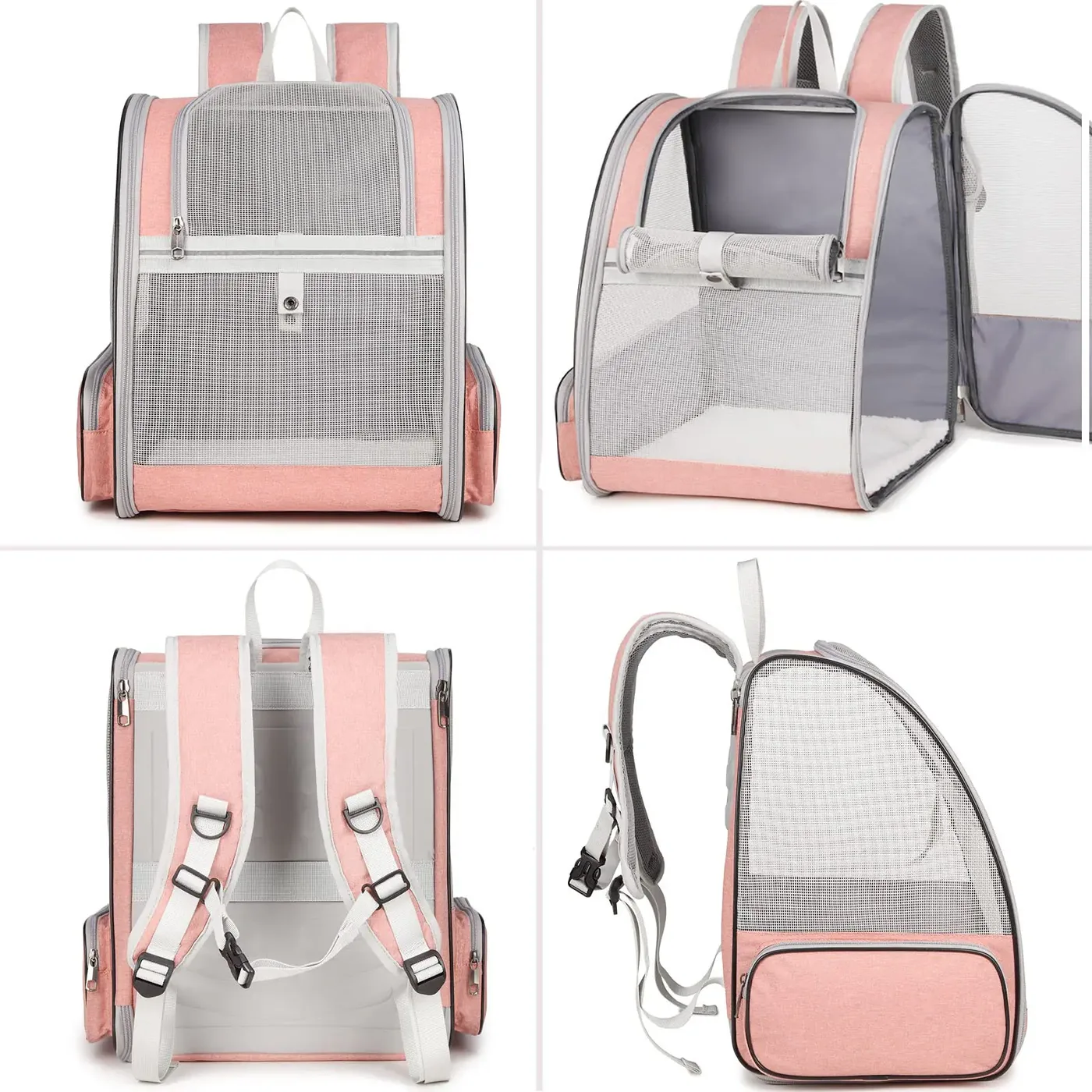
Material selection for puppy bags is largely a question of surface texture and edge construction. Puppies chew what is soft, protruding and reachable, which puts zip tapes, binding and handle roots at the top of the risk list. A tightly woven shell with a firm finish is less attractive to chew than a soft-coated one, and a heavier denier at the opening resists the initial damage that leads to a bag being destroyed.
Edge treatment is where the money goes. A standard binding tape is the first thing a puppy reaches, and once it is loose the rest of the opening follows quickly. A reinforced binding, or a welted corner construction on structured bags, costs more per unit and dramatically extends service life. Buyers should specify edge treatment explicitly, because it is invisible in a photograph and is routinely the first thing removed from a competitive quote.
Zip selection follows the same logic. A number 5 coil zip with a low-profile pull is the sensible baseline: it has no protruding element to chew, it runs smoothly enough that a puppy cannot easily catch it, and it is replaceable if it fails. A covered zip, where a flap of shell fabric protects the tape, is the most robust option and costs little. Metal pulls should be avoided because they are chewable, noisy and cold to the touch.
Interior material should be smooth and wipeable. A textured lining traps hair and moisture and is harder to clean, which matters when the bag is washed weekly. A light interior colour helps the owner see when the bag is clean, which in this category genuinely affects whether the product is kept or discarded.
- Firm-finish tightly woven shell rather than a soft rubbery coating.
- Reinforced or welted binding at every reachable edge.
- Low-profile coil zip, ideally covered by a shell flap.
- Smooth wipeable interior in a light colour.
- No protruding toggles, charms or dangling pulls anywhere on the bag.
Buyers should validate all of this on a sample with an actual puppy if possible. A supervised chew test of fifteen minutes tells a buyer more than any specification sheet, and it is the single most useful thing a supplier can support during the sampling window.
Small-part discipline and animal safety requirements
Small-part discipline is the safety core of this category. Anything that can be detached by chewing becomes an ingestion hazard, and the consequences run from a veterinary bill to a product recall. The discipline is simple to state and easy to lose during cost reduction: no component should be attached by a single line of stitching, no decorative element should be glued rather than sewn, and no cord or loop should be long enough to catch a limb or a tooth.
Pull testing is the practical control. Every attached component should be specified with a pull-test requirement, and the test should be performed on production samples rather than only on the approval sample. A pull test of modest force, applied to each component, catches the assembly shortcuts that appear when a line is running fast. Our production team records pull-test results per run, which is what makes a defect traceable rather than anecdotal.
Ventilation is the second safety requirement. A puppy bag used for short trips needs adequate airflow on at least two sides, and the mesh aperture has to be small enough that a tooth or a claw cannot engage it. This is a design constraint that interacts with the chew requirement: mesh is the most chewable element on the bag, so it should be positioned where it is least reachable and specified with a tight, strong weave rather than a loose decorative one.
Structural safety matters too. A bag intended to carry a small animal should have a base that supports the animal's weight without sagging, and the base should be removable for washing. A sagging base is uncomfortable and, for a young animal, genuinely unsafe. Buyers should specify the base board by thickness and material rather than accepting whatever the factory considers standard.
Escape resistance is the companion requirement and is often overlooked until a customer reports it. A young animal can push through a partly closed opening, and the closure has to resist that while remaining operable one-handed by an owner who is also holding a lead. A two-stage closure, with a secondary clip or hook-and-loop safety behind the zip, is the standard solution and costs very little to specify.
Sizing for a growing animal
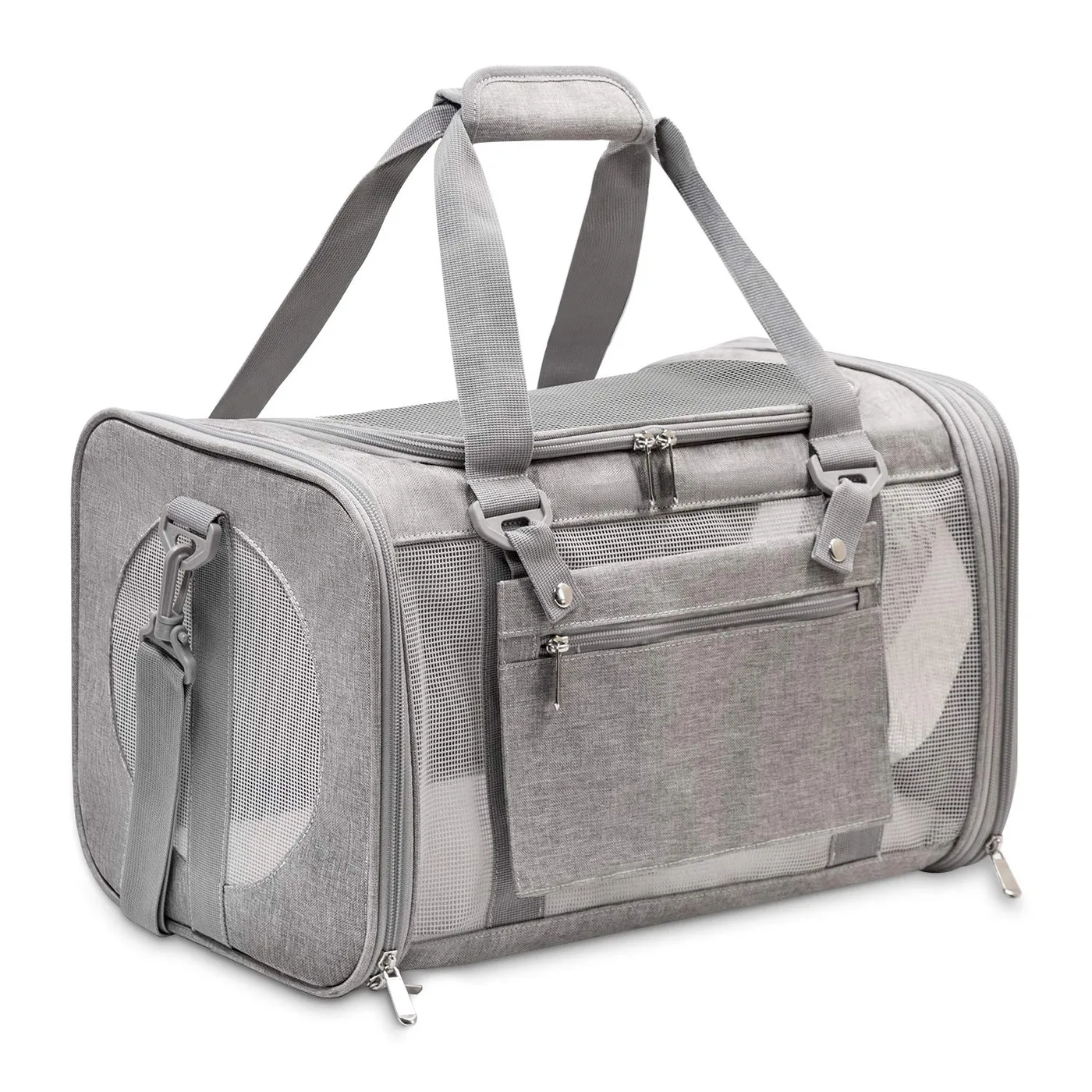
Sizing a puppy product is an exercise in predicting growth. A bag sized for an eight-week-old puppy of a small breed is outgrown in weeks; a bag sized for the adult animal is too large and too loose to feel secure for a young one. The resolution most buyers arrive at is to size for the animal at roughly four months and to use adjustability to cover the range below that.
Adjustability is cheap and effective. A removable divider, an adjustable internal tether and a roll-down opening let one bag serve a wide weight range without becoming a compromise at either end. The tether also serves a safety function, keeping a young animal from climbing out of an opening while the owner is distracted at a kerb or a reception desk.
Breed-band sizing is the alternative and suits buyers with a defined customer. A retailer serving large-breed buyers can specify one size confidently; a general pet store cannot, and is better served by an adjustable medium. Buyers should look at their own sales mix rather than at a generic size chart, because the mix differs sharply between urban and suburban stores.
The weight limit should be stated on the product and supported by testing. A stated limit protects the retailer, sets customer expectations and is increasingly required by marketplaces. Buyers should ask the supplier for the test basis of any weight claim, because an unsupported number is a liability rather than a feature.
Finally, consider that a puppy bag often outlives its original purpose. Owners keep using it for supplies, for travel and for small-animal transport long after the puppy has grown. Designing for that second life, rather than for the first month only, is what turns a puppy kit into a product that generates repeat brand exposure.
Buyers should also check how the size claim reads on a listing page. Online channels reward a stated weight band and an internal dimension, because customers compare those numbers directly, and a bag listed only by volume converts worse than one listing a weight range. Asking the supplier for internal dimensions in both centimetres and inches at quotation costs nothing and removes a round of listing revisions later.
Retail-ready packaging and channel requirements
Channel determines packaging, and packaging determines a meaningful part of the unit cost. A breeder distributing bags with a puppy takes bulk cartons. A pet specialty retailer needs individual polybags with a barcode and a hangtag. A subscription box needs a bag that presents well out of the box and survives parcel handling without additional protection. A marketplace seller needs all of the above plus scannable labelling on the outer carton.
Retail-ready requirements are more detailed than buyers expect. Barcode placement, hangtag content, warning text and country-of-origin marking are all specified by the retailer and are all cheap to get right and expensive to get wrong. A shipment arriving without the correct barcode is frequently refused at the distribution centre, and the cost of that refusal dwarfs any packaging saving.
Presentation also affects perceived value in a category where the buyer is spending emotionally. A bag that arrives flat and creased from a polybag looks cheaper than the same bag lightly stuffed with tissue. Buyers serving gift and subscription channels should specify stuffing and packing orientation explicitly, because it is the cheapest available improvement to the unboxing impression.
Carton configuration is the remaining lever and is frequently ignored until the freight quote arrives. An export carton dimensioned to the bag rather than to a standard size wastes container space and raises freight per unit by a meaningful margin. Asking for the carton specification and the units-per-carton figure at quotation, then comparing across suppliers, separates a genuinely competitive quote from one that has simply shifted cost into freight.
- Confirm barcode symbology, placement and verification requirement with the retailer.
- Specify hangtag content including warnings and origin marking.
- Decide stuffing and packing orientation for gift and subscription channels.
- Confirm outer carton labelling for marketplace fulfilment.
- Request a packing specification in writing before the bulk run.
Compliance, testing and documentation
Puppy products sold in the United States are consumer products and carry the full expectation set: CPSIA lead and phthalate limits on accessible substrates, and a Prop 65 assessment where the product is sold in California. The framework and current limits are published by the Consumer Product Safety Commission. Buyers should request reports against the production lot, not generic certificates, because retailers and marketplaces check the lot reference.
European distribution requires REACH SVHC declarations on shell, lining and print. An OEKO-TEX certificate on the fabrics is the efficient way to close the chemical question and is accepted by most European retailers without further discussion.
Animal-side guidance is separate from product compliance and is usually referenced by retailers and veterinary partners. Resources published by the American Veterinary Medical Association on young animal care and transport are commonly cited in buyer conversations, and a specification that supports ventilation, a supported base and a secure closure aligns with that guidance without overstating any claim about the product.
The documentation set should accompany the shipment: compliance reports, abrasion test data, pull-test records, a retained production sample and a packing list. Retailers ask for this file during onboarding, and programmes that hold it list faster and with fewer conditions than those that have to assemble it under time pressure.
Order planning: MOQ, seasonality and the re-order ladder
MOQ 500 per colour is the floor, and for puppy kits the practical question is how many colourways the range needs. A retailer typically wants three or four, which at 500 each is a real inventory commitment for a first season. The usual solution is one body colour with multiple print or trim variations, which delivers the range appearance while keeping the fabric purchase concentrated.
Seasonality is the dominant scheduling factor. Puppy acquisitions cluster in spring and again ahead of the winter gift season, which means bulk orders must be placed well before both. Working backwards from a shelf date: 35-50 days of production, plus freight, plus a sampling window of 6-10 working days, plus artwork approval. Buyers who place orders in the month the season starts are three months late.
Capacity is the constraint behind seasonality. Lines fill in the pre-season months, and a buyer who books late does not simply wait longer, they wait for the next available slot, which can be several weeks. Reserving capacity at quotation stage, against a defined artwork lock date, is the reliable way to hold a shelf date.
The re-order ladder is where margin is built. Unit cost steps down at predictable points, and a buyer who knows the ladder can choose an order quantity that clears the next breakpoint for a marginal increase in inventory. Buyers should ask for the ladder explicitly at quotation rather than accepting a single price against a single quantity.
Finally, hold the specification steady across seasons. A puppy kit that changes every year forces re-testing, re-certification and re-photography, all of which cost more than the design refresh is worth. The retailers that do this well run the same bag for three years and refresh only the printed artwork.
The commercial payoff for that discipline is the ability to re-order at short notice. A retailer whose bag is already specified, tested and photographed can respond to an unexpected sell-through in two or three weeks rather than in a full development cycle, and that responsiveness is often the difference between a season that clears and one that ends with markdowns.
Order and quality terms
- MOQ 500 pieces per colourway; samples in 6-10 working days
- Bulk production 35-50 days after approval; AQL 2.5 inspection standard
- T/T 30/70 terms, FOB Xiamen, full document set per shipment
People Also Ask
What size bag suits a new puppy?
A 6-12 litre bag covers most small and medium breeds through the first months, with adjustability used to cover the range rather than buying two sizes.
Are puppy bags machine washable?
Retail specifications target forty degrees for thirty to fifty cycles. Washability matters more here than in most categories because house training is incomplete.
What makes a puppy bag safe?
No detachable parts, pull-tested attachments, adequate mesh ventilation with a tight weave, and a base board that supports the animal without sagging.
Do puppy bags need a base board?
Yes. A sagging base is uncomfortable and unsafe for a young animal. Specify board thickness and material rather than accepting a factory default.
Can one bag serve both puppies and adult small dogs?
Usually yes, if it is sized to the adult animal and uses a divider and tether to make the smaller case feel secure. That second life is what generates repeat brand exposure.
Frequently Asked Questions
What is the MOQ for a wholesale puppy bag?
MOQ is 500 pieces per colour. Retailers wanting several colourways usually take one body colour with multiple print or trim variations to keep the fabric purchase concentrated.
How long do samples and bulk production take?
Samples take 6-10 working days. Bulk production is 35-50 days after sample approval and deposit, with pre-season capacity booked well ahead of the selling window.
Why should a puppy bag have no detachable parts?
Anything a puppy can chew off becomes an ingestion hazard. Retailers and marketplaces increasingly apply this standard at listing, so decorative toggles and dangling pulls are excluded by design.
What abrasion rating should we specify?
Ten thousand cycles is a sensible retail target and fifteen thousand for premium kits, always with the test method and load named and the report run against production fabric.
Which zip is best for a puppy bag?
A number 5 coil zip with a low-profile pull, ideally covered by a flap of shell fabric. Metal pulls are chewable, noisy and cold to the touch.
How should we size a puppy bag?
Size for the animal at roughly four months and use a removable divider and adjustable tether to cover the range below that, rather than sizing to the eight-week-old case.
What weight limit should be stated?
State a limit supported by a test and ask the supplier for the test basis. An unsupported number is a liability rather than a feature, and marketplaces increasingly require one.
What packaging do retailers require?
Individual polybags with a verified barcode, a hangtag carrying warnings and origin marking, and outer carton labelling for marketplace fulfilment. Confirm the symbology with the retailer before the run.
Which compliance documents do we need?
CPSIA lead and phthalate reports for the US, a Prop 65 assessment for California, REACH SVHC declarations for Europe, and ideally an OEKO-TEX certificate on the fabrics.
What inspection gates apply beyond AQL 2.5?
A pull test on every attached component and a wash-cycle check. These catch the assembly shortcuts and material substitutions that a visual inspection does not.
How should we plan around puppy season?
Work backwards from the shelf date: production, freight, sampling and artwork approval. Place orders well ahead of the spring and pre-holiday peaks, when line capacity fills.
Should the specification change every season?
No. Changing annually forces re-testing, re-certification and re-photography. Run the same bag for three years and refresh printed artwork only.
Talk to QUANZHOU JUNYUAN BAGS about a wholesale pet bag order: MOQ 500 pieces per colourway, samples in 6-10 working days, bulk production in 35-50 days under AQL 2.5 inspection.
Get a free quote Request a sample