Pet Seasonal Bag: Winter/Summer Assortment Planning
A winter/summer pet bag program needs two distinct spec sets built on one shell: a winter version with 4-6 mm insulation and a low-temperature-flexible shell, and a summer version with 35-45% mesh panel area and UV-stable fabric. Plan the split at roughly 45% winter units and 55% summer units for a Northern Hemisphere retail year. Both versions run at MOQ 500 pieces per color, and booking both in one production slot cuts total lead time by 10-15 days versus ordering them separately.
This planning note is for distributors and retail buyers assembling a two-season pet bag assortment rather than a single SKU. Seasonal programs fail on calendar and forecast, not on construction, so the emphasis here is on spec definition, order phasing and slot booking. Standard terms across both seasonal builds are MOQ 500 pieces per color per style, samples in 6-10 working days after tech pack approval, bulk production in 35-50 days from deposit, inspection to AQL 2.5 with season-specific functional checks, payment T/T 30/70 and quotation FOB Xiamen. Our production team schedules winter and summer builds through the same partner facilities, with the quality system audited to ISO 9001 and social compliance covered by BSCI. The sections below set out the assortment logic, both spec sets, material planning, hemisphere-based forecasting, cost and tooling, compliance differences and the reverse calendar from artwork approval to store shelf.
Pet bag tiered pricing usually breaks at three quantity points, and Pet Bag Types & Styles determines which point is realistic for a first order. Cheap pet carriers wholesale quotes that ignore carton cubage tend to lose their advantage once freight is added, so pet bag unit cost wholesale is the only number worth comparing.
Why Two Seasons Belong in One Buying Program
Most buyers approach seasonal pet bags as two unrelated purchases: a warm build ordered in late summer and a ventilated build ordered in early spring. That approach costs money twice. Each order carries its own sampling cycle, its own component purchase, its own setup amortisation and its own inspection event. Treating the pair as one program with two spec sets consolidates four of those six cost centres and, more importantly, reserves one production slot instead of competing for two.
The consolidation argument is strongest on the shell. Winter and summer versions of the same style can share the outer pattern, the cutting dies, the webbing specification and the majority of the sewing sequence. What changes is the insulation layer, the panel construction, the lining and the hardware finish. In cost terms, roughly 70% of the bill of materials is identical, which means the incremental engineering for the second season is a fraction of developing a separate style.
There is also a forecasting benefit. Seasonal demand is volatile, and a program with two spec sets can be rebalanced mid-season: if an unseasonably warm winter leaves insulation stock moving slowly, the summer build can be pulled forward from the same slot. Buyers locked into two separate orders with two separate suppliers have no such flexibility.
- One shell pattern, two spec sets, one production slot.
- Roughly 70% of the bill of materials is shared between seasons.
- Sampling runs once for construction and once per season-specific layer.
- Mid-season rebalancing is possible when both builds sit in one slot.
- Compliance documentation is largely reusable across the pair.
The discipline required is early definition. A consolidated program only works if both spec sets are written before the first sample is cut, because retrofitting a second season onto a style already in production means re-opening the pattern and paying for development twice.
Winter Spec Set: Insulation, Lining and Cold-Weather Hardware
The winter build is defined by thermal performance and by low-temperature material behaviour. Insulation thickness of 4-6 mm is the practical range for pet bags: below 4 mm the thermal benefit is marginal against the weight and bulk penalty, and above 6 mm the bag loses internal volume and becomes awkward to store at retail. Insulation should be specified by thickness and by type, with needle-punched polyester wadding the value choice and closed-cell foam the performance choice where a buyer is selling into genuinely cold markets.
The shell must stay flexible in the cold. Coated polyester and PVC-coated fabrics stiffen and can crack below -10 C, which is a real failure mode for bags sold into Canada, the Nordics and northern continental Europe. A TPU-coated or PU-coated shell with a stated low-temperature flex expectation is the safer specification, and it costs only a small premium over a commodity coating.
Hardware is the third element and the one most often missed. Zipper tape and pullers behave differently below freezing, and moulded plastic components become brittle. Specifying metal or cold-rated moulded hardware, plus a zipper that has been cycled at low temperature during sampling, prevents the winter-specific warranty pattern where a bag arrives intact and fails at the closure three weeks into the season.
| Component | Winter spec | Summer spec | Shared element |
|---|---|---|---|
| Insulation layer | 4-6 mm wadding or foam | None | Shell pattern |
| Panel construction | Solid, minimal mesh | 35-45% mesh area | Cutting dies |
| Shell coating | PU or TPU, flexible to -20 C | PU, UV-stabilised | Webbing spec |
| Lining | Brushed tricot or fleece | Moisture-wicking mesh | Handle construction |
| Hardware finish | Cold-rated metal or moulded | Corrosion-resistant | Base reinforcement |
Finally, the winter build should carry a thermal claim only if it has been tested. A statement such as retains warmth for two hours needs a defined test condition: ambient temperature, starting internal temperature and measurement interval. Without those three parameters the claim is not defensible and will not clear a retail quality review.
Summer Spec Set: Airflow, Mesh Area and UV Stability
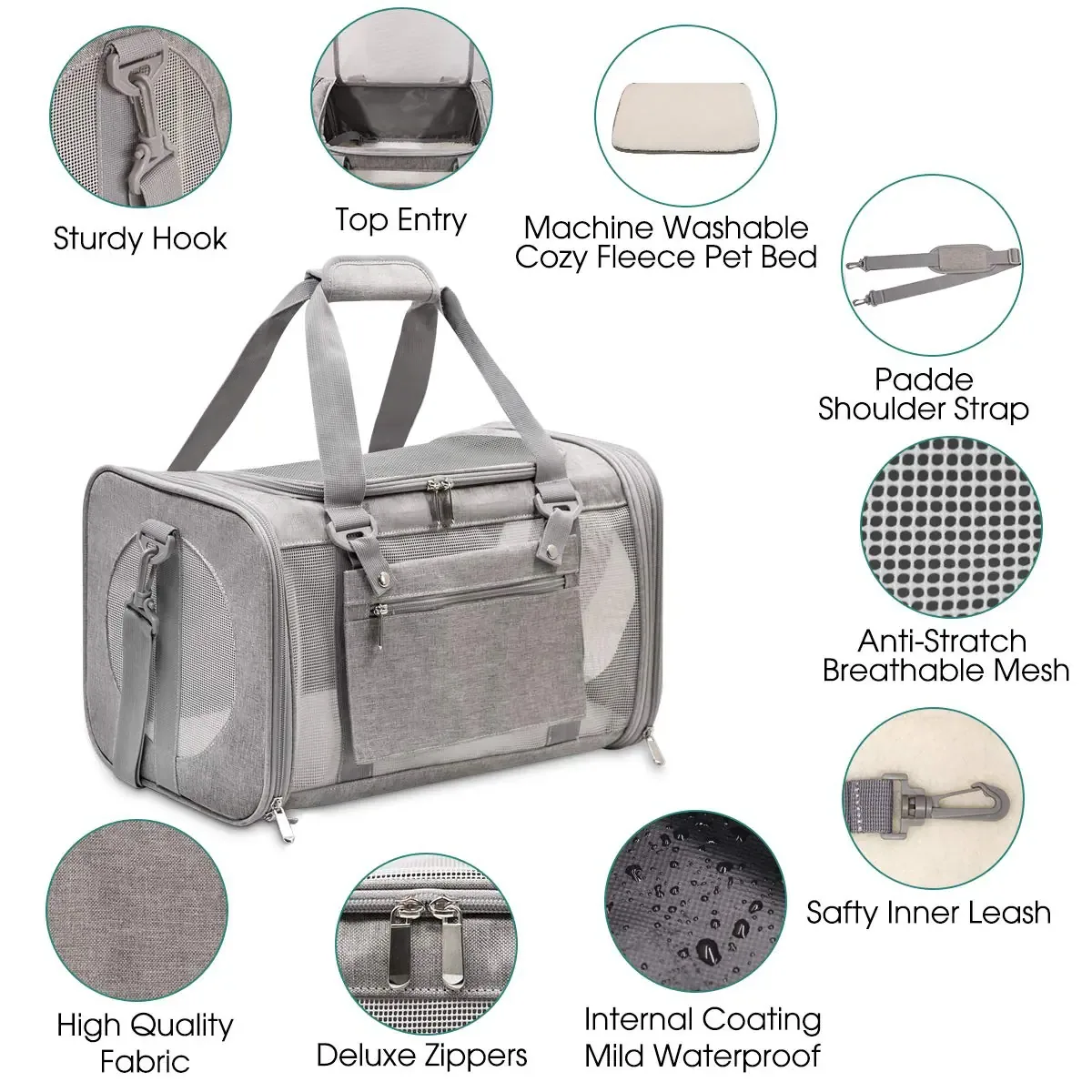
The summer build is defined by airflow, and airflow has to be specified numerically. The working target is 35-45% of the total panel area in mesh, distributed across at least two faces so air can cross the cavity rather than simply entering one side. A single large mesh panel on one face performs measurably worse than two smaller panels on opposing faces, even when the total mesh area is identical, because cross-ventilation rather than opening size drives the exchange.
Mesh specification matters as much as mesh area. A tight no-see-um mesh at roughly 20 x 20 threads per centimetre resists claw damage but restricts airflow; an open mesh at 8 x 10 flows well but snags. Mid-tier programs typically settle around 12 x 14 with a reinforced binding. Buyers should specify the mesh construction in the tech pack and require a snag-resistance check during inspection, because mesh is the single most returned component in warm-climate programs.
UV exposure is the summer-side equivalent of cold-crack. Fabric dyed for a summer palette fades fastest, and the failure is visible on the shelf as well as in the field. Specifying a colour fastness to light expectation, and verifying it through recognised textile procedures such as those published by AATCC textile test methods, protects a program from the slow, expensive problem of a seasonal colourway that looks tired halfway through the selling window.
Lining completes the summer build. A wicking mesh lining moves moisture away from the interior and dries quickly, which matters in humid markets where a non-breathable lining will develop odor within a season. Where the program includes a soiled compartment, the same logic applies to its lining: non-porous for containment, but vented high on the panel so the cavity can dry.
Material and Colour Planning Across the Seasonal Switch
Colour planning is where seasonal programs either look intentional or look accidental. Winter palettes in this category skew dark and saturated: charcoal, deep green, navy and burgundy, because they read as warm and because they hide the salt and grit of winter use. Summer palettes skew light and bright: sand, sage, sky and coral, because they read as cool and because they photograph well in outdoor lifestyle imagery. Both should be developed from the same base fabric so that dye-lot control and compliance testing carry across.
The switching point is the practical question. If both seasons run in one production slot, the line has to change thread, webbing and trim between colourways, and each changeover consumes time. Grouping colourways by season rather than interleaving them reduces changeovers from four or five to two. That is a scheduling decision made at the order stage, and it is worth several days of lead time on a large program.
Base fabric consistency protects the compliance file. Running both seasonal palettes on the same substrate means one restricted-substance test covers both, rather than two rounds for two fabrics. Buyers selling into the EU should confirm the fabric against REACH documentation and, for the US market, against applicable state chemical requirements before artwork approval, because a fabric change late in the program invalidates the file.
- Winter palette: charcoal, deep green, navy, burgundy.
- Summer palette: sand, sage, sky, coral.
- Develop both palettes on one base fabric to reuse compliance testing.
- Group colourways by season to cut line changeovers.
- Confirm restricted-substance documentation before artwork sign-off.
Demand Forecasting and Order Phasing by Hemisphere
Hemisphere dictates phasing more than any other variable. A Northern Hemisphere retail year puts winter sell-in in July and August and summer sell-in in January and February, which means the production slot for winter has to close in late spring and the summer slot in late autumn. Southern Hemisphere buyers run the same cycle six months offset, and distributors serving both should plan two consolidated slots per year rather than four small ones.
Split ratios should follow climate distribution, not intuition. For a general Northern Hemisphere assortment, 45% winter units and 55% summer units is a defensible starting point, because the summer selling window is longer and the addressable climate zone is wider. Buyers with concentrated cold-climate distribution should invert it. Either way the split should be set before the slot is booked, because shifting mix after components are ordered is expensive.
Phasing protects against forecast error. Releasing 70% of the seasonal volume in the first shipment and holding 30% for a mid-season reorder keeps inventory risk bounded while preserving the ability to chase a strong colourway. The reserved reorder slot should be agreed at the time of the original booking, when it costs nothing, rather than requested eight weeks later when the calendar is full.
Trade terms interact with phasing. Because quotations are FOB Xiamen with payment T/T 30/70, the deposit releases the bulk slot and the balance releases the shipment; buyers should align their own cash planning to those two milestones rather than to the retail delivery date, which typically falls four to six weeks after vessel departure depending on the lane.
Forecast accuracy improves materially when the buyer tracks sell-through by colorway rather than by style. Seasonal palettes behave unevenly: one shade frequently accounts for half the volume while another barely moves, and a style-level forecast hides that until it is too late to rebalance. Distributors who request weekly sell-through data from their retail partners in the first four weeks of the season can redirect the reserved reorder toward the strong shade and away from the weak one.
The other forecasting discipline is to separate base volume from seasonal volume. A distributor carrying a core range alongside a seasonal program should not allow a strong season to consume the replenishment capacity needed by core SKUs, because core stockouts in the following quarter cost more than the incremental seasonal margin. Building the seasonal plan as an explicit addition to the core plan, with its own capacity reservation, keeps both protected.
Cost and Tooling Implications of Running Two Specs
Running two seasonal spec sets costs more than running one and less than running two styles. The incremental cost sits in the insulation layer, the mesh panels, the lining and the hardware finish. On a 30-litre build quoted FOB Xiamen, adding a winter insulation and fleece lining package typically adds USD 1.20-2.30 per unit, and a summer mesh and wicking lining package adds USD 0.90-1.80 per unit, measured against a standard unlined, unventilated shell.
Tooling is largely shared. Cutting dies, patterns and jigs are common across both versions, which is the main saving of the consolidated approach. What is not shared is any moulded hardware specific to a season, such as a cold-rated zipper puller or a vent frame, and buyers should expect a separate mould charge where they want a proprietary component. Standard components avoid that charge entirely and should be the default unless the volume justifies custom tooling.
Setup amortisation is the other cost lever. Because the two builds share a line, a combined order of 3,000 winter and 3,000 summer units absorbs setup far better than two orders of 1,500 each. Buyers can see this directly in quotation differences of five to eight percent between consolidated and split programs at the same total volume, which is a meaningful margin on a seasonal category where retail prices are competitive.
Finally, plan the cost of the slow season. A program that sells 55% summer units will still carry winter inventory at the end of the window, and the carry cost belongs in the margin calculation rather than appearing as an unpleasant surprise. Many distributors handle this by pricing winter units slightly higher to fund the anticipated markdown.
A second cost lever that seasonal programs overlook is component standardisation. If both seasonal builds use the same zipper size, the same webbing width and the same buckle family, those components can be bought in one annual lot at a better price than two seasonal lots. The saving is small per unit but applies across the whole program, and it also reduces the number of component lines that have to be tracked and re-ordered.
Buyers should also model the cost of a missed season explicitly. A winter program that arrives four weeks late does not simply sell four weeks later; it loses a substantial share of its volume permanently, because retail space is released and the shopper has moved on. Comparing the cost of a faster component or an earlier slot against the cost of that lost volume usually makes the expedite decision obvious, and it is a comparison worth doing in advance rather than under pressure.
Compliance and Testing Differences Between Seasons
Seasonal builds trigger different test requirements, and a compliance file prepared for one season does not automatically cover the other. Winter builds with insulation and fleece linings need thermal performance data, low-temperature flex data on the coating and, where any heating element is involved, electrical safety documentation. Summer builds with large mesh areas need snag-resistance data, colour fastness to light and, where cooling inserts are used, documentation on the phase-change material.
Restricted-substance obligations apply to both, and the shared substrate helps here. Where a program uses the same base fabric across seasons, one test round covers both palettes; adding a second substrate reopens the file. Buyers should therefore avoid introducing a novelty fabric for a single seasonal colourway, because the compliance cost of that decision usually exceeds the marketing benefit.
Mechanical and physical performance should also be measured seasonally. Insulation compresses over time, mesh stretches under load, and coatings behave differently at temperature extremes. Recognised procedures published by standards bodies such as ASTM International test standards give buyers a neutral reference framework for abrasion, tensile and coating tests, which removes the argument about whose laboratory method applies.
Inspection then translates compliance into a line check. Visual and workmanship defects run to AQL 2.5 on both builds, while season-specific functional items such as insulation coverage, mesh integrity and closure behaviour at temperature belong in a zero-tolerance gate. Stating that split in the purchase order is what makes the compliance file meaningful rather than decorative.
Calendar: Sampling, Bulk and Retail Delivery Windows
A consolidated seasonal program runs on a reverse calendar. For a Northern Hemisphere winter sell-in in early August, artwork and tech pack should be approved by early April, samples shipped by late April, sample approval completed by mid-May, the bulk slot booked by late May, production completed by late June and the vessel departed by early July. That schedule has roughly one month of slack, which is the minimum sensible buffer for a seasonal program.
Working backwards from the standard trading frame, samples take 6-10 working days from tech pack approval and bulk takes 35-50 days from deposit. Adding component procurement for seasonal materials, inspection, and inland movement to port typically brings the practical door-to-door figure to 55-70 days before the vessel even sails. Buyers who plan on 35 days alone will miss their window.
The summer cycle mirrors it. For a February sell-in, artwork is approved in October, samples move in November, and bulk closes in December before the pre-Chinese-New-Year rush. That last point is critical: the weeks before the holiday are the most congested in the production calendar, and a seasonal program that slips into that period routinely loses two to three weeks.
Distributors serving both hemispheres should plan two slots anchored to those two cycles and should not attempt to serve a Southern Hemisphere summer sell-in from a Northern Hemisphere winter slot, because the spec sets, colours and volumes are genuinely different. Two clean consolidated programs per year outperform four improvised ones on both cost and delivery reliability.
The habit that separates reliable seasonal buyers from the rest is booking the slot at artwork approval rather than at sample approval. Sample approval will almost always come; the slot will not always still be there.
Packaging, Photography and Claim Language for Seasonal Programs
Seasonal programs sell twice: once to the retail buyer and once to the shopper, and packaging has to do both jobs. For the retail buyer, the pack needs a clear season marker, a size statement and a compliance marking set placed where a planogram review can see it. For the shopper, it needs the seasonal benefit stated in one line, supported by a number wherever a number exists.
Claim language is where seasonal programs create risk. Winter packs that promise warmth and summer packs that promise coolness are making performance claims, and a claim without a test condition is a liability. The safe formulation names the construction and the measurement: insulation thickness, mesh percentage, or the result of a defined test. Buyers should review every word on seasonal packaging against the test file before approving the print run.
Photography should be planned alongside sampling rather than after it, because seasonal imagery has a narrow shooting window relative to the delivery date. A winter program delivered in August needs photography in summer conditions, which usually means studio work with artificial snow or a location shoot in the opposite hemisphere. Budgeting for that at the planning stage is far cheaper than discovering the need in July.
Packaging formats should stay consistent between the two seasons. A program that uses one box size, one hangtag format and one barcode position across winter and summer simplifies the retailer's planogram work and reduces the buyer's own packaging minimums. Consistency also makes the two seasons read as one brand line rather than as two unrelated products.
Finally, packaging quantities should be matched to bag quantities. Seasonal printed packaging has no residual value once the window closes, and an over-order of winter boxes is a pure write-off. Buyers should order packaging against the confirmed bag run plus a small spoilage allowance rather than against a theoretical maximum.
Why brands source here
- Pet bag programmes run since 2014; founding team in sewn goods since 2004
- SGS-verified production floor of 4,950 m² with 137 workers across 7 lines
- Monthly capacity of 200,000 units, audited to BSCI and ISO 9001
People Also Ask
What is a seasonal pet bag program?
Two spec sets built on one shell pattern: an insulated low-temperature-flexible winter version and a high-mesh UV-stable summer version, ordered in one production slot.
Why buy winter and summer pet bags together?
Both builds share about 70% of the bill of materials, so consolidating saves sampling cycles, setup amortisation and slot booking effort, and allows mid-season rebalancing.
How much insulation is right for a winter pet bag?
Four to six millimetres of needle-punched wadding or closed-cell foam, paired with a shell coating that stays flexible at -20 C and cold-rated hardware.
How much ventilation does a summer pet bag need?
Thirty-five to forty-five percent mesh area across at least two faces, using a mid-weight mesh around 12 x 14 that balances airflow against snag resistance.
When should seasonal pet bags be ordered?
For a Northern Hemisphere winter August sell-in, approve artwork in early April and book the bulk slot by late May. Summer February sell-in mirrors it from October.
Do seasonal bags need different compliance files?
Shared substrate allows one restricted-substance round, but winter needs thermal and cold-flex data while summer needs light fastness and snag resistance data.
Frequently Asked Questions
Should winter and summer pet bags be ordered as one program?
Yes. One shell pattern with two spec sets shares roughly 70% of the bill of materials, reserves a single production slot and allows mid-season rebalancing if the weather runs against the forecast.
How much insulation does a winter pet bag need?
Four to six millimetres. Below 4 mm the thermal benefit is marginal against the bulk penalty; above 6 mm the bag loses internal volume and becomes awkward to merchandise.
What mesh area should a summer pet bag have?
Thirty-five to forty-five percent of total panel area, distributed across at least two faces so air crosses the cavity. Two opposing panels outperform one large panel at identical total mesh area.
How should volume split between winter and summer units?
Roughly 45% winter and 55% summer for a general Northern Hemisphere assortment, because the summer window is longer. Cold-climate distributors should invert the ratio.
What is the MOQ for a two-season program?
MOQ is 500 pieces per color per style, applied to each seasonal version. Consolidating both into one slot improves setup amortisation and typically quotes five to eight percent better than two split orders at the same volume.
How long does a seasonal program take from approval to shipment?
Samples take 6-10 working days and bulk takes 35-50 days, but the practical door-to-door figure including components, inspection and inland movement is 55-70 days before the vessel sails.
Do both seasons need separate compliance testing?
Restricted-substance testing can be shared when both palettes use the same base fabric. Season-specific tests differ: thermal and low-temperature flex for winter, colour fastness to light and snag resistance for summer.
What winter-specific failures should buyers specify against?
Coating crack below -10 C, brittle moulded hardware and stiff zipper tape. Specify a PU or TPU coating with a stated low-temperature flex expectation and cold-rated hardware.
What summer-specific failures should buyers specify against?
Colour fade from UV exposure, mesh snagging and lining odor in humid markets. Specify colour fastness to light, a defined mesh construction and a wicking lining.
When should a production slot be booked?
At artwork approval rather than at sample approval. Sample approval will almost always come; the slot may not still be available, particularly before the pre-holiday peak.
How much does each seasonal package add to unit cost?
Winter insulation and fleece lining add USD 1.20-2.30 per unit; summer mesh and wicking lining add USD 0.90-1.80 per unit, measured FOB Xiamen against a standard unlined shell.
Can a single program serve both hemispheres?
Not from one slot. Southern Hemisphere demand runs six months offset with different colours and volumes, so plan two consolidated programs per year rather than four improvised orders.
Talk to QUANZHOU JUNYUAN BAGS about a wholesale pet bag order: MOQ 500 pieces per colourway, samples in 6-10 working days, bulk production in 35-50 days under AQL 2.5 inspection.
Get a free quote Request a sample