Pet Head Out: Head Out Design
A pet head out bag lets the animal's head and neck stay outside the shell through an aperture that the handler can tighten, and the sensible wholesale band is 3-9 kg. Plan on FOB Xiamen at USD 6.80-12.60 per unit from MOQ 500 per colour, with price set by the closing mechanism, the window construction and the collar layers rather than by shell fabric.
Head-out bags occupy the middle ground between a fully open tote and a closed carrier, and that middle ground is where specification discipline matters most: the aperture has to be loose enough for the animal to breathe and look around, and tight enough that it cannot push its way out. The build recommended here uses a two-stage collar, a rolled inner sleeve for comfort and an outer drawcord with a cord lock for containment, plus a rigid ring hidden between the two layers so the aperture cannot be forced open by shoulder pressure from inside.
Order mechanics match the rest of the range: MOQ 500 per colour, first samples 6-10 working days after the tech pack is confirmed, bulk 35-50 days from approval of sample, fabric and artwork, and release at AQL 2.5 on a defect list written around escape and contact hazards. Terms are T/T 30/70, FOB Xiamen. Our production team books through an SGS-verified production base and partner facilities, and a slot is confirmed by deposit plus booked trims.
The opening launch is two sizes in a dark neutral, because light shells show saliva marking around the collar within days. Ask for the quote, the aperture drawing, the escape-test result and the carton specification together, so the buyer, the merchandiser and the quality team work from one document set.
Wholesale heavy duty pet carrier builds start at the base panel, and Pet Bag Types & Styles documentation should state the board thickness before the fabric is chosen. Wholesale scratch resistant pet carrier and wholesale tear resistant pet carrier claims only hold when the test method is named, otherwise the coating alone is doing the work.
How the Head Opening Actually Closes: Drawcord, Roll Collar, Snap Yoke, Zip
Four closing mechanisms dominate this category and they behave very differently once an animal leans into the aperture. Choosing between them is the first specification decision and should be made on containment behaviour rather than on how the sample photographs.
A drawcord with a spring cord lock is the most common and the most misunderstood. It adjusts smoothly and looks tidy, but it is a friction device: the cord grips the fabric, and a determined animal pushing outward with its shoulders can work the aperture wider over several minutes. On its own it is a comfort feature, not a containment feature. It becomes adequate only when a semi-rigid ring or a webbing band sits under the cord and sets a hard maximum circumference.
A roll-down collar, like the top of a dry bag, gives the widest adjustment range and the softest edge, and it is genuinely difficult for an animal to push open because the rolled fabric resists outward force. Its weakness is that handlers roll it incorrectly, and an unrolled collar looks wrong on a shelf. If you specify it, the hangtag needs a three-step diagram.
A snap yoke uses two or three snap positions on a shaped collar panel. It gives discrete, repeatable sizing and audible confirmation, which retail staff appreciate, and it is the most secure of the four. It is also the least forgiving: an animal between snap positions gets either a loose or a tight fit, and there is no intermediate.
A zip-fastened aperture with a fabric guard under the slider offers the widest opening for loading and closes cleanly, but it introduces a slider near the animal's throat and a zip track that can abrade the neck if the guard is omitted. Only specify it with a full-width guard and a locking slider.
The recommendation for a wholesale core tier is a two-stage collar: a soft rolled inner sleeve that sets comfort, and an outer drawcord over a hidden rigid ring that sets the maximum. That combination covers the widest range of animals and survives a shoulder push.
Selection note: treat any single-stage closure as a comfort device and require a hard maximum circumference underneath it before you accept the sample.
Mesh Window Versus Open Collar: Choosing Sight Line or Air Flow
Once the aperture is settled, the next decision is what the animal looks through and breathes through. Buyers often assume these are the same question; they are not, and the two options trade against each other in a way that should be written into the range plan rather than discovered in a returns report.
An open collar exposes the animal's head completely. The sight line is total, the handler can read the animal's ears and eyes, and there is no fabric near the muzzle to collect saliva. The cost is exposure: in a crowded street or a vet waiting room, an anxious animal has nothing to retreat behind, and the handler loses the ability to reduce visual stimulus.
A mesh window over the aperture trades sight line for a sense of enclosure. A fine no-see-um mesh blocks most of the visual field and keeps insects out, which matters in summer markets; a coarse hexagonal mesh keeps most of the sight line while still providing a barrier. Neither adds much airflow at the head, because the head is already outside.
A solid fabric hood with a mesh panel is the third option and the most versatile: the animal can be fully exposed on a quiet street and partially covered in a crowded one. It adds a pattern piece, a fastening and a retail story, and it is the right answer for a premium tier.
The comparison below sets the four configurations against the criteria that actually drive buying decisions.
| Configuration | Sight line | Airflow at head | Insect barrier | Handler reassurance | Cost index | Channel fit |
|---|---|---|---|---|---|---|
| Fully open collar | Full | Full | None | Low in crowds | 100 | Urban short trips |
| Coarse mesh window | 70-80 percent | Near full | Partial | Medium | 112 | Summer and park use |
| Fine mesh window | 30-40 percent | Near full | Full | High | 118 | Vet visits, transit |
| Hood with mesh panel | Adjustable | Full when open | Full when closed | Highest | 134 | Premium and anxious pets |
| Open collar plus removable shade flap | Full | Full | None | Medium | 121 | Warm climates |
Use the cost index column as a relative planning figure rather than a quote, and request each configuration priced separately. Suppliers frequently quote the cheapest and photograph the most expensive.
One point is easy to miss: airflow at the head is near identical across all four, because the head is outside the shell in every case. Where airflow actually differs is at the neck and shoulders, which the collar covers, and that is the subject of the following section.
Selection note: choose the window on sight line and insect barrier, not on ventilation, and price each configuration separately rather than accepting a blended figure.
Shade, Exposure and the Heat Equation at the Neck
Heat management in a head-out bag concentrates in one narrow band: the collar. The animal's torso is inside the shell and shares its microclimate; the head is outside and fully ventilated; the neck and the area just behind the shoulders sit under the collar and are the only place where the design can genuinely overheat.
That band is also where the coat is often thickest and where the major blood vessels run close to the surface, which is why a heavy multi-layer collar is a real welfare consideration rather than a comfort nicety. Specify the collar as no more than two fabric layers over the neck, with the inner layer a brushed or spacer knit rather than a coated shell fabric.
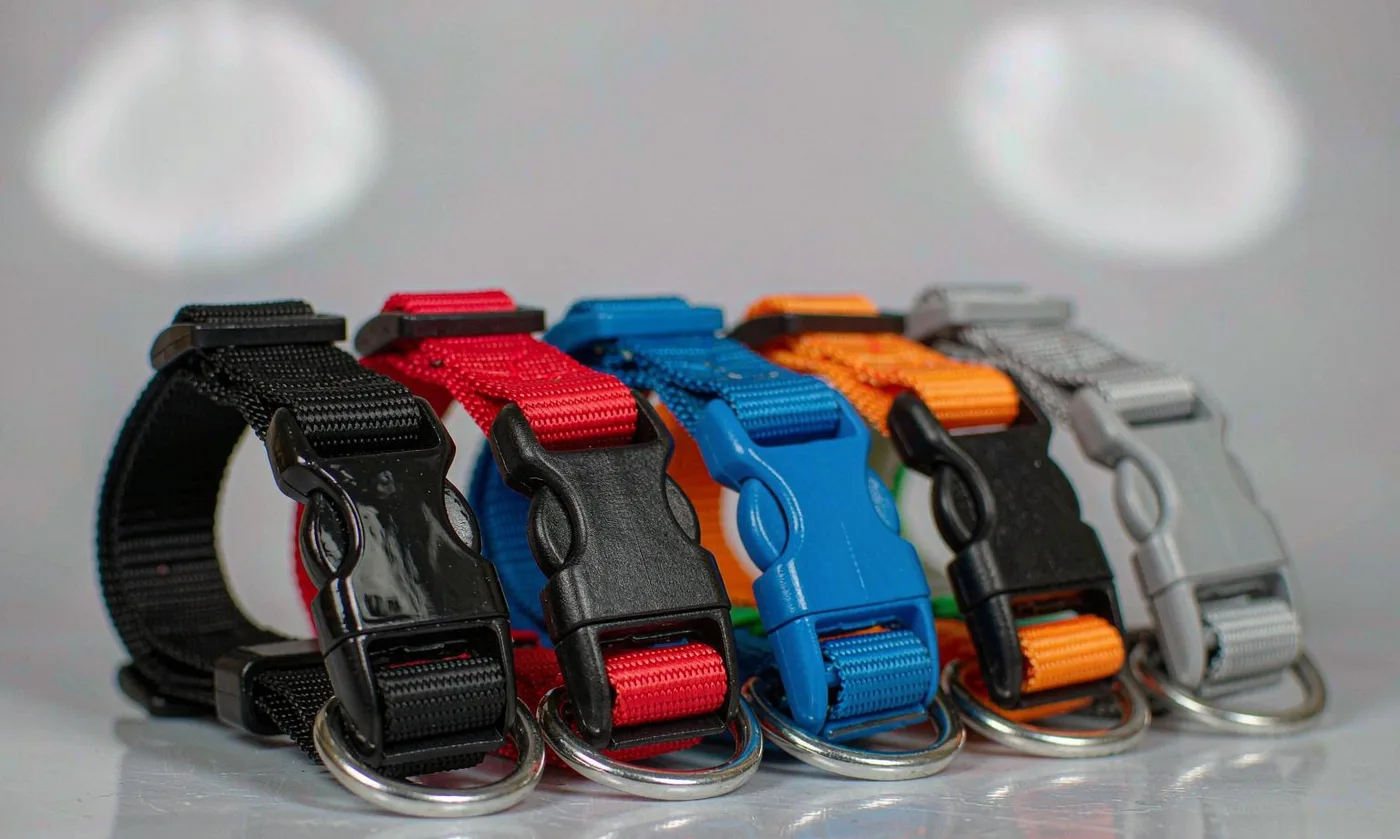
Shade is the counter-pressure. In a warm climate an animal with its head fully exposed at midday takes direct sun on the muzzle and ears, and light-coloured or thin-coated animals are at real risk. A removable shade flap that extends 8-12 cm beyond the aperture solves this without permanently blocking the sight line, and it stores flat inside the collar when not needed.
Colour choice at the collar matters more than on the shell. A dark collar absorbs radiation exactly where the design can least afford it; a mid-tone collar reflects more and shows less saliva marking than a light one. That is the reason the recommended launch colour is a dark neutral shell with a mid-tone collar rather than an all-dark build.
Reflective trim belongs here too, not on the base. A band of retroreflective piping around the aperture is highly visible to drivers at night because it sits at the top of the silhouette, and it costs a few cents.
Handlers should be told what to watch for: panting that does not settle within five minutes of rest, bright red gums, and a collar that feels damp to the touch. Those three signals are more useful than a temperature number, and they belong on the hangtag.
Selection note: keep the collar to two layers, add a removable shade flap for warm markets, and put reflective piping at the aperture rather than at the base.
Containment for Anxious or High-Drive Animals
Head-out designs attract two opposite customer groups: owners who want their animal to see out, and owners whose animal is calmer when it can see out. The second group is where containment failures concentrate, because an anxious or high-drive animal tests the aperture in a way a placid one never will.
Three escape routes exist and each needs a specific counter. The first is outward push: the animal braces its shoulders against the aperture and drives forward. Counter is the hidden rigid ring described earlier, which sets a hard maximum circumference the shoulders cannot force past. A drawcord alone does not stop this.
The second is backward withdrawal: the animal shrugs its shoulders and pulls its head back inside. Counter is an internal tether clipped to a harness, never to a collar, anchored low in the shell. A tether anchored high pulls the neck upward and increases the animal's agitation; one anchored low settles it.
The third is leverage from the paws: the animal hooks a front paw over the aperture rim and levers itself out. Counter is a rim stiffener plus enough shell depth below the aperture that the animal cannot get its elbows over the edge. Check this on the fit panel with a determined animal rather than assuming it.
Handlers should be instructed to fit the aperture to two fingers of slack at the neck: tight enough that the animal cannot get a jaw under it, loose enough that it does not restrict breathing or swallowing. That instruction should be printed, not implied, and demonstrated in the listing video.
Behavioural guidance belongs in the retail copy as well. Tell the handler to introduce the bag at home with the aperture fully open, to reward the animal for placing its head through, and to keep the first outing under ten minutes. Programmes that ship this guidance see materially fewer first-week returns.
Exit strategy matters too. If an animal panics, the handler needs to be able to open the shell from the side or base rather than wrestling the head back through the aperture. A full-length side zip is therefore a safety feature, not a convenience one.
Selection note: counter outward push with a rigid ring, backward withdrawal with a low-anchored harness tether, and paw leverage with a stiff rim and adequate shell depth.
Sizing the Neck Aperture: Head Circumference and Neck Length
Aperture sizing is the whole product. An opening that is 2 cm too large lets the animal out; one that is 2 cm too small is a welfare incident. Neither outcome is recoverable at the shelf, so the size chart has to be built on the right two measurements and published honestly.
Head circumference, taken at the widest point across the skull and cheeks, sets the minimum aperture. Neck circumference, taken at the base of the neck, sets how much collar contact the animal will tolerate. Both are needed because animals with heavy ruffs or thick neck coats have a large neck circumference relative to the skull and will be uncomfortable in an aperture sized on the head alone.
Neck length is the third figure and the one most often skipped. A short-necked animal in a deep collar has the fabric bunched at the shoulders and overheats; a long-necked animal in a shallow collar has the rim sitting on its throat. Publish a neck length range per size and let buyers match it.
Grading should run in steps of roughly 3 cm of maximum aperture circumference, which is small enough to be meaningful and large enough to be manufacturable. Two sizes cover 3-6 kg and 6-9 kg in most populations; a third size is justified only where the retailer sells to a breed mix with a wide skull spread.
Boundary guidance should say take the smaller size where head and neck disagree, and then adjust the collar outward, because a collar can be loosened but not tightened beyond its minimum. This is the opposite rule to the legs-out family, and mixing the two up in a range plan is a common and expensive error.
Fit panels need at least three animals per size, including one with a thick neck coat and one with a narrow head, and each should be observed for ten minutes rather than photographed once. Watch for pawing at the collar, which is the earliest sign of an aperture problem.
Selection note: publish head circumference, neck circumference and neck length per size, and instruct buyers to take the smaller size at the boundary.
Cost Structure of Adjustable Head Openings
Indicative FOB Xiamen for a head-out build is USD 6.80-12.60. Shell fabric is a minor contributor; the money is in the collar assembly, the window and the hardware that sets the maximum aperture.
The collar is the largest controllable cost. A single-layer turned collar with a drawcord is the cheapest and gives the least containment. Adding a second layer, a rolled inner sleeve and a hidden rigid ring typically moves the unit up by 8-14 percent, and it is the best value increment in the whole product. Adding a hood with a mesh panel moves it a further 12-18 percent and only makes sense at a premium price point.
The rigid ring deserves specific mention because suppliers omit it by default. A moulded acetal or a sewn webbing band with a stop costs a small amount and is the difference between a product that holds an anxious animal and one that does not. Specify it explicitly and check for it on the golden sample by feel.
Window construction is second. A fine mesh panel costs slightly more than coarse, mostly in the binding and the seam length; a hood adds a pattern piece, a fastening and about three minutes of assembly. Both should be quoted as separate line items so a buyer can trade them off deliberately.
Hardware is third. A metal spring cord lock costs more than a plastic one and holds its grip far longer; a locking slider on the side zip costs more than a standard one and is worth it; a clip for the internal tether should be a locking type, and the tether itself should be webbing rather than cord.
Saliva management is a hidden cost worth pricing. A collar with a removable, washable sleeve adds a component and saves the product from the smell that otherwise develops within weeks. It is cheap insurance and a legitimate retail feature.
Consumer product safety expectations in the United States are administered by the Consumer Product Safety Commission, and independent restraint and containment discussion is published by the Center for Pet Safety. Naming the applicable scope at quote stage keeps laboratory cost inside the unit price.
Selection note: spend on the collar assembly and the rigid ring before spending on the shell, and make the collar sleeve removable.
Approving Opening Behaviour Inside the Sample Window
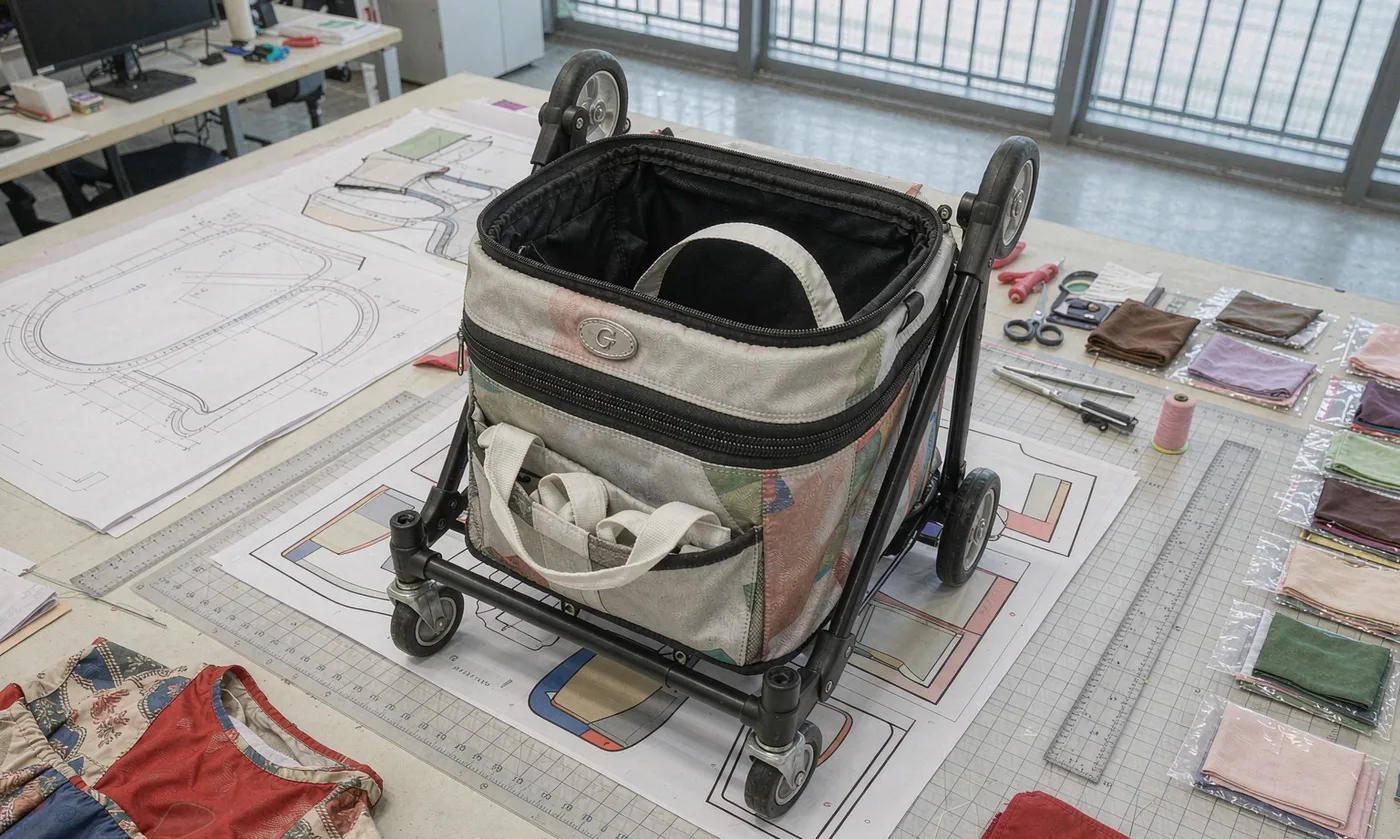
First samples are produced 6-10 working days after the tech pack is confirmed, provided the cord lock, mesh and shell fabric are stock items. A branded cord lock, a moulded ring or a dyed-to-match collar knit extends the first article onto a pre-production path, and that should be visible on the calendar before deposit.
The sample must be tested for behaviour, not just measured. Run three checks in order. First, the two-finger test: with the collar adjusted as a handler would, confirm two fingers of slack at the neck and confirm the aperture will not pass the animal's skull at that setting. Second, the push test: have a handler hold the loaded bag while an assistant applies gentle outward pressure from inside for sixty seconds, then measure the aperture circumference again. Movement beyond 10 percent fails. Third, the withdrawal test: with the internal tether clipped to a harness, confirm the animal cannot pull its head back past the shoulders.
Only then measure the collar layers, the binding width at the rim, the ring presence and the zip guard coverage. Those are quick checks and they should not be done first, because a collar that fails the push test will be re-cut and every measurement taken before that is wasted.
Wash one sample three times and check the collar for puckering and the cord lock for grip loss. Saliva marking around the aperture is the most common reason a head-out bag comes back, and a collar that puckers after washing looks defective even when it performs.
Colour, logo and print approval come last. Head-out collar geometry moves more often than any other element in the range, and approving artwork early is the usual cause of a relaid print file.
Bulk runs 35-50 days from approval of sample, fabric and artwork, covering material booking, cutting, collar assembly, inline checks, packing and final inspection. Capacity at the SGS-verified production base supports planning, but a dated slot is held by deposit and booked trims.
Selection note: pass the two-finger, push and withdrawal checks before any measurement, and hold artwork until the collar stops moving.
Defect Classes, Retail Copy and Reorder Signals
Release at AQL 2.5 against a defect list built around escape and contact hazards. A generic soft-goods list will pass a bag whose collar is one wash away from failure.
Critical: missing or undersized rigid ring, cord lock that slips under a 5 kg pull, tether anchor pull-out, side zip that opens from inside, and any exposed raw edge at the aperture rim. Each of these creates an escape or injury pathway.
Major: aperture circumference outside tolerance, collar layer count above the approved two, ring omitted or substituted, mesh panel void below specification, and zip guard missing or narrower than agreed. These will not release an animal immediately but degrade containment within weeks.
Minor: stitch irregularity on the shell, print registration tolerance, and shading variation between collar and shell inside the approved range.
Aperture circumference should be measured on every unit the inspector pulls, because collar cutting is the least consistent operation in this build. Record the spread across ten units; a wide spread points to a cutting or a sewing gauge problem.
Retail copy has three jobs. It must state the two measurements that drive fit, show the two-finger adjustment, and carry the exclusions: not for animals that paw persistently at the collar, not for brachycephalic animals in hot weather, and not for unattended use. Copy that promises security without those qualifiers creates liability for the merchant.
Handlers benefit from a short behavioural card in the box, covering home introduction, the ten-minute first outing and the panting signals. It costs a few cents and reduces first-week returns measurably.
Reorder timing should be driven by size-level sell-through and by return reason rather than by overall units. If the small size is returning at twice the rate of the large, the aperture chart is wrong for that size and the fix belongs in the next pattern revision, not in the next marketing push. With bulk at 35-50 days plus transit, that revision decision has to be taken while the first shipment is still selling.
Selection note: measure aperture circumference on every pulled unit, let the listing carry the exclusions, and let return reason rather than volume drive the reorder.
Order and quality terms
- MOQ 500 pieces per colourway; samples in 6-10 working days
- Bulk production 35-50 days after approval; AQL 2.5 inspection standard
- T/T 30/70 terms, FOB Xiamen, full document set per shipment
People Also Ask
What is a pet head out bag?
A soft carrier whose top aperture lets the animal's head and neck stay outside the shell while the body is supported inside.
Is a head-out bag safer than a fully open tote?
It is more contained, provided a rigid element sets the maximum aperture. Without that element the difference is mostly cosmetic.
How do I measure for a head-out bag?
Head circumference at the widest point, neck circumference at the base, and neck length. Where they disagree, take the smaller size.
Can cats use a head-out bag?
Yes for cats that tolerate having their head through an opening. Cats that paw persistently at the collar are poor candidates and should use a closed design.
Why does my pet panic in a head-out bag?
Usually too much visual exposure, a collar that is too deep, or a first outing that was too long. Introduce it at home and keep early trips short.
How much does a wholesale head-out bag cost?
Indicative FOB Xiamen is USD 6.80-12.60, driven mainly by collar construction, the containment ring and the window or hood option.
Does the collar overheat the animal?
It can if it runs to more than two layers or uses a coated shell fabric against the neck. A brushed inner sleeve with a removable washable cover avoids the problem.
Frequently Asked Questions
How tight should a head-out aperture be?
Two fingers of slack at the neck. Tight enough that the animal cannot get a jaw under the rim, loose enough that breathing and swallowing are unrestricted.
Can an animal push its way out of the opening?
Yes, if the closure is a drawcord on its own. A rigid ring or webbing band under the cord sets a hard maximum circumference and stops outward push.
Should the internal tether clip to a collar or a harness?
A harness, always, with the anchor low in the shell. A collar attachment risks neck injury and a high anchor increases agitation.
Does a mesh window reduce airflow?
Barely at the head, because the head is outside the shell. The window changes sight line and insect protection, not ventilation.
What pet weight suits a head-out bag?
3-9 kg in two sizes, graded on head circumference, neck circumference and neck length rather than on weight alone.
What is the MOQ for a wholesale pet head out order?
MOQ 500 per colour. A first programme usually takes two sizes in a dark neutral with a mid-tone collar.
How long does sampling take?
First samples are produced 6-10 working days after the tech pack is confirmed, assuming stock cord lock, mesh and fabric.
When does the bulk window start?
The 35-50 days begin at approval of the final sample, the material list and the carton print. Collar geometry often changes late, so approve it first.
Which closure is most secure?
A snap yoke, because it gives discrete repeatable positions and resists outward force. It is the least forgiving of animals between sizes.
Why is a side zip recommended?
So a handler can reach a panicked animal without pulling its head back through the aperture. It is a safety feature rather than a convenience.
What inspection standard applies?
AQL 2.5 against an aperture-specific defect list, with a missing ring or a slipping cord lock classified as critical.
Which payment and delivery terms are used?
T/T 30/70 with FOB Xiamen pricing, kept constant across competing quotes so freight does not distort the unit comparison.
Is a head-out bag accepted for air travel?
Not on the strength of this design alone. Any air travel claim belongs to categories built for it, and handlers must check the operator rule directly.
Talk to QUANZHOU JUNYUAN BAGS about a wholesale pet bag order: MOQ 500 pieces per colourway, samples in 6-10 working days, bulk production in 35-50 days under AQL 2.5 inspection.
Get a free quote Request a sample