Pet Dad Bag: Practical Style Wholesale Sourcing Guide
A wholesale pet dad bag program starts at MOQ 500 pieces per colorway, with samples in 6-10 working days and bulk in 35-50 days. Practical-style utility pet bags price from USD 9.20 to USD 22.40 FOB Xiamen, with fabric denier, coating and modular hardware driving the spread.
Practical-style pet bags are the opposite of the fashion-led end of the range. They sell on durability, capacity and restraint rather than on colour and finish, and that makes them the lowest fashion-risk category a wholesale buyer can carry: a well-specified utility bag in a neutral colour sells through across several seasons without restyling.
Commercial terms follow the standard framework: MOQ 500 pieces per colorway, samples in 6-10 working days, bulk production in 35-50 days after sample approval, pre-shipment inspection at AQL 2.5, T/T 30/70 payment and FOB Xiamen quotation. Production runs through an SGS-verified production base with BSCI and ISO 9001 coverage, 7 lines, 149 sets of equipment and around 200,000 pieces of monthly capacity.
The trade-off to understand is that durability spend is visible in cost but invisible in photography. A buyer has to decide how much abrasion resistance and hardware quality to specify without being able to show it on a product page, which is why the specification should be anchored to a stated use case rather than to a general impression of ruggedness, and why the published figures should be backed by test reports before the artwork is printed.
Pet bag market size is reported three different ways depending on whether carriers, travel bags and accessories are bundled, so Pet Bag Types & Styles planning should pick one definition and stay with it. Pet bag market report figures are useful for board decks and of little use for MOQ planning.
What Buyers Mean by a Practical-Style Pet Dad Bag
In wholesale terms, a practical-style pet bag is a utility-styled carry solution built for durability and capacity, sold in a restrained palette, and bought by a customer who wants gear rather than an accessory. It is the category where the shopper reads the specification rather than the styling, and where the purchase justification is function rather than appearance.
That has a direct consequence for how the product should be specified. Because the customer reads specifications, they should be published and they should be true. A denier figure, a coating description, a hardware type and a capacity in litres are the details that convert in this category, and a buyer who can put real numbers on a product page has an advantage that no amount of styling can match.
The category also has the most stable demand profile in the range. Because the styling is restrained, a utility bag does not date. A buyer can carry the same specification across three seasons with only minor refreshes, which amortises development cost and makes reordering substantially simpler than in fashion-exposed categories.
The commercial risk is different from the fashion end. Rather than colour risk, the risk here is specification mismatch: a bag that is built heavier than the customer needs is overpriced, and one built lighter than the use case requires fails and generates returns. Getting the durability tier right relative to the stated use is the central decision.
Finally, the category rewards honesty in presentation. Utility customers respond to plain specification and are sceptical of decorative claims. Packaging and copy that overstate performance do worse here than in any other pet bag category, and a single unsupported claim is enough to lose a customer who was otherwise ready to buy on the strength of the construction.
Utility Aesthetics and the Palette That Does Not Date
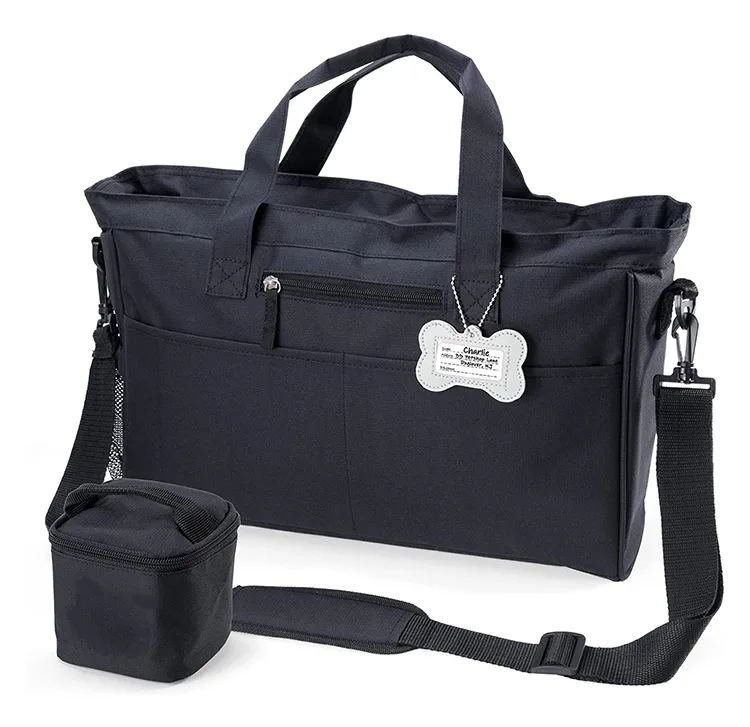
The visual language of the category is restraint. A utility pet bag should look like equipment: clean panels, minimal branding, matte hardware and a narrow palette. Anything that reads as decorative works against the product, because it signals that money was spent on appearance rather than on construction.
The safe palette is narrow and well established: black, charcoal, coyote, olive, navy and a small number of earth tones. Those shades reorder across seasons, they hide soiling, and they are the colours utility customers expect. Introducing a bright accent is possible but should be done as a trim detail rather than as a shell colour, because a bright shell in this category reads as a fashion product and confuses the positioning.
Branding should be small and durable. A woven label or an etched hardware badge suits the category; a large printed logo does not. Where a buyer wants visible branding, a tonal or debossed application is the most credible option, and it also survives abrasion better than a surface print.
Hardware finish should be matte rather than polished. Gunmetal, black oxide and matte nickel are the finishes utility customers expect, and they have a practical advantage as well: they show scratches less than a bright finish, which matters on a product sold on durability.
Shape should be functional. A utility bag reads better squared off than curved, with visible structure and a base that sits flat. That is not only an aesthetic point: a squared silhouette packs more usable volume into the same nominal dimensions, which is a genuine functional benefit a customer will notice the first time they load the bag, and it also stacks and displays better in a retail environment than a soft shape that slumps on a shelf.
Durability Specification: Denier, Coating and Abrasion Resistance
Durability is the specification core of the category and it should be written as measurable requirements rather than as general language. Three variables matter: the face fabric, the coating and the construction at stress points.
Face fabric is usually specified by denier and weave. For a practical-style pet bag, 600D polyester is the entry point, 900D is the mid tier, and 1680D ballistic weave is the premium option. Nylon at equivalent denier offers better abrasion resistance than polyester but costs more and has a different hand-feel. The right choice depends on the use case: 600D is adequate for daily suburban use, 900D suits regular outdoor use, and 1680D is justified only where the bag will be dragged over rough surfaces.
Coating matters at least as much as denier. A PU coating adds water resistance and stabilises the weave; a PVC coating adds more water resistance at the cost of weight and hand-feel; a TPU coating is the premium option and performs best in cold conditions. Coating weight should be stated in grams per square meter, because denier without a coating specification says nothing about weather performance.
Abrasion resistance should be tested rather than assumed. Martindale or Wyzenbeek abrasion results give a buyer a real figure to publish and to compare between quotes, and the test methods are published by AATCC. A supplier quoting 900D without an abrasion figure is not giving the buyer enough information to compare against a competitor quoting 600D with a good coating.
Construction at stress points is where durability actually fails. Bar-tack reinforcement at every strap root, box-stitching at handle bases, bound rather than raw internal seams, and a reinforced or moulded base are the four specifications that determine service life. They cost relatively little and they are the difference between a bag that lasts a season and one that lasts for years.
Specifying the right durability tier
The practical method is to define the use case first and then specify the minimum fabric that satisfies it. A bag marketed for daily walks does not need 1680D, and a bag marketed for outdoor use does. Over-specifying is the more common error, because it raises cost and weight without any benefit the customer can perceive.
Modular Attachment and Load-Carrying Features
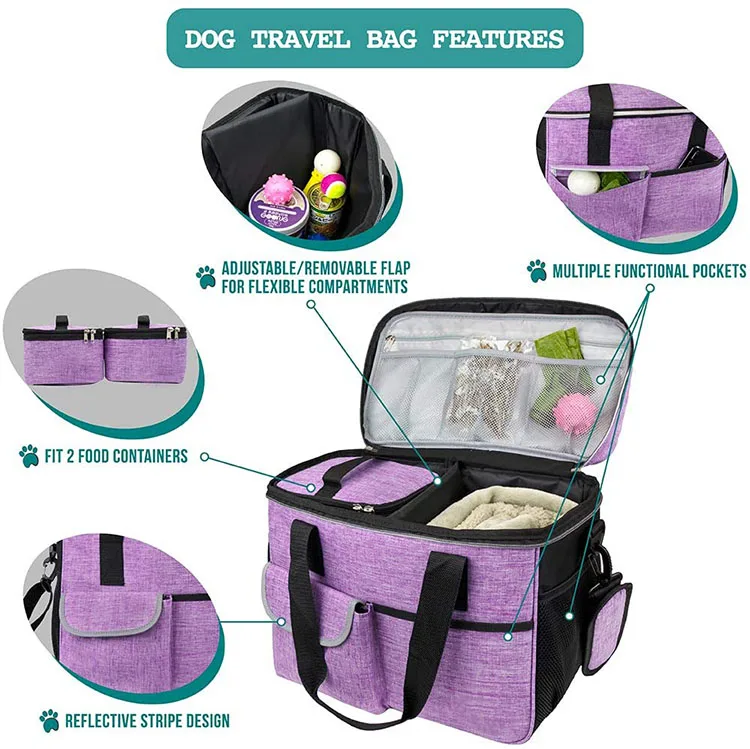
Modularity is the feature that most clearly separates the practical-style category from general pet bags, and it is also the most common source of unnecessary cost. Buyers should specify it deliberately rather than adding attachment points because they look functional.
Webbing attachment systems are the standard approach. A panel of horizontal webbing rows allows pouches and accessories to be added, and it reads as capability even when nothing is attached. The cost is in the webbing, the stitching and the labour: a full panel adds roughly USD 1.10-2.40 per unit depending on coverage. A partial panel on one face delivers most of the visual signal at a fraction of the cost, and it is usually the better commercial choice.
Load-carrying features should be specified around what the customer actually carries. A structured base, an internal divider, external compression straps and a reinforced grab handle are the features that get used. D-rings, carabiners and decorative attachment loops are specified frequently and used rarely, and they are the first things to cut when a price target has to be met.
Capacity should be stated in litres and verified rather than estimated. A buyer publishing a litre figure that does not match the physical product creates a return reason, and the measurement method should therefore be agreed in the specification.
Finally, modular systems create a commercial opportunity worth noting: accessories that attach to the bag are a natural second purchase, and they use the same webbing and hardware as the main product. A small pouch designed to attach to the bag sells at a good margin and shares the component set, which makes it one of the most efficient add-on SKUs in the range.
Cost Bands and Where Durability Spend Pays Back
A mid-tier utility pet bag at USD 14.60 FOB typically breaks down as follows: 900D shell fabric with coating USD 3.40, lining USD 1.30, webbing and attachment system USD 1.60, hardware and zips USD 2.40, structure and base USD 1.40, padding USD 0.70, cutting and sewing labor USD 2.70, QA and packing USD 0.50, and factory overhead and margin USD 0.60.
The pattern is clear: fabric and hardware dominate. That means specification is the effective lever, and it also means the category is relatively insensitive to volume. Moving from 500 to 3,000 pieces typically improves unit price by 6-10 percent, because material and labour content does not compress much.
| Durability tier | Shell | Hardware | FOB band | Use case |
|---|---|---|---|---|
| Light utility | 600D polyester, PU | Standard alloy | USD 9.20-12.80 | Daily walks, urban |
| Standard utility | 900D polyester, PU | Tested alloy, matte | USD 12.60-17.40 | Regular outdoor use |
| Heavy utility | 1680D ballistic | Rated hardware, reinforced base | USD 16.80-22.40 | Rough terrain, working use |
| Nylon upgrade | 1000D nylon, TPU | Tested alloy, matte | USD 15.20-20.60 | Premium outdoor |
| Attachable pouch | 600D matching | Webbing attachment | USD 4.20-6.80 | Add-on purchase |
The return on durability spend is not linear. Moving from 600D to 900D is usually worth it, because the cost increase is modest and the perceived and actual durability gain is real. Moving from 900D to 1680D costs substantially more and is only justified where the use case genuinely demands it, because the customer cannot see the difference in a photograph and may not need it in practice.
The most reliable payback in the category is on hardware and construction rather than on fabric. A rated buckle, a tested zip and bar-tacked strap roots prevent the failures that generate returns, and they cost far less than a fabric upgrade. Buyers working to a price target should cut fabric before they cut construction.
MOQ, Sampling and the Advantage of a Longer Lifecycle
Standard terms apply: MOQ 500 pieces per colorway, samples in 6-10 working days, bulk production in 35-50 days after sample approval, AQL 2.5 inspection, T/T 30/70 and FOB Xiamen. The category's distinctive advantage is that the specification does not need to change often.
That stability has real commercial value. Because the styling does not date, a buyer can carry the same specification across multiple seasons, which means the development and sampling cost is amortised over several orders rather than recovered from one. It also means reorders are faster, because there is nothing new to approve.
Sampling should still be used properly, and in this category the emphasis should be on physical testing rather than on appearance. A first sample should be assessed for abrasion feel, structure, hardware action and capacity. Buyers should load the sample and carry it, because utility customers will, and because a bag that feels right empty can feel wrong loaded.
Colourway planning is simpler here than anywhere else in the range. Two shades, black and one earth tone, cover most of the market and keep the commitment at 1,000 pieces. A third shade is a low-risk addition because the palette does not date, but it is rarely necessary for a first season.
Buyers should take advantage of the lifecycle by planning components across seasons. Because the webbing, hardware and fabric are stable, material can be purchased across two runs and component inventory carried forward, which reduces per-unit cost on both orders and shortens the effective lead time on the second.
Channel Fit: Where Utility Styling Sells
Practical-style pet bags sell through a different set of channels from fashion-led products, and the packaging and merchandising requirements differ accordingly. Understanding which channel the product is built for prevents the common mistake of specifying a utility bag and then trying to sell it through a gift channel.
Outdoor and sporting goods channels are the natural home for the category. They already merchandise by specification, their customers read denier and capacity figures, and they support the price point a well-built utility bag requires. Their requirement is accurate specification data and packaging that can survive a retail environment.
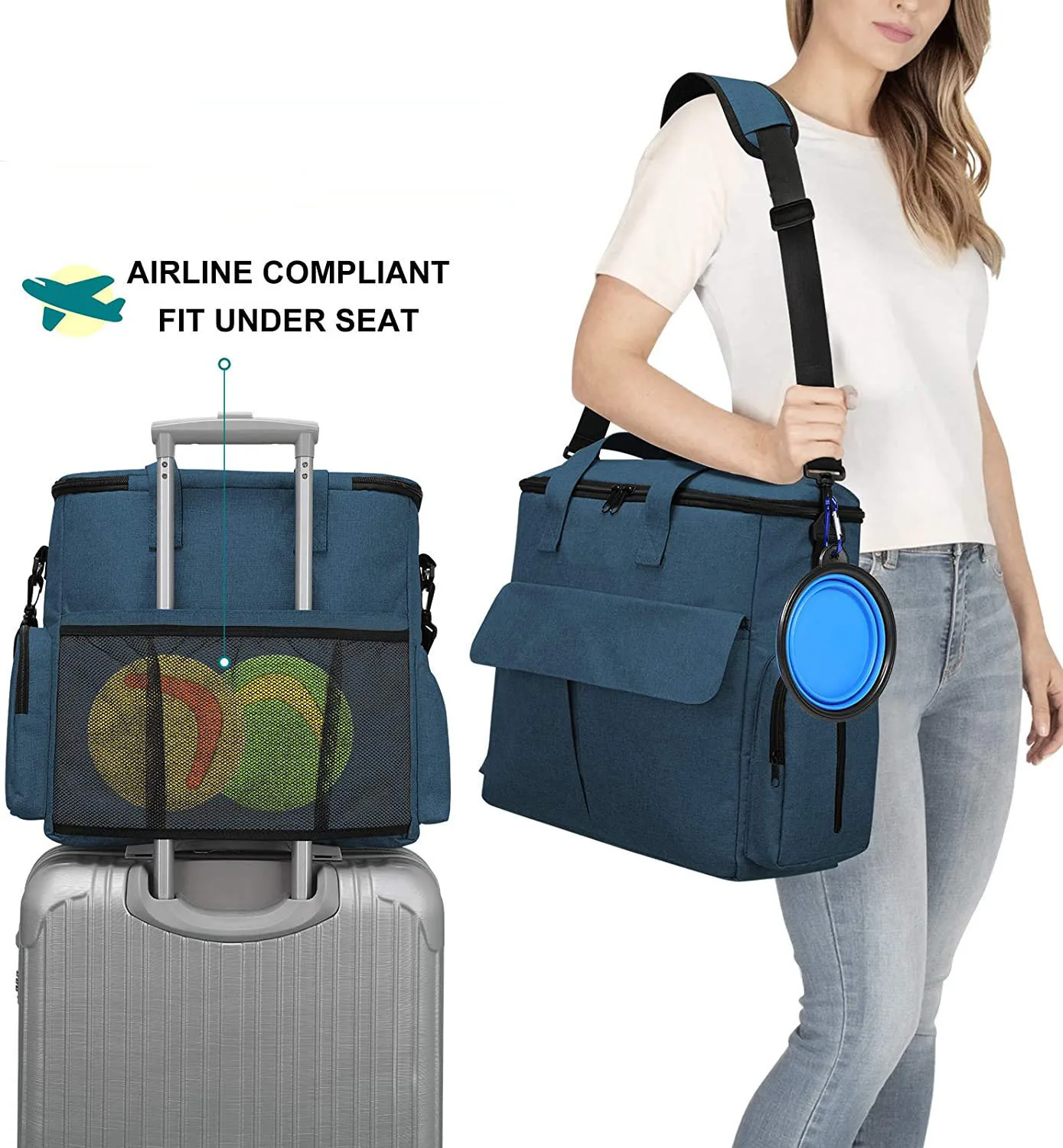
Online marketplaces are the volume channel. Utility products convert well online because the purchase decision is specification-driven and can be made from a product page. The requirement is photography that shows construction detail: stitching, hardware, base and interior. Without that photography, a durable bag looks identical to a cheaper one.
Hardware and home improvement retail is a channel buyers often overlook. It carries pet and outdoor adjacent products, it supports utility styling naturally, and it is less contested than pet specialty. The requirement is durable packaging that can be stacked or hung without damage.
Pet specialty stores carry the category as a premium alternative to fashion-led bags and usually stock it in one or two shades. They are a useful secondary channel but rarely the volume driver, because their core customer is buying on appearance.
Gift channels are the poor fit. A utility bag does not read as a gift, it does not benefit from gift packaging, and the customer who buys it is buying for themselves rather than for someone else. Buyers should not expect the category to perform there regardless of how well it is built.
Compliance, Testing and Documentation for Heavy-Duty Builds
Heavy-duty pet bags attract more testing questions than lightweight styles, largely because buyers publish performance claims. The documentation should be assembled before the claims are written, not after.
Chemical compliance is the baseline and should cover shell, coating, lining, webbing and hardware. OEKO-TEX certification across the construction is the efficient route, and the EU substance framework is maintained by the European Chemicals Agency. Coated and laminated materials should be explicitly named in the certificate scope, because a certificate for the base fabric does not cover the finished laminate.
Physical testing should cover abrasion resistance, tear strength, seam strength, hardware retention and colour fastness. Abrasion and tear results are the two that support published durability claims, and they should be obtained before artwork is approved so that the packaging carries only figures that are backed by a report.
Independent testing is worth budgeting for in this category because the claims are the marketing. Third-party verification through SGS gives a buyer a document a marketplace or retail compliance team will accept, and general product test methods are published by ASTM International.
Factory compliance documentation completes the file. BSCI and ISO 9001 coverage allows large buyers to approve the production base without commissioning their own audit, and the framework is summarised by ISO.
Labelling should be confirmed with the channel before artwork approval. Barcode position, country-of-origin marking and care symbols are routine, but a care symbol that contradicts the product's construction is a genuine problem in a category where customers follow instructions.
Inspection Priorities and AQL 2.5 on Heavy-Duty Builds
Heavy-duty products are inspected differently from lightweight ones because the defects that matter are structural. AQL 2.5 sets the sampling basis; the checklist is what makes it useful.
The plan should cover: fabric denier and coating verification against the approved specification, abrasion or tear test sampling where agreed, bar-tack coverage and stitch density at every strap root and handle base, seam strength at base corners, webbing attachment integrity on modular panels, hardware retention and cycle behaviour, zip operation under load, base structure seating, dimensional and capacity consistency, colour match against the retained standard, and packaging and barcode accuracy.
Material verification deserves particular emphasis in this category. Because the specification is the selling proposition, a substituted fabric is a more serious problem here than in any other pet bag line, and it is not visible in a routine visual inspection. Buyers should require a material declaration with the shipment and verify it at inspection.
Structural defects should be classified as critical. Insufficient bar-tack coverage, a missed reinforcement or a hardware failure are critical regardless of how the unit looks, because they are exactly the failures that generate warranty claims.
Buyers should agree the rejection remedy at quotation stage. Heavy-duty builds are labour-intensive, so re-work is expensive and a partial remedy is often the sensible outcome; settling that in advance avoids a slow negotiation after a failure.
Building a Utility Range That Compounds Over Seasons
The commercial case for the practical-style category is that it compounds. Because the specification is stable, each season adds volume to the same base rather than replacing it, and the buyer accumulates a growing reorder business on a specification that has already been tested, approved and proven.
The most effective range structure is narrow and deep. One core bag in two shades, one attachable pouch, and optionally a larger size for customers who need capacity. That is three SKUs, it shares one component set, and it covers the majority of the addressable demand without the colourway risk that a wider assortment would carry.
Accessories are the highest-margin extension. Because they use the same webbing, hardware and fabric, they carry a better percentage margin than the main bag, and they sell to customers who already own the bag. A pouch, a strap pad and a small organiser are the three most common additions, and because each shares the approved component set they can be added to an existing order without a new sampling round, which is the practical reason a utility range gets cheaper to extend as it matures.
Content should be built around proof rather than styling. Photography showing the stitching, the base and the hardware, plus published test figures, is what converts in this category. Buyers who invest in that content once can reuse it across several seasons, which is a further advantage of a stable specification.
Adjacent categories extend the range logically: all-in-one pet family bags suit buyers who want capacity over styling, and hiking pet bags share the fabric and hardware specification, so a consolidated reorder across all three improves both unit cost and scheduling.
Why brands source here
- Pet bag programmes run since 2014; founding team in sewn goods since 2004
- SGS-verified production floor of 4,950 m² with 137 workers across 7 lines
- Monthly capacity of 200,000 units, audited to BSCI and ISO 9001
People Also Ask
How much does a wholesale pet dad bag cost?
Practical-style utility pet bags generally price from USD 9.20 to USD 22.40 FOB Xiamen depending on fabric denier, coating and hardware. Fabric and hardware dominate the build-up, so volume negotiation has limited room.
What makes a pet bag practical rather than fashionable?
Durability-first specification, a restrained neutral palette, matte hardware and functional shape. Utility customers read specifications such as denier and capacity rather than judging on styling.
Is 900D better than 600D for a pet bag?
It is more abrasion resistant and costs more. For daily urban use 600D is usually adequate; 900D is justified for regular outdoor use. Coating quality matters as much as denier.
What is a modular attachment system on a pet bag?
Rows of webbing that allow pouches and accessories to be attached. A partial panel delivers most of the visual benefit at a fraction of the cost of a full panel.
How should capacity be stated?
In litres, measured by an agreed method rather than estimated. A published capacity that does not match the physical product is a direct return reason.
Do utility pet bags need certification?
No product-specific certification is mandatory in most markets, but OEKO-TEX covering the finished construction and physical test reports supporting durability claims are what retailers and marketplaces ask for.
What hardware finish is best for a rugged pet bag?
Matte gunmetal or black oxide. Both are expected in the category and both conceal scratches better than a bright polished finish.
Frequently Asked Questions
What is the MOQ for wholesale pet dad bags?
MOQ is 500 pieces per colorway. Because the palette does not date, two shades are usually sufficient for a first season, keeping the commitment at 1,000 pieces.
How long do samples take?
Samples are completed in 6-10 working days from specification sign-off. They should be assessed loaded rather than empty, because utility customers will carry weight in the bag.
What is the bulk production lead time?
Bulk production runs 35-50 days after sample approval. Reorders on an unchanged specification are usually scheduled at the short end of that window.
Which fabric denier should be specified?
600D polyester suits daily urban use, 900D suits regular outdoor use, and 1680D ballistic is justified only where the bag will be dragged over rough surfaces. Over-specifying is the more common error.
Does coating matter as much as denier?
Yes. A denier figure without a coating weight in grams per square meter says nothing about weather performance, and a lower denier with a better coating often outperforms a higher denier with a thin one.
Are abrasion test results available?
Yes. Abrasion and tear results can be obtained through recognised laboratories and should be obtained before artwork approval, so that published claims are backed by a report.
How much does a modular attachment panel add?
A full panel adds roughly USD 1.10-2.40 per unit depending on coverage. A partial panel on one face delivers most of the visual signal at a fraction of the cost.
What inspection basis is used?
Pre-shipment inspection is at AQL 2.5, with material verification and structural defects such as insufficient bar-tack coverage classified as critical.
Which colours sell in the utility category?
Black, charcoal, coyote, olive and navy cover most of the market. Bright accents work as trim details but not as shell colours, because a bright shell reads as a fashion product.
Should hardware be matte or polished?
Matte finishes such as gunmetal or black oxide are expected in this category and also show scratches less than bright finishes, which matters on a product sold on durability.
Can accessories be added to the range?
Yes, and they are the highest-margin extension. Attachable pouches share the webbing, hardware and fabric of the main bag and sell to customers who already own it.
What certifications can be supplied?
OEKO-TEX certification covering shell, coating, lining, webbing and hardware can be arranged, with REACH coverage for EU buyers and BSCI plus ISO 9001 documentation for the production base.
What are the payment and trade terms?
Standard terms are T/T with a 30 percent deposit and 70 percent balance before shipment, quoted FOB Xiamen. Other Incoterms can be quoted on request.
How often should the specification be refreshed?
Less often than in fashion-led categories. Because utility styling does not date, the same specification can run across several seasons, which amortises development cost and speeds up reorders.
Talk to QUANZHOU JUNYUAN BAGS about a wholesale pet bag order: MOQ 500 pieces per colourway, samples in 6-10 working days, bulk production in 35-50 days under AQL 2.5 inspection.
Get a free quote Request a sample