Pet Service Dog Bag: Working-Dog Gear Wholesale Sourcing
A wholesale pet service dog bag programme starts at MOQ 500 pieces per colourway, costs USD 6.80-13.20 FOB Xiamen per unit, and needs 35-50 days of bulk production after a 6-10 working day sample cycle. Working-dog gear is bought by institutions on specification rather than by consumers on appearance. Shipments release only after an AQL 2.5 pre-shipment inspection.
Working-dog gear is the most specification-driven category in the pet bag business and the one where institutional buyers replace individual consumers. Assistance dog organisations, training schools, service providers and public agencies purchase against a written specification, evaluate samples against stated performance criteria, and reorder on contract. That changes everything about how the programme is quoted and how it is sold. Orders are structured at MOQ 500 pieces per colourway against a contract or a framework agreement.
The specification priorities are function, durability and legal restraint. Function means a standardised identification panel, a load rating matched to the working weight, and no element that can snag or detach in service. Durability means a duty cycle measured in thousands of uses rather than in months. Legal restraint means the product and its documentation must not imply certification, registration or legal status that the law does not provide, which is a real and enforceable exposure in several jurisdictions.
Standard timing applies: sampling takes 6-10 working days from confirmed artwork and colour standard, bulk runs 35-50 days, and sea freight adds 28-35 days to a US West Coast distribution centre. Quality gates are fixed at AQL 2.5 under general inspection level II with zero tolerance for critical defects, and institutional buyers frequently add their own acceptance testing. Terms are T/T 30/70 against FOB Xiamen, and production runs through an SGS-verified production base with 7 lines, 149 machines and 200,000 pieces per month under BSCI and ISO 9001.
A wholesale dog carrier order and a wholesale cat carrier order rarely share one mould, so the Pet Bag Types & Styles decision has to be locked before tooling money moves. Wholesale pet carriers built on a single shared shell platform let a buyer cover both species from one fabric purchase, which is usually where the first real saving appears.
Working-Dog Gear as an Institutional Purchase
The first thing a buyer must understand about this category is that the purchaser is usually not the handler. The unit is bought by an organisation that trains, places or supports working dogs, and it is issued to a handler rather than sold to one. That single fact determines the specification, the documentation and the sales cycle, and it is why consumer-style merchandising does not work here.
Institutional purchase behaviour has three characteristics worth planning for. Procurement is specification-led, meaning the buyer writes what they need and evaluates samples against it rather than choosing from a catalogue. Evaluation is slow and thorough, frequently involving a field trial period of weeks or months before a decision. And the reorder cycle is long and stable once a supplier is qualified, because requalifying a supplier is expensive for the buyer and they will not do it without cause.
The commercial implication is that the first order is expensive to win and the subsequent orders are cheap to keep. Buyers should resource the qualification phase properly: complete documentation, samples built exactly to specification, and willingness to support a trial. Once qualified, the account is unusually stable, and the lifetime value of an organisational account in this category far exceeds anything available in consumer channels.
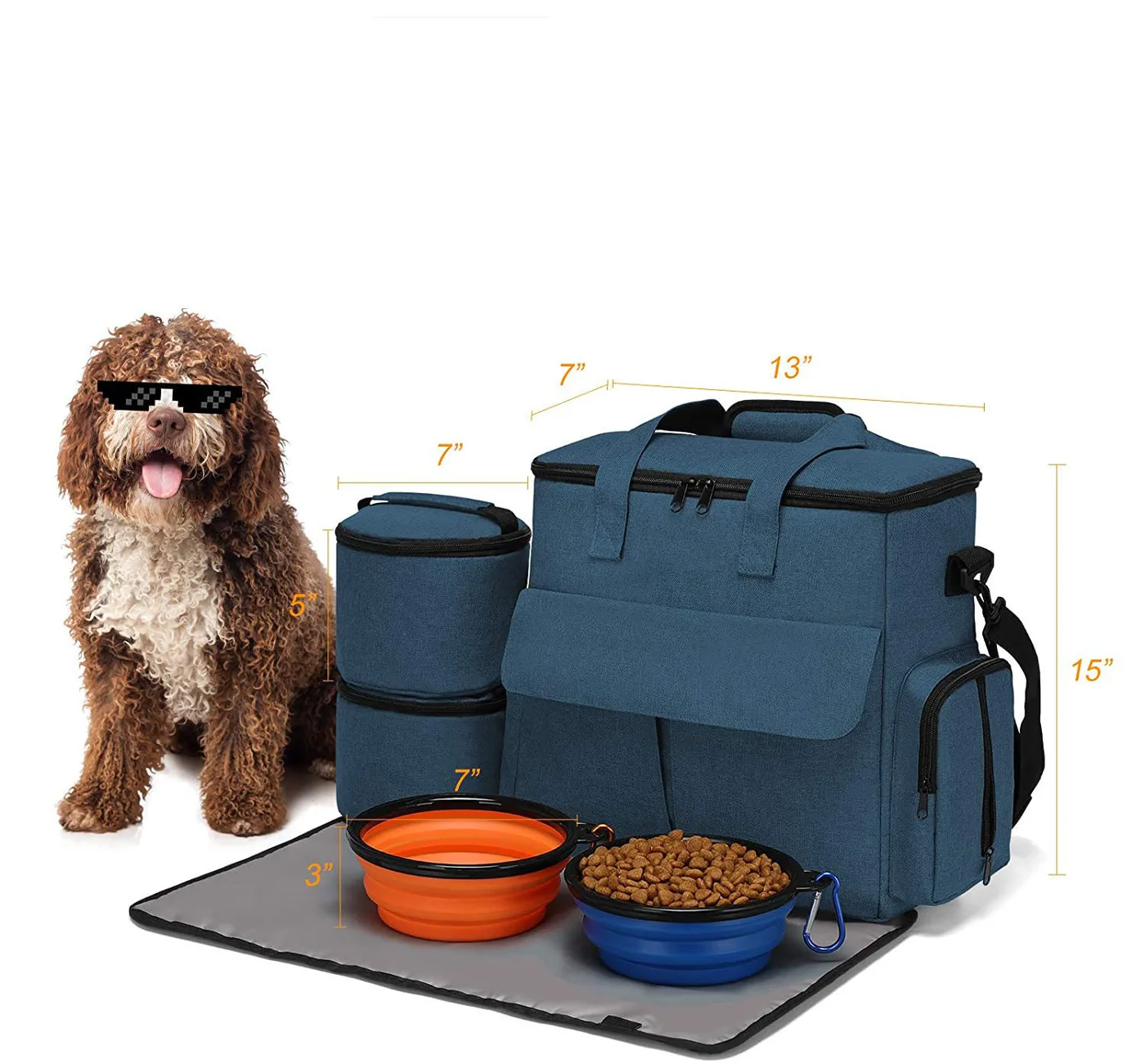
The table below shows the four configurations that carry working-dog category volume, priced FOB Xiamen at MOQ 500 pieces per colourway.
| Configuration | Working role | Size (cm) | Dog weight | FOB band (USD) | Duty rating |
|---|---|---|---|---|---|
| Patch-panel vest bag | Identification carry | 30 x 14 x 20 | 10-30 kg | 6.80 - 8.30 | Daily, 2 years |
| Training kit bag | Training programme | 40 x 22 x 28 | 10-35 kg | 8.10 - 9.90 | Daily, 3 years |
| Deployment backpack | Field and travel work | 46 x 28 x 34 | 20-45 kg | 10.20 - 12.40 | Daily, 5 years |
| Issue bundle | Organisational issue | Box 46 x 32 x 12 | 10-45 kg | 11.40 - 13.20 | Contract issue |
The duty rating column is the one that distinguishes this category from every other in the assortment. Where a consumer bag is evaluated on appearance and on months of use, working-dog gear is evaluated on years of daily service, and the specification has to be written to that standard. Buyers should expect institutional evaluators to ask what the duty rating is and how it was derived, and should have an answer supported by test data rather than by assertion.
Functional Specification: Patch Panels, Load Ratings and Duty Cycles
The identification panel is the single most specified feature in working-dog gear, and it is where most first-time specifications go wrong. A handler needs to attach and change identification without tools, without damaging the bag, and without the identification detaching during work. Those three requirements together define the specification.
The standard solution is a loop field, the soft side of a hook-and-loop system, sized to accept the organisation's standard patch. Sizes vary between organisations, so the correct approach is to size the panel generously and to confirm the organisation's patch standard before production. Our production team specifies a loop field with a defined peel strength and a defined cycle life, because a panel that loses grip after a hundred changes is a failure in service even though it looked correct on the sample.
Load rating is the second specification and it must be stated as a number rather than as a description. Working dogs in this category range widely in weight, and a bag rated for a twenty kilogram dog used with a forty kilogram dog will fail at the handle anchorage. The specification should state the rated working weight, the test method used to establish it and the safety factor applied. Institutional buyers will ask, and a supplier who cannot answer will not be qualified.
Duty cycle is the third specification, and it is best expressed as a number of operations rather than as a period of time. A main closure on working gear should be rated in cycles, a handle anchorage in loaded cycles, and a panel in attachment cycles. Expressing durability in operations rather than in months is what allows both parties to specify and verify the same thing, and it is the convention our production team applies to every working-dog programme.
Snag resistance is the fourth, and it is the one that separates working gear from consumer gear aesthetically as well as functionally. External loops, dangling pulls, decorative cords and protruding labels all snag in service. The specification rule is simple and should be stated plainly: nothing protrudes. Buyers who accept decorative elements on working gear will see them specified out by the evaluator, so it is cheaper to exclude them at the start.
Legal Claims Risk: What Can and Cannot Be Said About the Product
Working-dog gear carries a legal exposure that no other pet bag category has, and it attaches to the words used rather than to the product. Several jurisdictions regulate the misrepresentation of assistance animals, and a product that implies it confers, certifies or registers a legal status creates exposure for the manufacturer, the importer and the retailer.
The practical rule is that the product is equipment and must not be presented as anything more. It may carry a loop panel for the handler's own identification. It must not carry wording that states or implies that the wearer is a certified, registered or legally recognised assistance animal, and it must not be sold with any document that resembles a certification, registration card or identity credential. In the United States, the Americans with Disabilities Act service animal guidance is the reference point for what does and does not constitute recognition, and it makes clear that no registration or credential exists.
The exposure is not theoretical. Several US states and a number of other jurisdictions have enacted provisions specifically addressing the misrepresentation of assistance animals, and enforcement has included civil penalties against sellers of documents and equipment presented as conferring status. A wholesale buyer importing a container of gear with the wrong wording on a patch has a customs, a retail and a civil exposure simultaneously.
The operational safeguard is a copy review before production. Every word that appears on the product, on the hangtag, on the card and on the listing should be reviewed against the destination market's rules, and anything that could read as a credential should be removed. Our production team runs that review as a standard step on working-dog programmes and will not print a patch or a card that has not passed it.
Veterinary and animal health bodies publish useful reference material on working animal roles and terminology, and the American Veterinary Medical Association is a reliable source for buyers who need to check terminology before approving copy. Where a buyer is uncertain, the correct decision is to print less rather than more.
Material and Construction Standards for Daily Service Use
Daily service use over several years is a far harsher duty cycle than any consumer application, and the material specification has to be written to it. Three properties matter more than everything else: abrasion resistance at the contact points, seam integrity under repeated loaded cycles, and hardware that survives thousands of operations.
Shell fabric should be specified by abrasion performance rather than by denier alone. A high-denier fabric with a poor weave can abrade faster than a lighter fabric with a tight construction, and the specification should name a test method and a minimum cycle count rather than a fabric weight. The base and the lower side panels are the abrasion zones and should be specified separately from the upper panels, because using one fabric weight throughout either overbuilds the top or underbuilds the base.
Seam construction is the second property and it is where failures concentrate. Load-bearing seams on working gear should be specified with a stated stitch density, a stated thread and a stated seam type, and the handle anchorage should carry through to a load-spreading reinforcement rather than terminating in the shell. Institutional evaluators test handle anchorage to destruction, and a sample that separates below the rated load is an immediate disqualification.
Hardware is the third property and it should be specified by rating. Zippers need a stated cycle rating and a stated chain type, hooks and clips need a stated breaking load, and any metal component needs a corrosion resistance specification because working gear is used outdoors in all weather. Plating that survives a showroom will not survive three winters, and the specification should reflect the service environment.
Cleanability closes the specification. Working gear is cleaned frequently, often by the organisation rather than by the handler, and it should be specified with a wipeable lining, a method statement and a care label that survives repeated cleaning. A unit that cannot be cleaned to an institutional standard will be rejected regardless of how well it performs structurally.

Cost Structure and Price Bands for Working-Dog Programmes
Working-dog gear carries the highest price bands in the pet bag assortment, and the reason is genuine rather than positional. The material specification is higher, the hardware is rated rather than decorative, the testing burden is heavier, and the volumes are lower. Buyers who expect consumer-band pricing in this category will not be able to supply it.
On a mid-band training kit bag, fabric accounts for roughly a fifth of FOB, rated hardware and webbing for a quarter, cutting and sewing labour for around thirty percent, and testing, documentation and finishing for the balance. The hardware share is roughly double what it would be in a consumer unit, and it is the single largest driver of the price gap.
FOB Xiamen bands run USD 6.80-13.20 as shown earlier. Landed cost adds sea freight at roughly one dollar to one dollar forty per unit, because working-dog units are heavier and pack less densely than consumer bag units, plus duty and handling. The resulting landed cost supports institutional pricing from USD 39.99 for a patch-panel bag to above USD 140 for an issue bundle, and institutional buyers evaluate that price against service life rather than against a consumer comparison.
Volume elasticity is weak and buyers should plan for it. Moving from 500 to 3,000 units reduces unit cost by roughly six to ten percent, because the cost is concentrated in rated hardware and in labour rather than in amortisable setup. The negotiation that works in this category is on specification rationalisation, not on volume: consolidating on one hardware set across the programme saves more than a volume discount ever will.
The commercial model that suits the category is a service-life argument rather than a price argument. An institutional buyer paying twice as much for a unit that lasts three times as long is making a rational decision, and a supplier who can evidence the duty cycle with test data will win that argument. Buyers should invest in the test data before they invest in the pitch.
Procurement Routes: Tenders, Contracts and Framework Agreements
Institutional buyers in this category acquire goods through four routes, and each has a different sales requirement. Understanding the routes is what allows a supplier to allocate effort correctly, because the cost of pursuing each one is significant.
The first route is the open tender, used by public agencies and by larger organisations. It is formal, documented, and slow, and it requires a complete technical file, test reports, certifications and usually a financial stability statement. Winning an open tender is valuable because the contract is usually multi-year, but the qualification cost is high and the process can take most of a year.
The second route is the framework agreement, where a buyer qualifies several suppliers against a specification and then calls off against the framework as needed. This is common among larger assistance dog organisations and among government buyers, and it is the most attractive route for a supplier because qualification is permanent until review and call-offs arrive without a new competition.
The third route is direct contract with a training school or a service provider. It is the least formal and the fastest to close, and it is where most suppliers enter the category. Quantities are smaller, but the relationship is closer and the feedback loop on specification is much better, which is valuable for a supplier still developing the product line.
The fourth route is retail supply to working-dog handlers through specialist outlets and online, which is a consumer channel with a professional customer. It is the smallest route by volume but it is the one that generates product feedback and brand visibility, and it is worth serving for that reason rather than for the margin.
One practical caution applies across all four routes: qualification is expensive and it should be recovered across accounts rather than from a single order. The technical file, the accredited test reports and the certificates are reusable, and a buyer who builds them once can pursue many accounts with them. The mistake to avoid is treating each institutional opportunity as a fresh development cost, which makes every account look unprofitable at the qualification stage and leads buyers to abandon the category just before it starts paying.
Buyers entering this category should start with the third route, build a technical file from the resulting test data, and then use it to pursue frameworks. Attempting an open tender without a completed technical file wastes a year and produces nothing.
Compliance, Testing and Documentation for Institutional Buyers
Institutional buyers require a documentation package that goes well beyond the standard commercial set, and the package is frequently the reason a technically adequate product is rejected. Buyers should assemble it before approaching an account rather than in response to a request.
The core package has five elements. A technical file with dimensions, materials, hardware ratings and a duty rating. Test reports from an accredited laboratory covering seam strength, abrasion, hardware cycle life and colour fastness. Material declarations covering restricted substances, with a Prop 65 assessment for California against the safe harbour levels published by the California Office of Environmental Health Hazard Assessment. Social compliance and quality management certificates. And a copy review record showing that all product and packaging wording has been checked against the destination market's rules.
Test methods should be named standards rather than internal descriptions, because an institutional evaluator will not accept a supplier's own method. The ASTM International library covers seam strength, abrasion resistance and colour fastness methods that are widely accepted by name, and referencing them by number is what makes a technical file portable between accounts.
Traceability is the element most often missing. Institutional buyers want a lot code that identifies the production run, the fabric lot and the hardware batch, because it allows a targeted recall rather than a blanket one. Lot coding costs little to implement and is frequently a qualification requirement rather than a nice-to-have.
Independent verification ties the package together. A recognised body such as SGS can run both the performance testing and the pre-shipment inspection, which means one appointment produces the technical evidence and the shipment release. Buyers should budget for the testing as a programme cost rather than as an order cost, because the results are reusable across accounts.
Supplier Scorecard for Working-Dog Gear Programmes
The scorecard for working-dog gear weights evidence above everything else. Tested performance carries thirty percent, measured by whether the supplier can produce accredited test data against the stated duty rating. Specification compliance carries twenty percent. Documentation completeness carries twenty percent. Traceability carries ten percent. Continuity of supply carries ten percent. Price carries ten percent.
Price sits last and that is not a formality. An institutional buyer is issuing equipment to a working animal, and the cost of a failure in service is measured in lost working capability and retraining time rather than in the price of a bag. A supplier who competes on price in this category is signalling that they do not understand the category, and institutional evaluators read that signal correctly.
Quality gates are fixed at AQL 2.5 under general inspection level II with zero tolerance for critical defects, and institutional buyers frequently impose their own acceptance testing on top. The critical list for this category should include any handle anchorage failure below rated load, any closure failure below the stated cycle rating, and any hardware corrosion or plating failure visible on receipt. Major defects cover panel peel strength below specification, stitch density below specification and any protruding element that creates a snag risk.
Continuity of supply is worth a specific note because it is undervalued by buyers. An organisation that has qualified a supplier and issued equipment to handlers cannot change specification casually, because a change means requalification. That makes the supplier relationship unusually durable, and it means the supplier has an obligation to maintain specification continuity across years. Our production team holds fabric, hardware and trim standards on file for every working-dog programme for exactly this reason, and buyers should confirm that their supplier does the same. The production base behind this programme holds BSCI social compliance and ISO 9001 quality management across 4,950 square metres, 137 staff, 7 lines and 149 machines at 200,000 pieces per month, with certificates released at quotation stage.
Production capability
- SGS-verified production space of 4,950 m², 149 machines, 7 assembly lines
- Pet bag output since 2014 from a 137-person team
- 200,000 units shipped monthly under BSCI and ISO 9001 systems
People Also Ask
Who buys service dog bags wholesale?
Institutions rather than individuals. Assistance dog organisations, training schools, service providers and public agencies purchase against a written specification and reorder on contract.
Why is the duty rating important on working-dog gear?
Because working gear is evaluated on years of daily service rather than on months of occasional use. Ratings should be stated in operations, such as closure cycles and loaded handle cycles, and supported by test data.
Can I sell a service dog certification with the bag?
No. No registration or credential exists in the United States, and several jurisdictions penalise misrepresentation. Equipment must not be presented as conferring legal status.
What is a loop panel and why does it matter?
It is the soft side of a hook-and-loop system that accepts the handler's identification patch. It must hold grip over hundreds of changes and must not protrude, because protruding elements snag in service.
How do I win an institutional account?
With evidence rather than price. A technical file with accredited test data against a stated duty rating is what qualifies a supplier; competing on price signals a misunderstanding of the category.
What is a framework agreement?
An arrangement where a buyer qualifies several suppliers against a specification and calls off as needed. Qualification is permanent until review, which makes it the most attractive procurement route for a supplier.
Frequently Asked Questions
What is the MOQ for a service dog bag?
MOQ is 500 pieces per colourway. Institutional buyers typically order against a contract or a framework agreement, and a blanket release against an annual quantity is the standard structure.
How long does sampling take?
Sampling takes 6-10 working days once artwork, colour standard and the hardware ratings are confirmed. Institutional evaluation frequently adds a field trial of several weeks before a decision.
What is the bulk production lead time?
Bulk runs 35-50 days. Rated hardware and heavy-duty shells sit at the longer end, and buyers pursuing a tender should build the qualification period into the schedule separately.
Why is working-dog gear more expensive than consumer pet bags?
Because rated hardware accounts for roughly a quarter of FOB, roughly double a consumer unit, and because testing, documentation and lower volumes add fixed cost. The duty rating is three to five years of daily use.
What does a service dog bag cost FOB?
FOB Xiamen bands are USD 6.80-8.30 for a patch-panel bag, USD 8.10-9.90 for a training kit bag, USD 10.20-12.40 for a deployment backpack and USD 11.40-13.20 for an issue bundle at MOQ 500 per colourway.
Can the product say it certifies a service dog?
No. The product is equipment and must not imply certification, registration or legal status. Several jurisdictions penalise misrepresentation of assistance animals, and the exposure attaches to wording rather than to construction.
How should the identification panel be specified?
As a loop field with a defined peel strength and cycle life, sized generously and confirmed against the organisation's patch standard before production. Nothing should protrude, because external elements snag in service.
Which test methods do institutional buyers accept?
Named standards rather than internal methods. The ASTM library covers seam strength, abrasion resistance and colour fastness by number, which is what makes a technical file portable between accounts.
What documentation does an institutional buyer require?
A technical file with duty ratings, accredited test reports, restricted substance declarations, social compliance and quality certificates, a copy review record, and traceability through lot coding.
Which inspection standard applies?
AQL 2.5 at general inspection level II with zero tolerance for critical defects, including any handle anchorage or closure failure below the stated rating and any protruding element creating a snag risk.
How do I enter the institutional market?
Start with direct contracts with training schools or service providers, build a technical file from the resulting test data, then pursue framework agreements. Open tenders without a completed file waste a year.
How much does volume reduce the unit price?
Less than in consumer categories: roughly six to ten percent from 500 to 3,000 units. Consolidating on one hardware set across the programme saves more than any volume discount.
Talk to QUANZHOU JUNYUAN BAGS about a wholesale pet bag order: MOQ 500 pieces per colourway, samples in 6-10 working days, bulk production in 35-50 days under AQL 2.5 inspection.
Get a free quote Request a sample