Sample Rounds: What Each Revision Costs to Change
A pet bag programme needs three sample rounds on average, each taking 6-10 working days, and the marginal cost of a change rises sharply after round two. A pattern change in round one costs nothing beyond the sample fee; the same change in round three costs the fabric already cut, the re-tooling and two to three extra weeks. Rounds are cheap early and expensive late.
Sampling is the only stage of a pet bag programme where a mistake is inexpensive, and the value of that stage is destroyed the moment it is treated as a formality to be rushed. QUANZHOU JUNYUAN BAGS runs programmes at MOQ 500 per colourway, with samples in 6-10 working days per round, bulk production 35-50 days from final approval and release against AQL 2.5, and inside that timetable the number of rounds is the variable the buyer actually controls. Three rounds is normal, four is common on a new structure, and six usually means the brief was never settled rather than that the product is difficult. The cost of a round is not mainly the fee. It is the calendar: every additional round pushes the bulk slot, and a pushed slot in the pre-peak months costs capacity, freight mode and sometimes the season. That is why the discipline that matters most is not how fast a sample is made but how completely the change list is consolidated before it is sent. Buyers who collect feedback from merchandising, compliance and packaging into one consolidated round finish in three; buyers who send changes as they occur finish in six and pay for it in air freight. A pet bag wholesale business that treats sampling as schedule rather than ceremony consistently lands its season on the sea window instead of chasing it.
Wholesale hiking pet carrier programmes and wholesale airline approved pet carrier programmes pull in opposite directions - one needs ventilation area, the other needs a rigid footprint - and Market & Business Strategy has to pick which constraint wins. Wholesale pet carrier for small dogs and wholesale pet carrier for large dogs can share a brand but rarely share a pattern.
A Sample Round Is a Decision Unit, Not a Milestone
Most sourcing plans treat sampling as a stage with a duration, which is the wrong mental model and the reason the stage overruns. A round is not a period of time; it is a decision cycle with four parts: a build, an evaluation, a consolidated change list, and an approval or a rejection. Time is consumed by the build and by the evaluation, and the evaluation is usually the slower of the two because it sits with the buyer.
This matters because the buyer controls most of the elapsed time and rarely accounts for it. A supplier turning a sample in eight working days and a buyer taking eleven days to gather internal feedback have built a nineteen-day round, and the eleven days are the part that can be compressed without any effect on quality. Programmes that track supplier days but not buyer days consistently conclude that sampling is slow when their own approval loop is the constraint.
A pet bag buyer guide that skips this distinction will keep producing six-round programmes. The second reason the model matters is that each round should close a defined question, and a round that tries to close three questions at once usually closes none. Round one answers whether the structure and proportions are right. Round two answers whether the materials, hardware and finishing are right. Round three answers whether the approved build can be reproduced consistently. Collapsing those questions into one round produces a sample that is evaluated on the wrong criteria and a change list that keeps growing.
The third reason is commercial. Sampling is where pet bag sample cost is incurred and where it is either wasted or invested. A fee spent on a round that closes a real question is the cheapest money in the programme; the same fee spent on a round that re-litigates a decision already made is a pure delay cost.
Treated as a decision unit, the round becomes manageable: define what it will decide before it starts, evaluate against that definition, and do not move to the next round until the question is closed.
What Round One Actually Establishes
Round one is a structural round and should be evaluated as one. Its job is to confirm that the article holds its shape, that the proportions work with an animal inside rather than on a table, and that the entry and closure geometry is practical. Everything else about it is secondary, and buyers who evaluate a first sample on colour or on stitch cosmetics waste the round.
Shape is the first test. A pet bag has to hold an opening while remaining stable when set down, and those two requirements pull against each other: more structure improves the opening and worsens the packability, less structure does the reverse. Testing this properly means loading the sample with a weight approximating the target animal and setting it on a hard floor, not looking at it empty on a desk.
Access and closure is the second test. Zipper runs on a pet bag follow curves, and a curve that works on a flat pattern can bind once the panel is assembled. Open and close the sample twenty times, under load, and note any point where the slider hesitates. This is a ten-minute test and it predicts the most common field complaint on the category.
Ventilation is the third test and it is usually evaluated by eye, which is not good enough. Mesh area on a specification is not airflow; airflow depends on where the mesh sits relative to the animal's head and to the carrier's own blocked panels. Evaluate with the sample loaded and note whether air paths remain open when the bag is carried rather than when it is stationary.
Finally, evaluate the base. The base carries the load and it is the panel most often under-specified, because it is invisible in a product photograph. Flex it, load it, and set the loaded sample down on a corner. A base that deforms on a first sample will deform faster in production, where tolerances are wider than on a hand-made prototype.
Pet bag lead time is usually quoted as the production window, but the sampling rounds sit in front of that window and frequently consume more calendar than the run itself. The output of round one should be a structural change list and nothing else. The underlying intervals are set out in sample lead time and cost, which is the reference for everything in this section. Colours, trims and branding belong in round two, and mixing them in is how a programme loses a fortnight.
The Round Table: Days, Decisions and the Cost of a Change
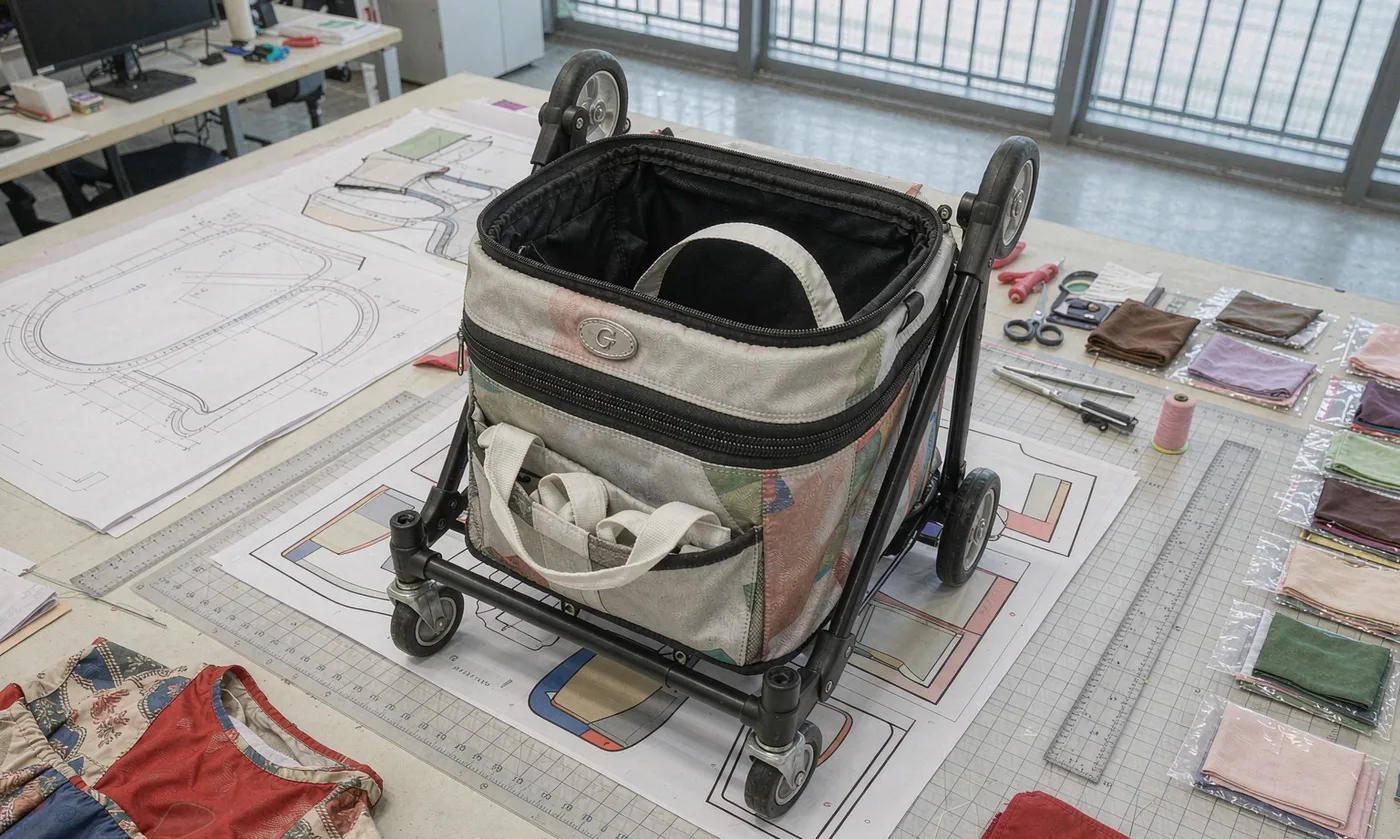
The cost of a change is not constant. It depends on which round it happens in, because each round commits a different set of resources, and the commitments accumulate. The table below is the working pattern for a soft-sided pet bag programme and gives the shape of that accumulation.
| Round | Working days | Question the round closes | Typical fee treatment | Cost of a change made in this round |
|---|---|---|---|---|
| Round 1 | 6-10 | Structure, proportions, closure geometry | Standalone sample fee, sometimes credited | Sample fee only; no material or tooling committed |
| Round 2 | 6-10 | Materials, hardware, finishing, branding | Fee usually credited against the bulk order | Re-cutting and re-sampling; trim already ordered |
| Round 3 | 6-10 | Reproducibility, packaging fit, pre-production check | Credited; treated as pre-production sample | Pattern amendment and material already bought for bulk |
| Round 4+ | 6-10 each | Usually an unresolved round-one or two question | Charged at cost | Bulk slot pushed; risk of air freight to recover |
Two things in that table deserve emphasis. The first is that the day count per round does not grow; what grows is the consequence. A change in round one costs a fee, a change in round two costs a re-cut, and a change in round three can cost material that has already been booked against the order. Same change, three very different prices.
The second is what round four and beyond actually indicate. In most programmes a fourth round is not evidence of a difficult product; it is evidence that a question from round one or two was never closed and has resurfaced in a more expensive place. Diagnosing that early is worth more than any sampling speed.
A pet carrier wholesale price agreed before the specification is locked is provisional, and re-quoting after a late change is the normal consequence. Read the fee treatment column carefully as well. Whether a sample fee is credited against the bulk order is a commercial term that should be stated in writing at the outset, because it is one of the few places where pet bag sample cost is genuinely negotiable and it is often left vague until it becomes an argument.
The Cost of a Change by Category
Not all changes are equal, and categorising them helps a buyer decide which are worth making late. Four categories cover most of them, and they behave very differently.
Pattern changes are the most consequential. A change to a panel shape, a seam position or a dimension affects the marker, the cutting and every subsequent sample, and it invalidates any fit testing already done. Pattern changes belong in rounds one and two and should be considered unacceptable after round three, not because the supplier will refuse but because the downstream effects are wide.
Material changes are the second category and the most deceptive, because they look simple. Changing a lining or a mesh appears to be a substitution, but it resets the material buy, which may already have been placed against a lot price, and it can reset any test report issued against the previous material. If the article carries a compliance claim, a late material change can invalidate the documentation supporting it, which is a far bigger problem than the change itself.
Hardware changes sit in the middle. Changing a buckle or a zipper after round two is usually feasible, because hardware is bought against its own lot and can be swapped, but it affects the load paths and therefore any strength testing already completed. Where a rating matters, re-testing follows, and re-testing takes calendar time rather than money.
Cheap pet carriers wholesale programmes are especially exposed at this point, because a late material change on a tight cost specification often leaves a worse substitute as the only available option. Colour changes are the cheapest and the most commonly made late, and they are the ones buyers should be most willing to defer. A colourway adjustment can often be handled as a production instruction rather than as a new sample, provided the material is available in the new shade. Deferring colour decisions to the bulk instruction, while locking structure and material early, is one of the most effective ways to reduce round count without accepting a worse product.
The rule that follows from the four categories: make structural decisions early, material decisions early, hardware decisions early, and colour decisions last. The order is the reverse of the order in which most buyers raise them.

Rounds Two and Three: Where Programmes Stall
Round two is where most programmes lose time, and the reason is predictable: it is the round in which the buyer's organisation discovers the product. Merchandising sees it for the first time, compliance looks at the claims, packaging tries to fit it into a carton, and each of them produces a change request that nobody had raised before.
This is not dysfunction; it is the normal cost of a first physical article. The failure is procedural rather than organisational: the change requests arrive sequentially over three weeks instead of in one consolidated list. Each arrival restarts the clock, and a supplier receiving a new change every few days cannot batch the work, so the round stretches from eight working days to twenty-five.
For a pet bag wholesale business the pattern is expensive precisely because it repeats on every new style. The fix is a consolidation gate. When the round-two sample arrives, circulate it to everyone who has an opinion, set a fixed internal deadline of five working days, and produce one combined change list with each item marked must-change, should-change and defer. Send that list once. Suppliers can batch a consolidated list into a single build; they cannot batch a stream.
Round three stalls for a different reason: it is the round where reproducibility is tested, and reproducibility is boring. The sample looks right, so the temptation is to approve and move to bulk. That is exactly the point at which a second unit should be requested, because a single hand-made sample proves the design can be made once, not that it can be made five hundred times.
Ask for two units in round three and evaluate them against each other rather than against the brief, and set the tolerance question by fixing the AQL level applied at release before production starts. Differences in seam alignment, panel symmetry, base flatness and hardware placement between the two units are the tolerances the bulk run will inherit. If the two differ visibly, the bulk run will differ more.
Where a late change forces a re-quote, pet carrier wholesale price usually rises, because the material buy has already been placed and the lot price no longer applies. Where a programme needs dimensional compliance, such as an airline cabin bag, round three is also the point at which the dimension should be verified against the carrier's published rule rather than against the drawing. Air transport requirements are set out in the live animal regulations published by IATA, and a bag that measures correctly when empty can measure differently when loaded.
Writing the Approval Criteria Before the First Sample Arrives
The cheapest way to reduce round count is to decide what approval means before the first sample exists. Without a written criterion, approval becomes a feeling, feelings differ between the people evaluating the sample, and the sample goes round again while the group converges on a standard it never defined.
A usable approval document is short and it lists tests rather than adjectives. It should state the dimensional tolerances that will be accepted, the load the article must carry and how that will be checked, the closure cycles it must survive, the airflow requirement if one is claimed, and the cosmetic standard with a reference rather than a word. Where a claim is made, the document should name the test method; strength and abrasion methods published by ASTM International give both parties a shared reference and remove the argument about what durable means.
Where the article is a new structure rather than a repeat, ODM development adds a round and should be planned into the calendar. The document should also state who approves. A single named approver with a deadline closes rounds; a committee that approves by consensus does not. Where several functions must be satisfied, name one person to consolidate and give them the authority to accept a deferral.
State how pet bag lead time is measured and when the clock starts, so a slow approval does not become a dispute about who caused the delay. Include the packaging fit in the same document. A sample approved without its carton frequently turns out not to fit the intended carton, and the resulting change is a late one with freight consequences. Approve the product and its pack together.
Finally, state what happens to the fee and to the calendar if the criteria change mid-programme. A buyer who changes the standard halfway through is effectively starting a new round, and saying so in advance keeps the conversation honest when it happens.
One sentence worth putting at the top of the document: approval means the sample meets this list, and any item not on this list is not grounds for rejection. That single line removes most of the scope creep that turns three rounds into six.
Compressing Rounds Without Skipping Them
Compression and skipping are different things, and confusing them is how programmes end up in bulk with an unresolved design. Compression reduces the elapsed time inside a round; skipping removes a round's question, which means it gets answered later at greater cost. The first is worth pursuing aggressively and the second is worth refusing.
Five compression techniques work without risk. The first is parallel evaluation: send the round-one sample to the buyer and to any third-party reviewer at the same time rather than sequentially, which typically saves a week. The second is a standing internal deadline of five working days for consolidated feedback. The third is approving structure, material and colour on separate tracks, so a colour decision does not hold up a structural one. The fourth is requesting two units in the final round rather than approving one and discovering tolerance later. The fifth is booking the bulk slot conditionally at the start of the final round, so production starts the day approval lands rather than the day it is scheduled.
What does not work is starting bulk before approval. A programme that begins cutting on the assumption that round three will pass saves at most eight working days and risks the entire run, because a change discovered after cutting is a change applied to finished goods.
Neither does compressing by removing the pre-production check. The final sample is the only evidence that the production line, not the sample room, can make the article, and the sample room is always better at it than the line is. Removing that check transfers an unknown into a 500-piece commitment.
The realistic best case for a new structure is three rounds at roughly eight working days each plus two evaluation windows of five days, which is about thirty-four working days end to end. Programs that beat that do so by deciding well, not by sampling faster.
Recognising the Point of Diminishing Return
Every programme reaches a point where another round produces less improvement than it costs, and recognising that point is a commercial judgement rather than a technical one. Three signals indicate it has arrived.
The first signal is repeated items. If the same change appears on the change list in two consecutive rounds, the problem is not the sample; it is either an ambiguous instruction or a manufacturing capability limit. Both need a conversation rather than another round, and the conversation is cheaper.
The second signal is cosmetic-only feedback. Once a round produces nothing but stitch-alignment and panel-symmetry comments, the structure is settled and the remaining items are production tolerances that belong in the inspection standard rather than in the sample. Move them to the AQL criteria and approve.
The third signal is calendar pressure. When the remaining rounds would push bulk past the sea-freight window, the correct response is not to skip a round but to reduce the first order quantity and protect the schedule. A smaller first buy that ships by sea is usually better business than a full buy that ships by air, and the arithmetic is straightforward once freight is modelled.
On cheap pet carriers wholesale programmes the temptation is to accept the first sample that looks acceptable, which is exactly when a second matched unit is most valuable. There is also a signal that more rounds are genuinely needed, and it is worth naming: a change in the target market's compliance requirement, a change in the dimensional rule for an airline-compliant article, or a material failure in testing. In those cases an extra round is cheap relative to the alternative.
The general principle: a further round is justified when it closes a question that would otherwise be answered by a customer, and it is not justified when it addresses a preference that could be handled as a production tolerance. Buyers who apply that test rarely exceed three rounds, and the ones who ignore it routinely reach six and pay for the extra three in freight.
Any competent pet bag buyer guide should include this test, because it is the difference between a sampling process that protects the launch and one that delays it.
Production capability
- SGS-verified production space of 4,950 m², 149 machines, 7 assembly lines
- Pet bag output since 2014 from a 137-person team
- 200,000 units shipped monthly under BSCI and ISO 9001 systems
People Also Ask
How many sample rounds does a pet bag programme need?
Three on average, at 6-10 working days each, plus an internal evaluation window per round. Four is common on a new structure and six usually means an earlier question was never properly closed rather than that the product is difficult.
What does a sample round cost?
The fee is the smaller part; the calendar is the larger one. Pet bag sample cost escalates with the round because later rounds have material, trim and pattern work already committed, and an extra round can push the bulk slot past the sea-freight window.
Which changes are cheapest to make late?
Colour changes, which can often be handled as a production instruction rather than a new sample. Pattern and material changes are the most expensive late, because they reset the marker, the material buy and any test report issued against the previous material.
How do I reduce the number of sample rounds?
Write the approval criteria before the first sample arrives, name a single approver with a deadline, and consolidate feedback from every function into one change list per round. Most extra rounds come from sequential rather than batched feedback.
Should I approve on a single sample?
No. Request two units in the final round and compare them against each other. A single hand-made sample proves the design can be made once, not that a line can reproduce it five hundred times within tolerance.
When should I stop sampling and approve?
When a round produces only cosmetic feedback, when the same item has appeared twice without resolution, or when further rounds would push bulk past the sea window. Move cosmetic items into the inspection standard rather than into another round.
Frequently Asked Questions
What is a sample round in pet bag sourcing?
A decision cycle with four parts: a build, an evaluation, a consolidated change list and an approval or rejection. It is not a duration, and treating it as a stage with a length is the usual reason sampling overruns.
Why does the buyer control most of the sampling time?
Because the build is typically 6-10 working days while internal evaluation often takes longer. Programmes that track supplier days but not their own approval loop usually misdiagnose where the delay is.
What should round one be evaluated on?
Structure, proportions, closure geometry, ventilation under load and base stability. Colour, trim and branding belong in round two, and evaluating them in round one wastes the round.
Is the sample fee credited against the bulk order?
Often, but it is a commercial term that should be stated in writing at the outset. Fee treatment is one of the few genuinely negotiable parts of sampling and is frequently left vague until it becomes a dispute.
What is a pre-production sample?
The final sample made on the production line rather than in the sample room, used to confirm reproducibility and packaging fit. It is the only evidence that a line can make the article, not just that a sample maker can.
Can a material change invalidate a test report?
Yes. Reports are issued against a specific material, so changing a lining or mesh after testing can invalidate the documentation supporting a compliance claim. That is a bigger problem than the change itself.
How do I handle change requests from several departments?
Set a fixed internal deadline of five working days, circulate the sample to everyone at once, and send one consolidated list with items marked must-change, should-change and defer. Suppliers batch a single list; they cannot batch a stream.
What dimensional rules apply to airline-compliant pet bags?
Carrier rules vary and are published in the live animal regulations. Verify the dimension on a loaded sample in the final round, because a bag that measures correctly empty can measure differently with an animal inside.
Should bulk start before final approval to save time?
No. Starting cutting on the assumption that the final round will pass saves at most eight working days and risks the entire run, because a change found after cutting applies to finished goods.
What belongs in a written approval criterion?
Dimensional tolerances, the load and how it will be checked, closure cycles, airflow if claimed, a cosmetic standard with a reference, packaging fit, the named approver, and the test method for any claim made.
How can I compress sampling safely?
Parallel evaluation, a five-day internal deadline, separate tracks for structure and colour, two units in the final round, and a conditionally booked bulk slot. Compression inside a round is safe; removing a round is not.
What is the realistic best case for a new structure?
About thirty-four working days: three rounds at roughly eight days each plus two five-day evaluation windows. Programmes that beat that do so by deciding well rather than by sampling faster.
Talk to QUANZHOU JUNYUAN BAGS about a wholesale pet bag order: MOQ 500 pieces per colourway, samples in 6-10 working days, bulk production in 35-50 days under AQL 2.5 inspection.
Get a free quote Request a sample