Pet Beach Bag: Summer Style Sourcing for Seasonal Bulk Orders
A wholesale pet beach bag should be specced at 20-28 L with solution-dyed or UV-stabilised 600D polyester, PVC-free drainage mesh, corrosion-resistant hardware and a colour-fastness to light rating of grade 4 or better. Expect USD 8.60-15.20 FOB Xiamen. Orders run at MOQ 500 pcs per colourway, sample in 6-10 working days and ship 35-50 days after approval under AQL 2.5.
Executive Summary
This guide covers the seasonal beach programme: the highest-risk, highest-reward SKU in a lifestyle pet bag assortment. It sells in a compressed window, it is exposed to the harshest environment any bag in the range will face, and a late delivery cannot be recovered by discounting because the season ends regardless.
Our production team runs these programmes at MOQ 500 pcs per colourway, with mixed colourways permitted in one order. Samples take 6-10 working days after tech pack confirmation; bulk runs 35-50 days after approval. Shipments are offered to AQL 2.5 pre-shipment inspection on T/T 30/70 against FOB Xiamen, and DDP can be quoted alongside for buyers who prefer a single landed number.
The three variables that determine whether a beach season is profitable are booking freight early, specifying for salt and UV at design stage, and sizing the buy so that end-of-season markdown is a choice rather than a rescue. A fourth is the colourway decision, which carries more risk in a seasonal programme than in any year-round category. A neutral body with a seasonal accent protects the buy if the trend moves before the goods land.
Where to buy pet bags wholesale is less a question of directory listing than of Pet Bag Types & Styles verification - ask for the test report before the price list. Pet bag wholesale vendors who can name the fabric mill will usually also name the failure mode, which is the fastest way to separate a real programme from a catalogue.
Why the Beach Bag Is a Seasonal Programme, Not a Year-Round SKU
A beach-positioned pet bag has a selling window of roughly fourteen to eighteen weeks in a temperate market, and a materially shorter one in the northern European markets that dominate European summer volume. Everything about the programme - order size, freight mode, colour count and markdown plan - follows from that fact. Treating it as a permanent catalogue SKU is the single most common and most expensive error in this category.
The commercial consequence is that the buy decision is made against a forecast, not against a reorder signal. By the time sell-through data arrives, there is no time to reorder: sampling and production alone exceed the remaining window. Buyers therefore need a different planning discipline here than for a work bag or a weekender, and the discipline is conservative sizing plus early freight.
- Selling window: 14-18 weeks in temperate markets, 8-12 weeks in northern Europe.
- Reorder possibility: effectively zero within the same season for sea-freight programmes.
- Air-freight rescue: possible but at 4-6 times sea cost, which usually destroys the margin.
- End-of-season: markdown to 40-60% off, or carry to the following year at holding cost.
- Channel: coastal retail, resort and hotel shops, summer gift programmes, marketplaces with seasonal search spikes.
There is one structural way to reduce the risk, and it is worth naming early: design the beach SKU so it can be repositioned for the following season's general outdoor range with only a hangtag and photography change. A bag in a neutral colour with a removable summer-themed label can be relisted as an outdoor or travel bag in September, which converts dead stock into slow-moving stock.
The second structural point is that the beach bag is often the entry purchase for a new customer. It is inexpensive, giftable and seasonal, and it introduces the brand. That argues for protecting quality even at a compressed price point, because the review generated in July affects the conversion rate of every other SKU in the range for the rest of the year.
Material Performance Against Sand, Salt and UV
Beach conditions attack a bag from three directions at once: abrasive sand at every seam and zip, salt spray that drives corrosion, and ultraviolet exposure that fades colour and degrades coating. A specification that addresses only one of the three will fail in the field, and the failure will appear in reviews during the compressed window when there is no time to fix it.
Fabric choice should start with the dyeing method. Solution-dyed or UV-stabilised polyester holds colour dramatically better under sunlight than piece-dyed fabric, and the cost difference of USD 0.30-0.80 per unit is trivial against a faded-collar return. Colour fastness to light should be specified to a named test method with a minimum grade, and that grade belongs in the tech pack rather than in a conversation.
| Exposure | Failure mode | Specification answer | Cost impact |
|---|---|---|---|
| Sand | Zip jam, seam abrasion | Reverse-coil zips with a covered garage; bound internal seams | + USD 0.25-0.55 |
| Salt spray | Hardware corrosion, staining | Stainless or coated hardware; salt-spray test on finish | + USD 0.35-0.90 |
| UV | Colour fade, coating chalking | Solution-dyed polyester, UV-stabilised coating | + USD 0.30-0.80 |
| Heat | Adhesive softening, foam odour | High-temperature-stable adhesive; closed-cell foam only | + USD 0.15-0.40 |
| Water | Lining wicking, slow drying | PVC-free coated lining, drainage mesh base panel | + USD 0.40-0.85 |
Hardware is the component most often under-specified. Standard zinc-alloy hardware in a nickel finish will show corrosion after a handful of salt-air exposures, and it stains the fabric around it, which makes the bag look older than it is. Stainless steel or a properly coated alloy with a documented salt-spray result is the correct answer for any programme that will be sold within five kilometres of a coast.
Coatings and adhesives deserve a specific question at quoting stage, because heat is the hidden failure mode. A base board laminated with a standard adhesive can soften in a hot car or on hot sand, and the result is a bag that loses its floor. Ask for the adhesive's temperature rating and for closed-cell foam rather than open-cell anywhere in the build.
Verification should be method-named. Colour fastness to light and to rubbing, and abrasion resistance, are normally measured to AATCC textile test methods, and a result quoted without a method number cannot be enforced when a shipment differs from the sample.
Drainage, Drying and Quick-Dry Construction
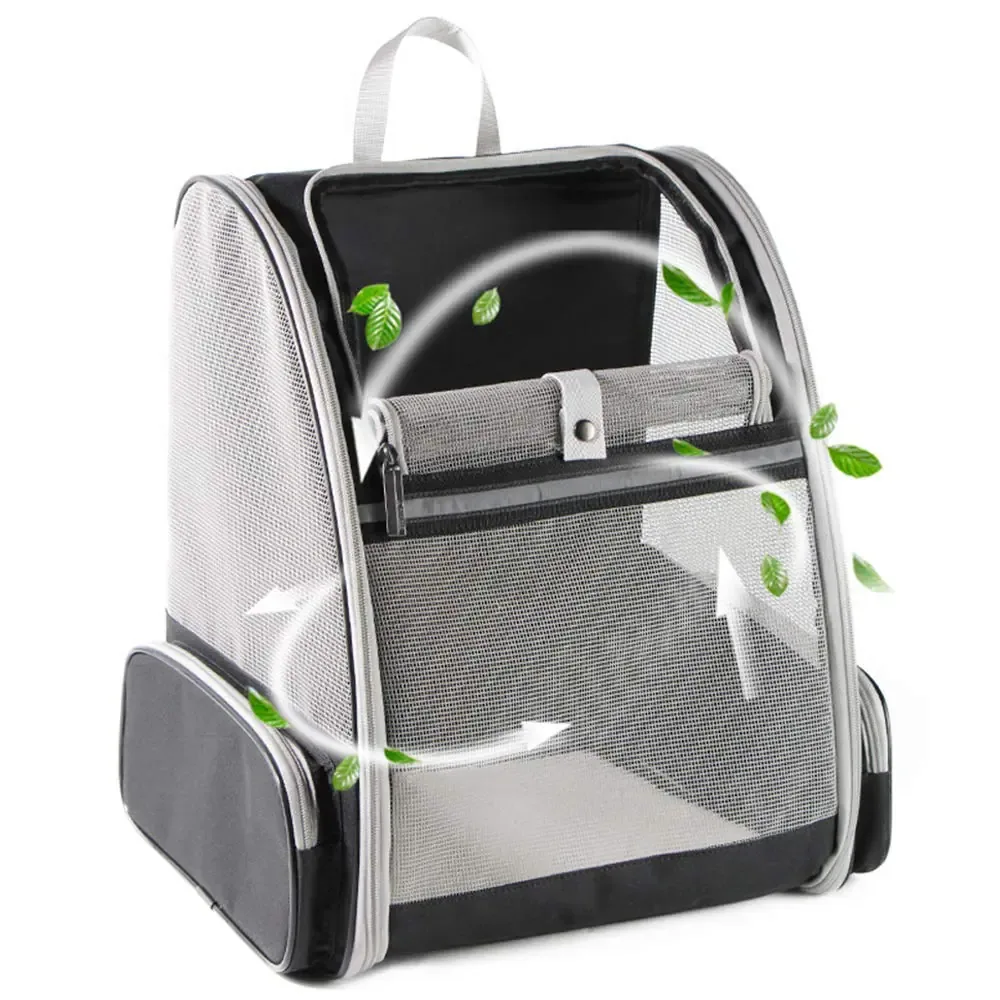
Water management separates a beach bag that works from one that merely looks like a beach bag. A pet that has been in the sea carries litres of water into the bag; sand comes with it; and if there is nowhere for that to go, the lining stays damp for days and the bag develops odour before the season is out.
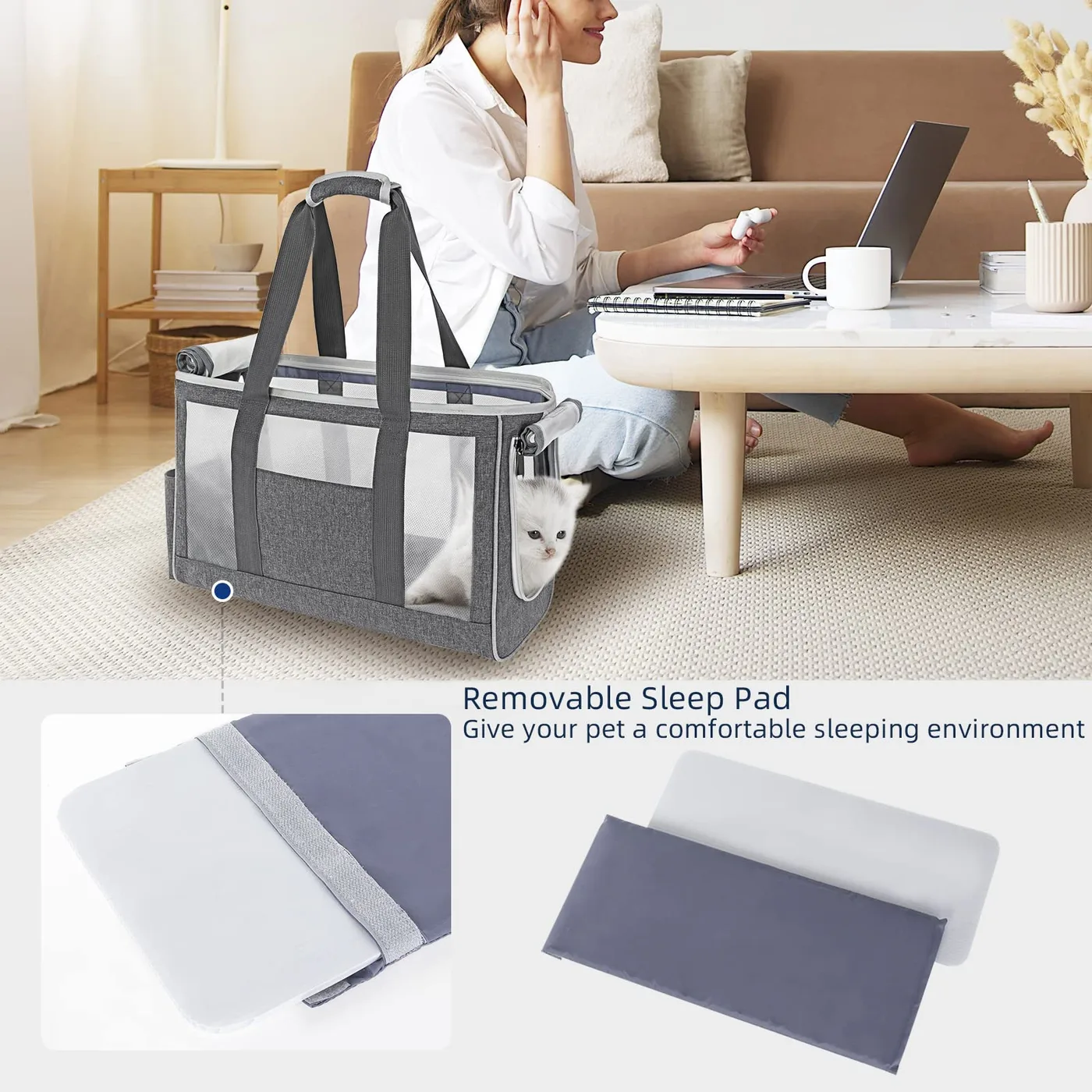
The effective construction is a drainage floor: a PVC-free coated mesh panel across the lowest section of the pet cavity, sitting above a shallow sump with two or three drainage grommets at the low corners. Water and sand pass through, and the animal's resting surface is a removable pad that sits above the mesh and dries independently. This is a genuine design feature, it photographs well, and it costs USD 0.45-0.95.
Sand management is a separate problem and it has a simpler answer: bound internal seams. Raw or overlocked internal seams trap sand permanently, and the customer's experience is a bag that grits forever. Binding every internal seam adds labour and roughly USD 0.30-0.60, and it is the detail most often cut to hit a price.
- Drainage: coated mesh floor panel with two to three grommets at the low corners.
- Resting surface: removable closed-cell pad with a coated cover, drying independently of the shell.
- Seams: all internal seams bound; no exposed overlock in the pet cavity.
- Zips: reverse-coil with a fabric garage to keep sand out of the teeth.
- Pockets: at least one external wet pocket with a mesh base for a bottle or a damp towel.
Drying time should be a specified and measured target, not an aspiration. A sensible brief is that a fully wetted bag drains to touch-dry within four hours in shade at 25 degrees Celsius, and that the removable pad dries within two. Put those numbers in the tech pack and test the sample in a garden rather than trusting the material data sheet.
Finally, think about where the bag goes after the beach. It goes into a car, onto a hotel floor and into a hallway. A coated base that does not wick and feet that keep it off wet ground are the difference between a bag that survives the summer and one that is thrown out in August.
Shade and thermal design for hot climates
Heat is a welfare issue as much as a comfort one. A dark-coloured bag on hot sand can reach internal temperatures well above ambient within minutes, and a pet inside it is at risk. Specify light-colour linings for warm-market programmes, a minimum mesh area across two opposite panels, and a roll-back top that gives shade and airflow. State the operating limit in the instruction insert: never leave an animal in a closed bag in direct sun.
The second thermal decision is the colour of the shell itself. A dark body absorbs substantially more radiant heat than a light one, and on a beach that difference is measured in degrees inside the cavity. Where the brand's palette allows it, a light or mid-tone body is a genuine welfare improvement as well as a commercial one, and it is worth raising with the brand team before the colourway is fixed.
Third, consider an insulating shade flap: a light-coloured panel that can be deployed over the top of the pet cavity when the bag is stationary. It costs USD 0.40-0.90, it is visible in photography as a feature, and it materially reduces internal temperature in direct sun. Very few programmes specify it and customers notice immediately when it is present.
A fourth point belongs on the insert rather than in the build: water. Saltwater and sand irritate skin and paws, and a pet that has been in the sea should be rinsed before a long period in the bag. Stating that plainly is a welfare measure and it also reduces the staining complaints that otherwise arrive as reviews.
Colour, Print and the Summer Trend Cycle
Colour carries more commercial weight in a seasonal programme than in any year-round category, and it carries more risk. A summer palette that is right sells through at full price; a palette that is six months late reads as last year's product and gets marked down. The decision is therefore a forecasting exercise as much as a design one.
The structure that reduces the risk is a neutral body with a seasonal accent. A sand, stone or navy body with a bright accent on the webbing, zip tape and hangtag gives the seasonal read without committing the entire buy to a trend colour, and it is the same logic that works in fitness assortments. If the season's bright turns out to be wrong, the body colour still sells.
- Body: sand, stone, navy or olive - neutral enough to survive a trend cycle.
- Accent: the seasonal bright, on webbing, zip tape, pullers and the hangtag.
- Print: a small-scale placement print reads seasonal at low cost; an all-over print commits the whole dye lot.
- Hangtag: the cheapest place to change the seasonal story, and the cheapest thing to reprint.
- Photography: shoot the neutral body as the hero image so the listing survives into autumn.
Print method matters for a different reason. Sublimation on polyester gives colour depth and pattern definition at moderate order sizes, while pigment printing is cheaper and flatter. Whichever is used, insist on a strike-off approved in daylight, because summer colour shifts visibly under showroom lighting and the customer will see it on a beach.
Colour fastness to light is a specification issue as much as an aesthetic one, and it deserves a number in the tech pack rather than a conversation. A bright accent that fades to a different hue after three weeks of sun is a return waiting to happen, and it is entirely preventable by specifying solution-dyed yarn for the accent components.
Finally, plan the photography alongside the colour decision. A beach bag shot against grey studio background converts at a lower rate than the same bag shot in context, and context shots have to be taken in season or they have to be shot the previous year. That is another reason the calendar has to run backwards from the selling window rather than forwards from the sample.
Cost Structure and the True Cost of a Seasonal Miss
The quoted FOB is only part of the cost of a beach programme. The relevant calculation is landed cost plus the expected cost of getting the size wrong, and the second term is usually larger than buyers expect.
| Build level | Specification | FOB band | Landed, sea | Target retail |
|---|---|---|---|---|
| Entry | 600D polyester, standard hardware | USD 8.60-10.80 | USD 10.10-12.60 | USD 39-52 |
| Mid | Solution-dyed 600D, coated hardware, mesh floor | USD 11.20-13.90 | USD 12.90-15.90 | USD 55-72 |
| Premium | UV-stabilised recycled fabric, stainless hardware | USD 13.80-17.40 | USD 15.70-19.70 | USD 75-98 |
Landed figures here assume sea freight on a reasonably dense carton and exclude duty, which varies by classification and by market. The point worth taking is the ratio: freight and duty typically add 15-25% to FOB for a sea programme, and air freight adds 60-120%. A two-week delay that forces air freight on half the order can consume the entire season's gross margin.
The cost of over-buying is equally quantifiable. Unsold seasonal stock marked down to 50% off converts a 55% gross margin into a small loss once holding cost and handling are included, and the cash is tied up for up to ten months. Buying 20% fewer units than the optimistic forecast and selling out in August is almost always more profitable than buying to the forecast and marking down in September.
The cost of under-specifying is the hardest to quantify and the most damaging, because it arrives as reviews. A faded, corroded, sand-logged bag generates one-star reviews in July, and those reviews sit on the listing for every other SKU in the range. Budget the USD 0.90-2.25 that the environmental specification costs; it is the cheapest insurance in the programme.
MOQ, Colourways and Consolidating a Summer Buy
The standard MOQ 500 pcs per colourway applies, and for a seasonal programme the colourway decision deserves more thought than usual. Beach assortments want bright, saturated colour, and saturated colours are exactly where dye-lot consistency is hardest. Two practical rules follow: keep the colourway count low, and approve physical swatches under daylight rather than under showroom lighting.
Consolidation is the main economic lever. A summer buy that includes a beach bag, a picnic bag and a lightweight travel bag can share fabric, hardware, lining and a single inspection booking. Placed as one production slot, that consolidation is worth several percent per unit and, more importantly, it reduces the number of moving parts in a calendar that has no slack.
- First season: 1,000-1,500 pcs across two or three colourways - deliberately conservative.
- Second season: buy to the prior year's sell-through curve, not to the forecast.
- Shared components: one fabric, one lining, one hardware finish across the summer family.
- Branding: one woven label loom setup reused across all summer SKUs.
- Packaging: a single carton spec to simplify receiving at the warehouse.
For buyers selling into both hemispheres, there is a genuine arbitrage worth considering: the same SKU sells in the northern summer and the southern summer, twelve weeks apart. Two buyers, or one buyer with both markets, can share a production slot and split the freight, which improves the economics of the specification upgrades described above.
One caution on colour naming and packaging: resort and hotel channels frequently require a neutral or branded colour rather than the seasonal bright. If that channel is in the plan, run the bright colourway as a removable hangtag story on a neutral body rather than committing the whole buy to one palette.
Working with a split shipment
One structural tool deserves more use than it gets in seasonal programmes: splitting the shipment. Rather than shipping the whole order on one vessel, send 60-70% in the early sailing to cover the opening weeks of the season and hold the remainder for a second sailing three to four weeks later.
The economics are favourable. The early portion arrives before congestion risk and before peak surcharges build; the second portion can be redirected, air-freighted in a smaller volume if demand is strong, or cancelled into a markdown plan if it is not. The cost is a second freight booking and a slightly worse per-unit rate on two smaller shipments, typically 3-6% more freight in total.
That premium buys genuine optionality in a category where the alternative is a single irreversible bet on a forecast. For a first season in particular, when there is no sell-through history to plan against, the split is usually the right structure.
The split also improves the quality of the data. The first sailing's sell-through rate arrives while there is still time to act on the second, which converts a seasonal bet into a managed programme. Buyers who use it consistently tend to reduce both stockouts and markdowns in the second season, because they have a real demand curve rather than a forecast.
There is one condition: the two sailings have to be genuinely separate bookings, not one booking split at the destination. If both portions travel on the same vessel the congestion risk is shared and the structure achieves nothing except an extra handling cost. Confirm the vessel schedule with the forwarder in writing.
Freight, Customs and the Seasonal Booking Calendar
Freight is where beach programmes are won or lost. Peak season surcharges, equipment shortages and port congestion all cluster in exactly the weeks a summer programme needs to ship, and booking late is the most reliable way to turn a profitable season into a marginal one.
| Milestone | Target | Why it matters |
|---|---|---|
| Tech pack and colour approval | September | Solution-dyed fabric lead times |
| Structure and colour samples | October | Physical swatches under daylight |
| Bulk production slot | November to December | Before the pre-Chinese-New-Year rush |
| Book sea freight | At production start | Peak surcharges build from spring |
| Sail and clear customs | January to February | Avoids the congestion peak |
| On shelf | Late April | Ahead of the selling window |
The critical line in that table is the production slot. Programmes that start bulk in January compete with the pre-holiday shipping surge for both line capacity and containers; programmes that start in November arrive before it. The difference is measured in weeks of delay and in percentage points of freight cost.
Customs classification is a smaller but real risk. Pet bags are classified differently from pet carriers in several tariff schedules, and an incorrect declaration discovered at clearance costs days. Confirm the classification with a broker before the first shipment rather than after a delay, and keep the ruling on file for reorders.
Finally, build a buffer for the inspection gate. AQL 2.5 inspection takes two to three days including the re-check if a first inspection fails, and a failed inspection on a seasonal programme is the most expensive kind of delay because it cascades directly into freight booking. Book the inspection with a named date at the start of production.
Building a two-season colourway plan
The most effective defence against end-of-season markdown is to plan colourways across two seasons rather than one. Choose a body colour that will still be current in the following year - sand, stone, navy or olive are safe across several cycles - and let the accent colour and the hangtag carry the seasonal read.
With that structure, unsold stock does not need to be discounted into a dead season. It can be held, re-hangtagged and relisted in the following year with the new accent, or sold into a market whose season runs in the opposite half of the calendar. The holding cost is real but it is materially lower than a 50% markdown.
The discipline this requires is restraint at the design stage: resisting the all-over seasonal print that looks excellent in the range review and cannot be sold in year two. That restraint is usually worth more than the design win.
The same logic applies to the photography and to the listing copy, which should be written for the neutral body rather than for the seasonal accent. Listings built around a seasonal colour lose relevance the moment the season ends, and rebuilding them costs more than writing them conservatively in the first place.
Finally, agree the markdown trigger in advance. A pre-agreed rule - for example, markdown when four weeks of the window remain and sell-through is below a stated percentage - removes the emotional decision that otherwise happens in September, and it usually recovers more cash than a late, deeper discount.
Compliance, Labelling and End-of-Season Planning
A beach bag sold in summer is still a consumer product with the same obligations as any other SKU in the range, and the seasonal channels add a few of their own. Resort and hotel shops, in particular, often require supplier insurance documentation and packaging that meets their receiving specification.
For the US, general consumer-product obligations and recall traceability sit with the US Consumer Product Safety Commission, and the practical requirement is a batch code on the product with retained production records. California exposure warnings are administered by OEHHA; coatings, UV stabilisers and hardware finishes are the usual questions.
For the EU, REACH restrictions apply to coatings and hardware, and single-use-plastic and packaging-waste rules affect both the bag and its packaging. A PVC-free coated lining - which the drainage design wants anyway - also simplifies the chemical declaration, which is a useful alignment of commercial and compliance incentives.
- Batch code on the product, retained production record for 24 months.
- Fibre composition and country of origin in the importing market's format.
- Instruction insert: weight rating, drainage care, sun and heat warning, tether use.
- Test reports: colour fastness to light and rubbing, abrasion, salt-spray on hardware, chemical screens as requested.
- Carton marking and barcode to the retailer's receiving specification.
End-of-season planning should be decided before the season starts, not during it. Three options exist and each has a place: markdown in the final four weeks of the window; transfer to a non-seasonal listing with a hangtag and photography change; or carry to the following year, which is only rational if the colour was chosen to be neutral enough to survive a trend cycle.
On the manufacturing side, an ISO 9001 quality management system is what makes next season's order match this season's, and independent verification through SGS testing and inspection gives the retail buyer a name they recognise on the file. Our SGS-verified production base runs seasonal slots with pre-booked inspection dates for exactly this reason.
Order and quality terms
- MOQ 500 pieces per colourway; samples in 6-10 working days
- Bulk production 35-50 days after approval; AQL 2.5 inspection standard
- T/T 30/70 terms, FOB Xiamen, full document set per shipment
People Also Ask
What size pet beach bag do I need?
20-28 L for a pet of 5-9 kg plus towel, bottle and sunscreen. Below 20 L the wet gear has nowhere to go; above 28 L it stops reading as a beach bag.
How do you keep sand out of a pet bag?
Bind every internal seam so sand cannot lodge in overlock, use reverse-coil zips with a fabric garage, and put a drainage mesh floor in the pet cavity so sand falls through rather than sitting in the lining.
Is a mesh pet bag safe at the beach?
Mesh panels are fine for airflow, but the animal needs a firm, non-abrasive resting surface above the mesh and shade from direct sun. Never leave a pet in a closed bag on hot sand.
How quickly should a beach pet bag dry?
A sensible brief is touch-dry within four hours in shade at 25 degrees Celsius, with the removable pad drying within two. Specify it as a number and test the sample.
Can the same SKU sell in both hemispheres?
Yes. Northern and southern summers are roughly twelve weeks apart, so one production slot can serve both markets and split the freight cost.
Should a first beach order be large or small?
Deliberately conservative - 1,000-1,500 pcs. Selling out in August is more profitable than marking down in September once holding cost is counted.
What colour works best for summer pet bags?
Bright seasonal colour sells, but a neutral body with a seasonal hangtag protects against end-of-season markdown and suits resort channels.
Frequently Asked Questions
When should a summer beach programme start production?
Bulk should start in November or December for a late-April shelf set. Starting in January means competing with the pre-holiday surge for line capacity and containers, which costs weeks and percentage points of freight.
What fabric holds colour best in sunlight?
Solution-dyed or UV-stabilised polyester, specified with a minimum colour-fastness-to-light grade tested to a named method. The cost premium of USD 0.30-0.80 is small next to the cost of faded returns.
How should hardware be specified for coastal markets?
Stainless steel or a properly coated alloy with a documented salt-spray result. Standard nickel-finished zinc alloy corrodes after a few salt-air exposures and stains the surrounding fabric.
What is the MOQ for a pet beach bag?
MOQ is 500 pcs per colourway with mixed colourways permitted in one order. A first season of 1,000-1,500 pcs across two or three colourways is deliberately conservative.
How long do samples take?
6-10 working days per round after tech pack confirmation. For a beach programme, budget a second round to approve physical colour swatches under daylight.
How long is bulk production?
35-50 days after sample approval, plus 30-45 days for sea freight and customs. Air freight is possible at 4-6 times sea cost but usually destroys the margin.
How does the bag handle sand and water?
A coated drainage mesh floor with grommets at the low corners, bound internal seams so sand cannot lodge, reverse-coil zips with a garage, and a removable coated pad that dries separately.
How much does a wholesale pet beach bag cost?
USD 8.60-10.80 FOB Xiamen for an entry build, USD 11.20-13.90 for a mid build with solution-dyed fabric and coated hardware, and USD 13.80-17.40 for a premium UV-stabilised recycled build.
Can unsold summer stock be relisted?
Yes, if the body colour is neutral. A hangtag and photography change can reposition the same bag as an outdoor or travel SKU for autumn, converting dead stock into slow-moving stock.
What inspection standard applies?
AQL 2.5, booked with a named date at the start of production. On a seasonal programme a failed inspection is the most expensive kind of delay because it cascades into freight booking.
Which documents do resort and hotel channels require?
The standard retail pack plus, often, supplier insurance documentation and packaging to their receiving specification. Confirm before the buy rather than after it.
Is air freight worth it to rescue a late season?
Rarely. At 4-6 times sea cost it usually consumes the season's gross margin. Buying conservatively and shipping early is the better hedge against both over- and under-stock.
Talk to QUANZHOU JUNYUAN BAGS about a wholesale pet bag order: MOQ 500 pieces per colourway, samples in 6-10 working days, bulk production in 35-50 days under AQL 2.5 inspection.
Get a free quote Request a sample