Pet Backpack: Hands-Free Travel
Short answer: a pet backpack program works when three things are specified together — interior volume matched to a real weight band, a harness system that transfers load to both shoulders and the hips, and ventilation area on at least two opposing faces. Standard terms are MOQ 500 pieces per colour, 6-10 working days for sampling, 35-50 days for bulk production and AQL 2.5 final inspection.
Pet backpacks are the format where engineering and channel expectations meet most directly. They promise hands-free carry, which means the load is borne entirely by the harness system, and they are frequently sold with travel positioning, which means dimensions and claims attract scrutiny from customers and marketplaces alike. Our production team specifies backpack programs on MOQ 500 pieces per colour, 6-10 working days for development samples, 35-50 days for bulk after sample approval and deposit, AQL 2.5 final random inspection, T/T 30/70 payment and FOB Xiamen, from an SGS-verified production base of 4,950 square metres running 7 lines, 149 machines and 137 staff at roughly 200,000 pieces of monthly output under BSCI and ISO 9001 certification. The sections below move from format definition through volume and weight bands, harness engineering, ventilation, structure, hardware, cost allocation, channel requirements and launch sequence. Buyers who specify the harness system as carefully as the exterior get a product that earns reviews; those who do not get a product that earns returns.
Pet bag lead time is quoted from sample approval, not from enquiry, and Pet Bag Types & Styles choices are the main variable inside that window. Pet bag production time stretches when a colourway is added late, so pet carrier lead time and pet bag wholesale cost should be agreed in the same email.
Three Distinct Products Called Pet Backpacks
The word "pet backpack" covers three products with different engineering requirements, different price bands and different return profiles. Distinguishing them before specification is the first and most consequential decision in the program.
The first is the soft backpack carrier: a structured or semi-structured bag worn on both shoulders, with the animal inside a ventilated compartment. This is the volume product and the one most buyers mean. Its engineering requirements are a real harness system, adequate ventilation and shape retention that keeps the compartment from collapsing onto the animal.
The second is the front pack: worn on the chest with the animal in front of the carrier. It is smaller, suited to very small pets, and its load path runs through the shoulders and upper back rather than down the spine. It sells on the visibility and contact it gives the animal, and its return profile is dominated by back discomfort in the carrier rather than by animal comfort.
The third is the hiking or adventure pack: a larger, load-bearing pack for longer walks, with a hip belt, a framed back panel and sometimes a removable compartment. It commands the highest price point and the highest specification requirement, and it competes with technical outdoor products on harness quality rather than with pet products on price.
Choosing between them should follow the channel. Marketplace programmes usually succeed with the soft backpack carrier because it photographs well and fits the price expectations of the category. Specialty outdoor and premium retail channels support the hiking pack, where customers will pay for a genuine harness system. Front packs work best as an add-on SKU rather than as a hero, because their appeal is narrow and intense.
Buyers should resist the temptation to design one product that spans all three. A backpack with a hip belt, a front-carry option and a large ventilated compartment will be heavy, expensive and compromised in each use case. Pick one, specify it properly, and add an adjacent format in the second season.
For programs with travel positioning, the framework to design against is the IATA Live Animals Regulations, with individual carrier policies imposing stricter limits, and United States carriers additionally operating under national aviation rules referenced by the FAA.
Volume, Dimensions and Weight Bands
Backpack volume should be specified in litres and matched to a stated weight band, because the two together determine harness requirements, structure requirements and ultimately cost. Volume alone is misleading: a 25-litre pack for a 4 kg cat and a 25-litre pack for a 12 kg dog are different products requiring different harness systems.
| Format | Volume (litres) | External dimensions (cm) | Pet weight ceiling |
|---|---|---|---|
| Front pack | 10-14 | 35 x 30 x 20 | Up to 4 kg |
| Compact backpack | 18-24 | 40 x 30 x 25 | Up to 6 kg |
| Standard backpack | 28-36 | 45 x 32 x 28 | Up to 10 kg |
| Large travel backpack | 38-48 | 50 x 34 x 30 | Up to 14 kg |
| Hiking pack | 45-60 | 55 x 36 x 32 | Up to 15 kg with hip belt |
The weight ceiling drives the harness specification more than any other single figure. Below about 6 kg, well-padded shoulder straps are sufficient. Between 6 and 10 kg, a sternum strap becomes necessary to stop the straps spreading. Above 10 kg, a hip belt and a structured back panel are required to move part of the load off the shoulders entirely. Specifying a 12 kg ceiling without a hip belt is the most common structural error in the category.
Interior dimensions should be stated separately from external dimensions, because structure and padding consume a surprising amount of space. Customers measure the inside, and listings that quote external figures generate "too small" returns even when the bag is accurately described. Publish both, and state the weight ceiling alongside.
Dimension sets for travel-positioned backpacks should be written external, measured loaded, including hardware, with a stated tolerance — the only formulation that survives contact with a customer holding a tape measure or a gate agent applying a sizer. Where compressibility is claimed, publish the compressed and uncompressed figures separately rather than implying one.
Finally, plan the size curve against demand. Compact and standard backpacks carry most of the volume; large and hiking formats sell in smaller quantities at materially better margin. A curve weighted toward the middle, with a modest quantity at the top, is the usual commercial answer.
Harness System: Straps, Back Panel and Load Transfer
The harness system is what separates a pet backpack from a bag with two straps, and it is the single specification most worth getting right. Load transfer in a backpack should work downward through a structured back panel, with the shoulders carrying most of the weight and a hip belt carrying part of it in larger sizes.
Shoulder straps should be specified by width, foam density and covering. Forty-five millimetres with 8 to 10 mm of closed-cell foam is a reasonable starting point for the standard size, widening to 55 mm for larger formats. The foam should be specified by density and compression set rather than by feel, because low-density foam flattens within weeks and the complaints begin.
Strap geometry matters as much as width. An S-shaped strap follows the shoulder and lies flat; a straight strap bridges across it and creates pressure points at the edges. Specifying the curve costs nothing at the pattern stage and cannot be added later, which makes it one of the cheapest comfort decisions available.
The back panel determines whether load transfers. A flat fabric panel allows the pack to sit away from the back, and the load is then carried entirely by the straps. A structured panel with a slight lumbar curve and a spacer mesh surface keeps the pack close and lets the hips take some of the load. For anything above 6 kg, this panel is not optional.
A sternum strap and, in larger sizes, a hip belt complete the system. The sternum strap stops the shoulder straps spreading under load, which is the most common cause of shoulder discomfort in this format; the hip belt transfers load to the pelvis, which is the only way to make a 14 kg carry tolerable. Both should be adjustable and positioned so they can be fitted to real body types, and both should use rated hardware.
Load-lifter straps — short straps from the top of the shoulder strap to the top of the pack — are a small addition available on hiking formats that materially improves comfort by pulling the pack closer to the body. Where the price point allows, they are the highest-value harness addition in the category.
Ventilation and Visibility: Mesh, Bubble and Hybrid Designs
Ventilation is a comfort and a safety specification, and it is the attribute customers inspect first in a pet backpack. Panels on one face only allow air in but not through; panels on two opposing faces create cross-flow, which is what actually cools the compartment.
A sensible specification requires a defined percentage of total surface area in mesh, distributed across at least two opposing faces, with the largest panel on a face that is not covered by the carrier's back during wear. That last point is the one most often missed: a large mesh panel on the back-facing side of the pack is largely blocked by the wearer, and the animal gets little benefit from it.
Mesh should be specified by aperture and snag resistance. A 3 mm aperture air-mesh is the common choice; tighter weaves resist claws better and reduce airflow. All mesh should be bound rather than set directly into a single layer of shell fabric, because an unbound edge is where holes start.
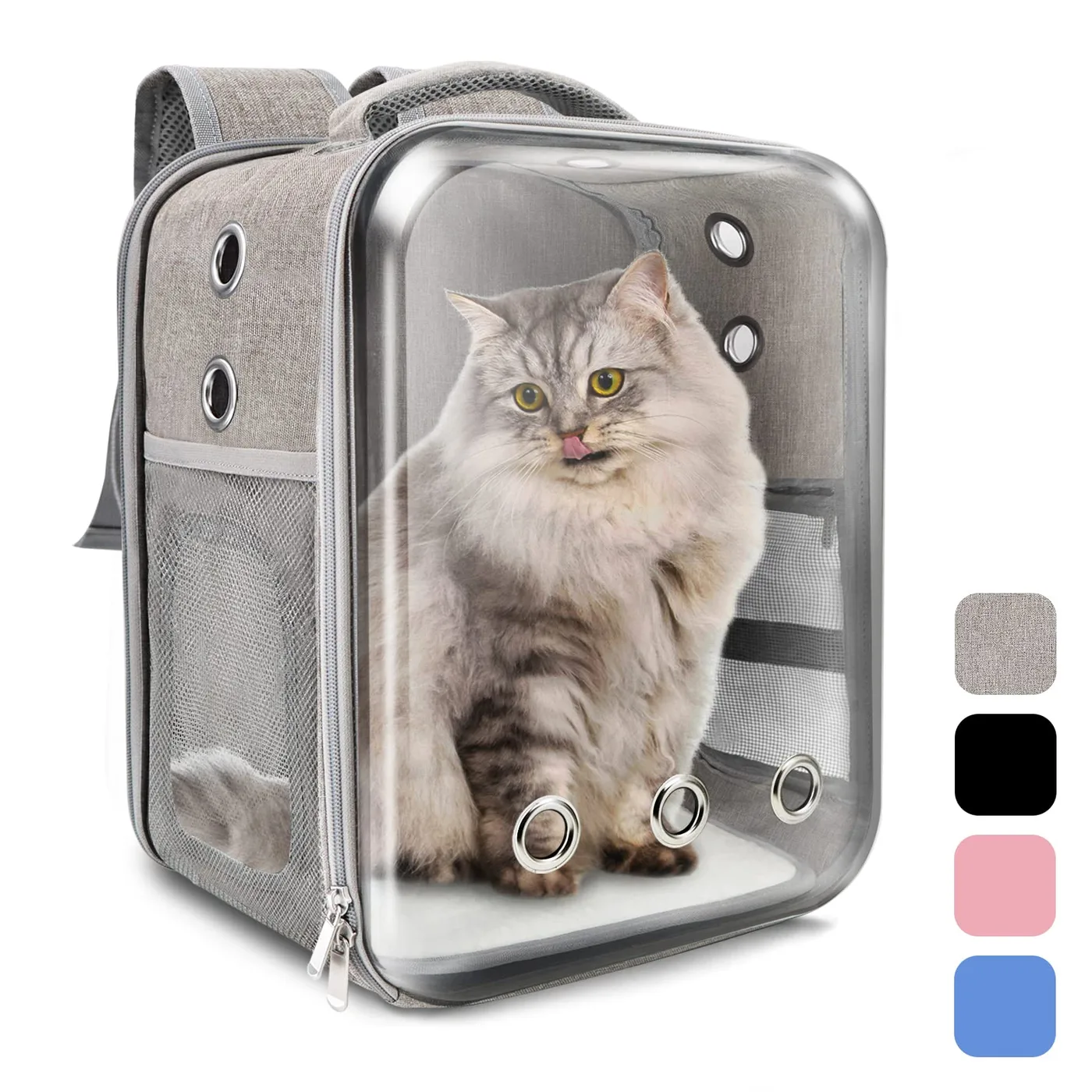
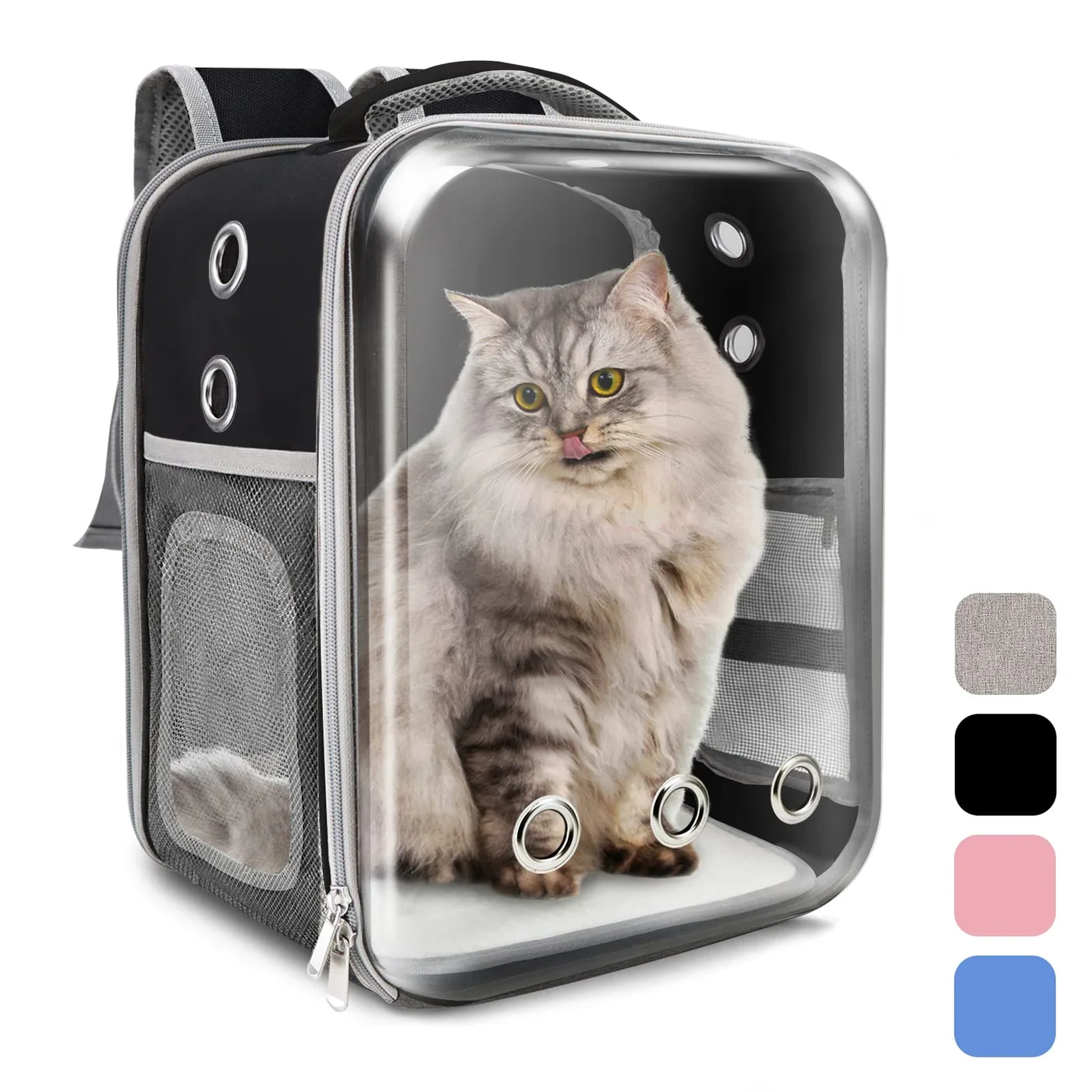
Transparent or bubble designs deserve specific consideration. A rigid transparent shell gives the animal a view and photographs extremely well, which is why it sells, but it reduces ventilation options, adds weight, cubes poorly in a container and raises heat-build-up risk in warm climates. Where a bubble is specified, the ventilation requirement should be increased to compensate and the material should be specified for impact and scratch resistance.
Hybrid designs — a mesh base with a transparent upper, or a mesh panel with a roll-up cover — attempt to balance the two and are often the commercially sensible answer. They add components and cost, and they let a program serve customers who want visibility and customers who prioritise airflow without stocking two separate products.
Whatever the design, heat build-up should be tested rather than assumed. A loaded pack worn for thirty minutes in a warm environment will reveal ventilation problems that no visual inspection will, and it is a cheap test to run during sampling.
Structure, Shape Retention and Packability
Structure in a pet backpack has to do two contradictory jobs: keep the compartment from collapsing onto the animal while being carried, and allow the pack to be packed and shipped efficiently. The resolution depends on where in the product the structure is placed.
A removable stiffened base panel is the minimum sensible provision. It prevents sag, gives the animal a stable floor, and can be removed for washing or for flat packing. Specify the board material, thickness, sleeve fabric and retention method, because a loose panel inside a lined compartment is a defect that inspection rarely catches.
Side and back structure should be light. Foam sheet or a thin frame sheet in the back panel provides the load-transfer surface the harness needs without adding much weight or cube. Full perimeter framing protects the compartment completely and should be reserved for hiking formats and premium positioning, because it costs more, weighs more and ships worse.
Compression is the design risk. A pack that is too soft lets the animal's weight push the walls inward, reducing usable volume and pressing on the animal; a pack that is too rigid cannot be compressed for travel or storage. The commercial answer for travel-positioned backpacks is a semi-structured design with a compressible top section and a stable base, which satisfies both requirements at modest cost.
Packability has a direct freight consequence. Semi-structured backpacks can often be nested or compressed for shipping, which improves carton density, while fully framed packs cannot. Ask for carton dimensions and a container loading estimate at quotation stage, and model landed cost across the assortment rather than per SKU, as set out in our wholesale pet bags bulk buying guide.
Finally, structure should be tested loaded. Fill the compartment to the stated weight ceiling, wear the pack for a defined period, and inspect whether the walls hold, whether the base deflects and whether the harness geometry still sits correctly. Shape failure under load is the most common structural complaint in this format.
Hardware, Zippers and Access Design
Backpack hardware carries more load and sees more use than hardware in any other pet bag format, and it should be specified accordingly. Four component groups matter: zippers, strap hardware, structural fittings and adjustment hardware.
Zippers on the main compartment should be a minimum #5 nylon coil, with #8 or #10 on larger formats and on any curved opening that sits under tension when the pack is loaded. Reverse-coil or weather-resistant zippers add cost and a quality signal. The slider and puller should be specified as carefully as the chain, because the slider is what fails under repeated use and the puller is what the customer grips while wearing the pack.
Access design deserves thought beyond the obvious. A top-loading pack is simple and secure; a front-loading pack lets the animal step in voluntarily, which many owners prefer and which reduces the struggle that produces negative reviews; a side access point is convenient and adds a failure surface. Front-loading designs are commercially popular for exactly this reason and should be specified with a closure that cannot be opened from inside.
Strap hardware should be rated for the working load with a defined safety factor. Triglides, ladderlocks and buckles must be sized exactly to their webbing or they will slip under load, and slipping is the most common hardware complaint in backpack formats. Specifying one hardware family across the range prevents both mixed finishes and sizing errors.
Adjustment hardware should be operable while the pack is worn. A sternum strap that cannot be adjusted one-handed will simply not be adjusted, and the comfort benefit is lost. Specify slider type and position deliberately, and validate adjustment with the pack loaded.
Finally, cycling tests should be part of sampling. Zippers on the main compartment should be cycled several hundred times under load, buckles cycled repeatedly, and the sternum and hip strap sliders tested for retention. These are cheap tests that predict the most expensive failure modes in the format, and third-party verification through SGS is available where a channel requires an independent report.
Cost Bands and Component Priorities
Backpacks sit in the upper-middle of the pet bag price range, and the spread is driven by harness quality, structure and hardware rather than by fabric. Understanding the ranking lets a buyer place a product deliberately in a price band rather than discovering its cost after sampling.
| Configuration | Cost index | Appropriate positioning |
|---|---|---|
| Soft pack, basic straps, no frame | 82-92 | Entry marketplace, small pets |
| Semi-structured, padded S-straps, base panel | 100-115 | Core retail and marketplace |
| Structured back panel, sternum strap, hip belt | 115-135 | Premium and travel positioning |
| Hybrid mesh and transparent shell | 125-145 | Design-led, gifting |
| Framed hiking pack with full harness | 145-180 | Specialty outdoor retail |
The components to protect in any cost conversation are the harness system and the base panel. Strap width, foam density, back panel structure and hip belt provision are what make the product wearable at its stated weight ceiling, and reducing them to hit a price point converts a small saving into a large return rate.
The components to economise on are decorative and secondary features: extra pockets, premium pullers, contrast binding and printed linings. A backpack with fewer external pockets is cheaper to make, has fewer defect opportunities and is frequently better looking, because pocket proliferation is the fastest way to make a pack look cluttered.
Platform sharing works here as elsewhere but with one caveat: harness components should be shared across sizes only where the load requirement is genuinely similar. Sharing a strap specification between a 6 kg and a 14 kg pack is a false economy; sharing webbing, hardware finish and fabric across them is a real one.
Finally, model the return rate honestly. Backpack formats have a higher return rate than totes or crossbody bags because fit and comfort vary by body type, and that cost belongs in the margin model. A program priced without it will look profitable on paper and disappointing in the annual review.
Channel Requirements and Listing Accuracy
Backpack listings attract more scrutiny than most pet bag formats, because they combine travel positioning, weight claims and comfort claims in one product. Three areas require particular care: dimensional accuracy, weight claims and ventilation claims.
Dimensional accuracy is straightforward and frequently wrong. Publish internal and external dimensions, state the weight ceiling, and state whether the figure was measured loaded or empty. A listing that quotes the largest possible number invites returns from customers who measured differently, and those returns are attributed to the product rather than to the listing.
Weight claims should be conservative and validated. A pack that technically holds a 12 kg animal but carries badly at that weight will generate complaints; stating 10 kg and delivering a comfortable carry generates reviews. The ceiling is a specification, not an aspiration, and it should be set by a loaded carry test.
Ventilation claims should be substantiated by the specification rather than by adjectives. Where a listing states a ventilation feature, the underlying mesh area and panel distribution should be in the product file, because these claims are increasingly the subject of marketplace challenges and customer complaints.
Compliance documentation follows the standard market requirements: CPSIA screening and California Prop 65 for the US, REACH for the EU, and OEKO-TEX on skin-contact textiles. Because harness components sit against the carrier's clothing for extended periods, colourfastness testing on strap covers is worth including in the test matrix.
Animal welfare expectations also attach to this format more than to others. Guidance published by organisations such as the American Veterinary Medical Association shapes what customers consider responsible transport, and listings that appear to disregard comfort or ventilation attract criticism as well as returns.
Sampling, Testing and Launch Planning
Backpack sampling needs two gates beyond the standard sequence, because both load transfer and ventilation are experienced rather than seen. Plan five gates.
Gate one is the development sample, delivered in 6-10 working days, checked for volume, dimensions, harness geometry and panel alignment. Gate two is the loaded carry test: fill to the stated weight ceiling, wear for a defined period on at least two body types, and record harness fit, strap spread, back contact and ventilation performance. Gate three is the component test set — zipper cycling, buckle cycling, slider retention and strap pull tests. Gate four is material compliance testing by family. Gate five is the production pilot at AQL 2.5 before balance payment.
The loaded carry test is the one that decides whether the product works. Backpacks fail in use rather than in inspection: straps spread, packs sit away from the back, ventilation panels are blocked by the wearer, and the base deflects under the animal's weight. None of these is visible on a sample table, and all of them are obvious after twenty minutes of wear.
Bulk production takes 35-50 days from sample approval and deposit. Backpack programs trend toward the longer end because harness components, frames and structured panels are ordered items rather than stock, and locking them at sample approval is what protects a fixed launch date.
Launch sequencing should follow the size curve. Ship the compact and standard sizes first, hold the large and hiking formats for a second drop, and use the first eight weeks of returns and reviews to confirm that the harness specification holds at the top of the range. Programs that launch four sizes at once cannot tell whether a comfort complaint is a sizing issue or a specification issue.
Finally, build the calendar backwards from the travel or outdoor season and re-baseline on any slip. Allow 6-10 working days for sampling, roughly two weeks for approvals and artwork, 35-50 days for bulk, and three to five weeks for freight and clearance. Northern hemisphere demand builds ahead of summer and again ahead of the year-end period, and production slots are allocated in deposit order — the earlier the deposit, the better the slot and the price.
Production capability
- SGS-verified production space of 4,950 m², 149 machines, 7 assembly lines
- Pet bag output since 2014 from a 137-person team
- 200,000 units shipped monthly under BSCI and ISO 9001 systems
People Also Ask
What is the difference between a pet backpack and a pet travel bag?
A backpack carries the load on both shoulders through a harness system, while a travel bag is carried by hand or over one shoulder and is usually dimensioned for cabin or under-seat space. Backpacks prioritise load transfer and ventilation; travel bags prioritise dimension compliance.
How do I specify a comfortable pet backpack?
Specify the harness system numerically: strap width and foam density, an S-shaped strap geometry, a structured back panel with spacer mesh, a sternum strap above 6 kg and a hip belt above 10 kg. Validate with a loaded carry test on two body types.
Why do pet backpacks get returned more than other formats?
Fit and comfort vary by body type, and the product is worn rather than carried, so harness geometry and back contact are judged in use. Publishing accurate internal dimensions and a conservative weight ceiling removes the largest share of avoidable returns.
What ventilation is enough in a pet backpack?
Mesh across at least two opposing faces, specified as a percentage of surface area, with the largest panel placed where the wearer's back will not block it. A single large panel ventilates far less effectively than two smaller opposing ones.
Should a pet backpack be structured?
Semi-structured is usually right: a removable stiffened base panel plus light side and back support, which prevents collapse while remaining packable. Full framing suits hiking formats and premium positioning, where cost, weight and freight cube are acceptable trade-offs.
How far ahead should I plan a backpack launch?
Allow 6-10 working days for sampling, about two weeks for approvals, 35-50 days for bulk and three to five weeks for freight and clearance. Book early for summer and year-end demand, because production slots are allocated in deposit order.
Frequently Asked Questions
What is the MOQ for a pet backpack program?
The standard MOQ is 500 pieces per colour. Backpack programs use ordered components such as harness webbing, buckles, frames and structured panels, so ordering below the threshold mainly raises the per-unit cost of those components.
How long do sampling and bulk production take?
Development sampling takes 6-10 working days and bulk production takes 35-50 days from sample approval and deposit. Backpacks trend toward the longer end because harness and structural components are ordered rather than stocked.
What weight can a pet backpack carry comfortably?
Comfortably rather than merely physically: up to about 6 kg with padded shoulder straps, up to 10 kg with a sternum strap and structured back panel, and above 10 kg only with a hip belt that transfers load to the pelvis. Validate the ceiling with a loaded carry test.
Do pet backpacks need a hip belt?
Above roughly 10 kg, yes. A hip belt is the only way to move part of the load off the shoulders, and specifying a high weight ceiling without one is the most common structural error in the category.
How much ventilation does a pet backpack need?
Specify a defined percentage of total surface area in mesh across at least two opposing faces so that air can cross the compartment, with the largest panel on a face that is not blocked by the wearer's back. A panel on the back-facing side delivers little benefit.
Are transparent bubble backpacks safe?
They are safe when ventilation is increased to compensate for the reduced airflow, and when the material is specified for impact and scratch resistance. They add weight, cube poorly in a container and raise heat-build-up risk in warm climates, so hybrid mesh and transparent designs are often the better commercial answer.
What zipper gauge should a pet backpack use?
A minimum #5 nylon coil on the main compartment, with #8 or #10 on larger formats and on curved openings that sit under tension when loaded. Specify the slider and puller as well, because the slider is what fails under repeated use.
Why does my backpack sit away from my back?
Usually a flat, unstructured back panel that provides no load-transfer surface, so the straps carry everything. A structured panel with a slight lumbar curve and a spacer mesh surface keeps the pack close and lets the hips take part of the load.
What does AQL 2.5 cover on a backpack order?
AQL 2.5 is the acceptable quality limit for the final random inspection. For backpacks, the defect list should classify strap root bar-tacking, hip belt anchoring, zipper function under load and buckle retention as critical or major rather than general workmanship.
Can I share components across backpack sizes?
Share webbing, hardware finish and fabric, but not harness specifications across very different weight bands. Sharing a strap specification between a 6 kg and a 14 kg pack is a false economy that produces failures at the top of the range.
Which compliance requirements apply to pet backpacks?
CPSIA screening and California Prop 65 for the US, REACH for the EU, and OEKO-TEX on skin-contact textiles. Include colourfastness testing on strap covers, because harness components sit against clothing for extended periods.
How should I launch a backpack range?
Ship the compact and standard sizes first, hold large and hiking formats for a second drop, and use eight weeks of returns and reviews to confirm the harness specification holds at the top of the range before scaling the larger sizes.
Talk to QUANZHOU JUNYUAN BAGS about a wholesale pet bag order: MOQ 500 pieces per colourway, samples in 6-10 working days, bulk production in 35-50 days under AQL 2.5 inspection.
Get a free quote Request a sample