Pet Gym Bag: Fitness Style Specs for Wholesale Buyers
A wholesale pet gym bag should be specified with a fully welded or laminated wet zone holding 3-5 L, a 600D-900D abrasion-resistant shell rated to 20,000 Martindale cycles, and a wipe-clean lining with no absorbent foam in the pet cavity. Expect USD 8.20-14.90 FOB Xiamen. Programmes run at MOQ 500 pcs per colourway, sample in 6-10 working days and ship 35-50 days after approval under AQL 2.5.
Executive Summary
This guide is for buyers building a fitness-positioned pet bag for sporting-goods retail, gym-chain shops or marketplace listings aimed at active owners. The category looks like a duffel and is judged like gym equipment: buyers expect wipe-clean surfaces, a separated wet zone and hardware that survives daily use.
Our production team quotes these programmes at MOQ 500 pcs per colourway, with mixed colourways permitted inside one purchase order. Samples take 6-10 working days after the tech pack is confirmed, and bulk production runs 35-50 days after sample approval. Shipments are offered to AQL 2.5 pre-shipment inspection with third-party inspectors accepted, on T/T 30/70 against FOB Xiamen.
Three specifications decide whether this SKU earns repeat orders: the construction of the wet zone, the absence of absorbent materials in the pet cavity, and the durability of the closure system under daily cycling. A fourth variable is commercial rather than technical: the fitness retail calendar. January resets and late-summer routines are planned months ahead, so a programme that starts sampling late has lost the window regardless of how good the product is.
Wholesale hiking pet carrier programmes and wholesale airline approved pet carrier programmes pull in opposite directions - one needs ventilation area, the other needs a rigid footprint - and Pet Bag Types & Styles has to pick which constraint wins. Wholesale pet carrier for small dogs and wholesale pet carrier for large dogs can share a brand but rarely share a pattern.
Where the Fitness-Style Pet Bag Sits in a Wholesale Assortment
A fitness-style pet bag is merchandised next to duffels, not next to pet beds. That placement changes what the buyer expects and what the product has to survive. In a sporting-goods channel the bag is judged on material credibility, cleanability and closure quality, because those are the attributes the same shopper uses to judge a gym bag. Pet-specific features - ventilation, tether, base board - are expected but they are not the selling argument.
This matters commercially because the buyer you pitch is usually a different person. A pet-category buyer asks about weight rating and escape prevention. A fitness buyer asks about wipe-clean surfaces, odour control and whether the bag can be dropped in a locker without picking up damage. A listing written for one buyer will underperform with the other, and the fix is not better copy - it is a spec that genuinely supports the claim.
- Channel: sporting-goods retail, gym-chain retail, active-lifestyle marketplaces, corporate wellness gifting.
- Price architecture: USD 39-79 retail is the workable band for a fitness-positioned pet bag.
- Payload: pet 5-9 kg plus gym kit, shoes, bottle and towels - plan for 18-26 L total.
- Use pattern: 4-7 sessions per week, so closure cycles per year run into four figures.
- Failure expectation: buyers in this channel accept wear, but not seam splits or zip failure within a season.
The second commercial point is seasonality. Fitness retail has two clear peaks - the January reset and the late-summer back-to-routine window - and both are planned months ahead. A fitness-positioned pet bag that misses the January plan ofogram does not get a second chance until the following year, which is a stronger argument for early sampling than any price negotiation.
Finally, decide whether the SKU is unisex or gendered in its colour story. Fitness assortments are usually unisex with a colour-blocked accent, and a pet bag that arrives in pastels will be re-coloured by the retailer's planogram team or, more likely, dropped. Ask the buyer for the seasonal palette before you choose Pantone references, not after.
Wet-Zone Separation and Cleanability Specifications
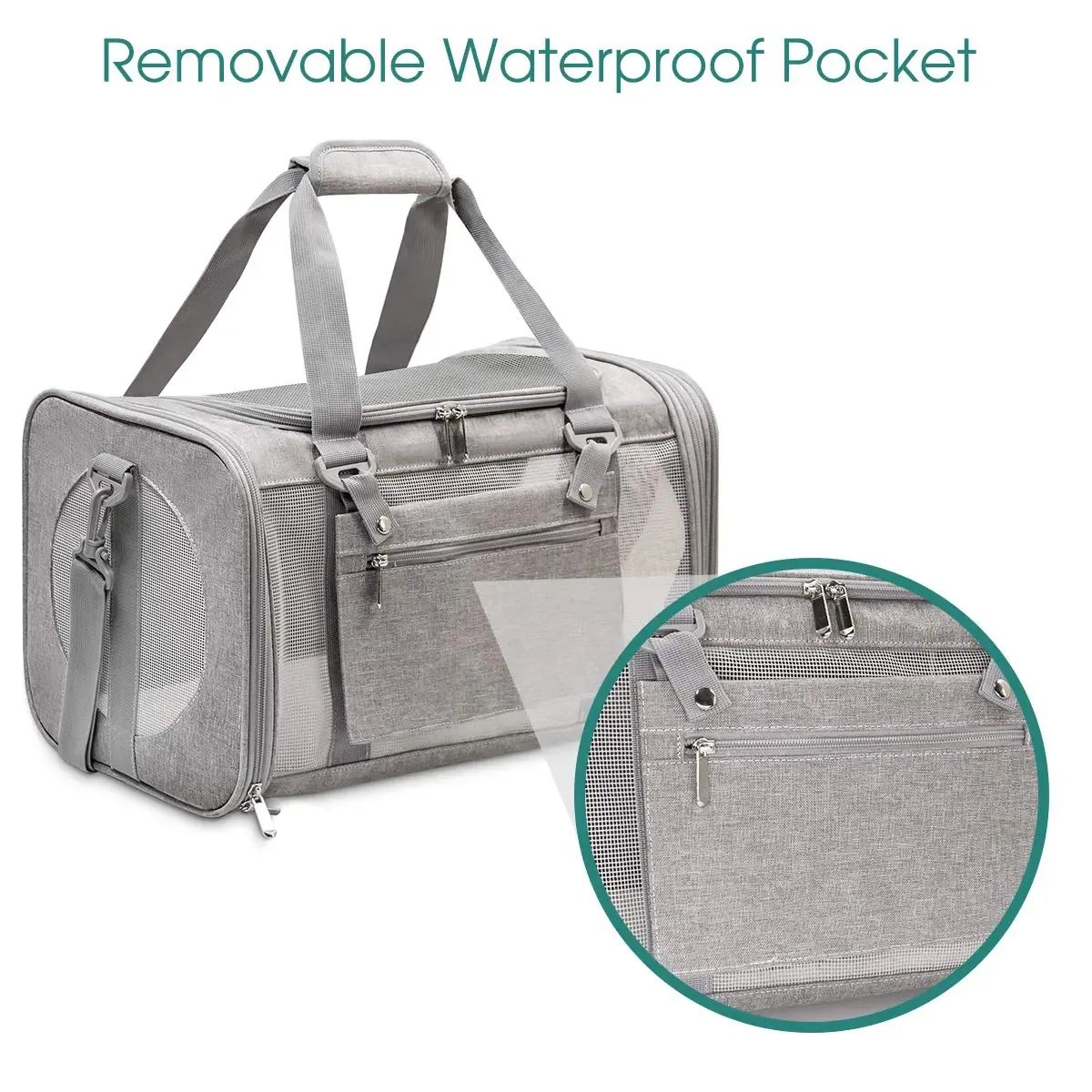
The defining feature of a fitness-style pet bag is a wet zone: a fully sealed compartment for damp towels, a water bottle that has leaked, or a pet that came in from rain. In a pet bag this compartment also has a second job - it keeps moisture away from the animal's resting surface, because a damp floor is the fastest route to skin complaints and to a one-star review.
Construction is the whole game here. A wet zone lined with fabric and stitched at the corners will leak through the needle holes within weeks. The options that hold up are high-frequency welded TPU-laminated polyester, or a drop-in liner with sealed seams. Welded construction costs more per unit and requires tooling; a drop-in liner is cheaper and replaceable, which is genuinely attractive for a consumer and simplifies the spare-parts conversation.
| Option | Unit cost impact | Leak performance | Best for |
|---|---|---|---|
| Stitched lining, no coating | baseline | Fails within weeks at corners | Not recommended |
| PU-coated lining, sealed tape | + USD 0.45-0.80 | Good for 6-12 months | Entry programmes |
| TPU laminate, welded seams | + USD 1.20-2.30 | Full life of the bag | Mid and premium |
| Removable welded drop-in liner | + USD 1.60-2.80 | Full life, replaceable | Premium and DTC |
Volume matters as much as construction. A wet zone under 2 L is decorative - it will not hold a towel and a bottle. The working range for this category is 3-5 L, positioned at the end of the bag so it can drain independently and so a leaking bottle cannot reach the pet cavity even if the bag is laid flat. Specifying a grommet drain at the low corner is a small detail that buyers notice and appreciate.
Cleanability extends beyond the wet zone. The pet cavity should use a non-absorbent base pad - closed-cell foam with a welded or coated cover, not an open-cell foam pillow in a fabric sleeve. Absorbent padding is the root cause of persistent odour complaints, and it is also the single most common reason a returned bag cannot be resold. The base pad should lift out entirely for wiping, and the spec should say so.
Fabric and Finish Selection for High-Frequency Use
A gym bag is used hard: thrown into lockers, dragged across floors, stuffed beyond its intended volume and zipped one-handed while the owner is holding something else. Fabric selection should be driven by abrasion resistance and dimensional stability, with hand feel a distant third.
For the shell, 600D polyester is the entry point and 900D is the practical default; both should carry a PU or TPU backing for dimensional stability and a durable water-repellent finish for the outside. Where the programme needs to justify a higher retail price, a recycled 900D with a GRS certificate allows both a durability and a sustainability claim from the same material. Laminates and coated nylons look excellent on a sample and scuff visibly after a month in a locker - worth knowing before you commit to a colour.
Lining colour is a decision with commercial consequences that buyers routinely overlook. A pale lining looks premium on a product page and shows every mark in week one; a mid-tone or dark lining hides wear and reads as practical in a fitness context. If the brand's visual language requires a light interior, specify a coating that is genuinely wipe-clean and say so in the copy.
Testing should be named rather than assumed. Abrasion and colour-fastness behaviour is normally measured to AATCC textile test methods, and a result without a method number is not a result you can enforce. For coated fabrics, also ask for hydrolysis or coating-integrity data if the bag will be sold into humid markets; coating failure shows up as flaking and it is not covered by a general abrasion claim.
- Shell: 600D or 900D polyester, PU or TPU backed, DWR finish, 20,000 Martindale cycles minimum.
- Lining: 210D ripstop with wipe-clean coating; avoid brushed tricot in the pet cavity.
- Mesh: PVC-coated polyester, 1.2-1.5 mm aperture, welded rather than stitched where possible.
- Base: coated fabric over 4 mm closed-cell foam, with five feet minimum.
- Webbing: 25-38 mm high-tenacity polyester, bar-tacked at every load point.
Odour Control and Antimicrobial Claims - What Is Defensible
Odour is the number one complaint driver in fitness bags and it is worse when an animal is involved. Buyers routinely ask for an antimicrobial treatment as the fix. The honest position is that a finish helps at the margins and cleanable construction solves the problem, and a spec that reverses that priority will disappoint.
Where a finish is used, be precise about what is being claimed. A treatment applied to the lining reduces bacterial growth on the treated surface; it does not make the bag self-cleaning and it does not survive unlimited wash cycles. Any claim printed on packaging should be backed by a test report naming the organism and the reduction method, and the certificate should be renewable annually, because certificates expire and retailers do check.
If the programme wants a certified textile input, an OEKO-TEX certified textile input is the cleanest route: the certificate number can be printed on the hangtag and verified by the retailer without a separate laboratory exercise. It addresses the chemical-safety question rather than the odour question, and buyers should not conflate the two in their copy.
The construction measures that actually control odour are unglamorous and cheap:
- No open-cell foam anywhere in the pet cavity - it absorbs and it cannot be fully dried.
- A removable, welded base pad that lifts out and wipes in seconds.
- Ventilation panels on two opposite sides so damp air can escape rather than recirculate.
- A wet zone with a drain grommet so standing moisture has somewhere to go.
- An instruction insert telling the owner to air the bag open after use - the cheapest intervention of all.
One caution on finishes and compliance: an antimicrobial treatment is a chemical input, and it needs to appear on the chemical compliance declaration for the market you are selling into. Adding a finish late in development without updating that declaration is a common and avoidable audit failure.
Hardware and Closure Durability Under Daily Cycling
Closures are the most heavily cycled component on a gym bag and the most frequently cited cause of returns. A bag used five times a week accumulates roughly 500 zip cycles a year, and a fitness-positioned pet bag also has to survive being over-packed, because owners routinely push volume beyond the intended limit.
Specify zips by size and by cycle rating, not by appearance. A #8 coil zip with a metal-look tape is the practical default for main openings; a #5 is acceptable on secondary pockets and inadequate on a main closure that will be forced. Sliders should be locking on any panel that carries load, and pullers should be sized for one-handed use with a gloved or wet hand.
Attachment points deserve equal attention. Handle roots, strap roots and D-ring anchors should be bar-tacked with a specified stitch count and reinforced with a hidden webbing extension that distributes load into the panel rather than into the seam. This is where cheap bags fail catastrophically rather than gradually, and it is a defect that shows up in the first month.
- Main closure: #8 coil, locking slider, branded puller, cycle-tested to 3,000 open-close operations.
- Secondary closures: #5 coil, non-locking acceptable.
- Load points: bar-tack reinforcement with webbing extension into the panel.
- Hardware finish: matte nickel or gunmetal; require a corrosion test result for humid markets.
- Strap: 38 mm webbing with a removable pad, tested to 20 kg static pull.
For verification, use a written sampling plan and a named inspection standard rather than a spot check. SGS testing and inspection services cover both the laboratory side and the pre-shipment side, and most sporting-goods retailers accept their reports without further argument. Cost of one laboratory cycle test on a new zip specification is trivial next to the cost of a season of returns.
Colour strategy and the fitness planogram
Fitness assortments are planned by colour story, and the pet bag has to fit the story the buyer has already committed to rather than the one the brand would prefer. That means the colour decision belongs early, alongside the material decision, and it means asking the retailer for the seasonal palette before Pantone references are chosen.
The practical structure that works for volume programmes is a black or charcoal body with a seasonal accent colour on the webbing, zip tape and logo. One body colour across the whole order keeps the dye lot simple and the price in the mid band, while three accent colours give the retailer three planogram SKUs. Changing the body colour per SKU, by contrast, triples the fabric buy for a benefit the shopper barely notices.
Contrast placement also carries a functional role in this category. A dark body hides locker scuffing; a light accent on the webbing makes the bag visible in a changing room and in a car park. That combination - dark where it wears, bright where it is looked for - is the logic behind most successful fitness colourways and it costs nothing to specify.
Finally, decide whether the SKU carries a gendered or unisex colour name in the listing. Fitness retail is predominantly unisex and gendered naming can suppress search visibility in a channel where most buyers filter by product type rather than by recipient.
The second colour decision is accent placement on the pet cavity itself. A mesh panel in a bright accent colour draws the eye to the animal in photography, which helps the listing, but it also shows dirt faster than a dark mesh. The compromise most programmes settle on is dark mesh with a bright binding tape, which gives the colour read without the maintenance problem.
Finally, keep one colourway deliberately plain. Fitness retailers frequently use a single black or charcoal SKU as the volume driver behind a brighter planogram, and a range with no neutral option loses that placement entirely to a competitor who has one.
Cost Structure and Price Banding
Fitness-positioned pet bags sit in a competitive price band where buyers are tempted to chase entry pricing. The economics say otherwise: this SKU is used harder than a fashion tote, so the cost of under-specifying shows up as returns and as lost reorder, both of which are more expensive than the material saving.
| Build level | Wet zone | Shell | FOB band | Target retail |
|---|---|---|---|---|
| Entry | Taped PU lining, 3 L | 600D polyester | USD 8.20-10.40 | USD 34-45 |
| Mid | Welded TPU, 4 L | 900D recycled polyester | USD 11.10-13.80 | USD 49-65 |
| Premium | Removable welded liner, 5 L | 900D recycled, coated base | USD 14.20-18.90 | USD 69-89 |
For a mid build at roughly USD 12.40, the split is: shell and lining fabric 32-38%, wet-zone material and welding 11-15%, hardware 13-17%, foam and structure 8-11%, labour 20-24%, packaging and documentation 4-6%, factory margin 8-12%. Welding is a tooling cost on the first order and a per-unit cost thereafter, which is why the first-order price for a welded wet zone is higher than the reorder price.
The saving levers, ranked by value divided by risk: consolidating volume into fewer, larger orders; reducing colourways; standardising hardware rather than tooling custom pullers; simplifying packaging; and only then, reducing fabric weight. Dropping the welded wet zone to a taped lining saves USD 0.75-1.50 and moves the leak risk to the customer - a legitimate choice for an entry SKU provided the listing does not claim a fully sealed compartment.
Freight is worth a line in the model. A 22 L duffel-style body packs reasonably well compared with a structured work bag, but a coated, non-compressible wet zone reduces carton density. Ask for packed carton dimensions and a volumetric quote before fixing retail pricing; a carton that ships at volumetric weight rather than actual weight can add several percent to landed cost.
MOQ, Sampling, Lead Time and the Fitness Retail Calendar
The working minimum remains MOQ 500 pcs per colourway, driven by fabric dye lots and cutting efficiency. Fitness programmes often want more colourways than other categories because the channel merchandises by colour story, so the mixed-colourway structure matters: three colourways at 500 each in one order is the standard shape of a first buy.
Sampling takes 6-10 working days per round after tech pack sign-off, and bulk runs 35-50 days after approval. Welded wet zones add 5-8 days to the first sample because tooling has to be cut; reorders using the existing tool do not carry that penalty. Add 30-45 days for sea freight and customs to a US or EU warehouse.
| Milestone | Target date | Note |
|---|---|---|
| Retailer palette issued | 1 March | Drives Pantone selection |
| Tech pack locked | 15 April | Includes welding drawings |
| Structure sample approved | End May | Two rounds expected |
| Bulk production | June to July | 35-50 days |
| Sea freight and receipt | August to September | 30-45 days |
| Shelf set | 1 January | Planogram confirmed |
Read that calendar and the lesson is clear: a January shelf set is decided in the spring, not in the autumn. Buyers who start sampling in September are air-freighting or missing the window, and air freight on a 22 L duffel-shaped carton costs multiples of sea freight.
Pre-shipment inspection at AQL 2.5 should be booked before production finishes, not after. For this SKU specifically, add weld integrity at the wet-zone corners, zip cycling smoothness, and bar-tack presence at every load point to the critical-defect list. A generic bag checklist will not catch a weld that has a 4 mm gap at the corner, and that defect reaches the customer as a wet pet and a wet car.
Accessory programmes and attach rate
Fitness bags sell accessories better than almost any other SKU in a lifestyle pet range, because the customer is already in a gear-buying mindset. A removable wet pouch, a shoe compartment bag, a branded towel and a collapsible bowl are all cheap to develop and retail at high margin.
The commercial logic is straightforward. An accessory at USD 1.80-4.20 FOB retailing at USD 12-25 carries a better percentage margin than the bag itself, and it raises the attach rate on the primary SKU. It also improves review scores, because a bag that arrives with a useful extra reads as considered rather than generic.
Development cost is the constraint worth noting: each accessory needs its own tech pack, sample round and inspection line. The efficient approach is to develop accessories that share fabric and hardware with the bag, so one fabric buy and one inspection booking cover the whole programme.
The accessories that sell best in this channel are the ones that solve a wet problem: a removable wet pouch for gym kit, a shoe bag with a drained base, and a microfibre towel. All three are cheap, all three are genuinely used, and all three reinforce the cleanability story the bag is already making.
One caution on bundling. A bundle raises perceived value but it also raises the return surface: if the accessory fails, the customer returns the whole set. Test the accessory as rigorously as the bag, and avoid bundling anything with a closure that has not been cycle-tested.
Compliance, Documentation and Channel Onboarding
Sporting-goods and gym-chain retailers have onboarding processes that are often more demanding than pet-specialty ones. They require a supplier profile, a compliance declaration, packaging that meets their receiving specification and, increasingly, a sustainability statement. None of this is hard; all of it is slow if it starts late.
For the US, general consumer-product obligations apply and recall traceability has to be built into the product rather than the carton. Guidance and obligations sit with the US Consumer Product Safety Commission, and the practical requirement for a buyer is a batch code on the product and a retained production record. California exposure warnings are administered by OEHHA, and coated fabrics, foam and hardware finishes are the components most often asked about.
For the EU, REACH substance restrictions apply to coatings, foam and hardware, and packaging waste rules are tightening year on year. A mono-material construction - polyester fabric, polyester webbing, polyester thread - makes both the compliance declaration and any future extended-producer-responsibility reporting materially simpler.
- Batch or date code sewn into the bag for traceability.
- Fibre composition and country of origin marking in the importing market's format.
- Instruction insert: weight rating, tether use, air-dry guidance, wet-zone care.
- Test reports: abrasion, colour fastness, zip cycling, hardware corrosion, chemical screens as requested.
- Certificate numbers for any recycled-content or OEKO-TEX claim, current and renewable.
- Carton marking and barcode format matching the retailer's receiving specification.
Quality-system consistency across repeat seasons is the part buyers feel but rarely specify. An ISO 9001 certified quality management system is what keeps the fourth order matching the first after a fabric lot changes or a line is rebalanced. Our SGS-verified production base carries that certification, and the pre-shipment inspection is the per-shipment check that sits on top of it.
Finally, seal and keep a golden sample. Fitness programmes reorder annually, and annual reorders are where silent spec drift happens: a zip supplier changes, a foam density drops, a coating is swapped for a cheaper equivalent. A physical reference plus a written component list costs nothing and settles the argument immediately.
Why brands source here
- Pet bag programmes run since 2014; founding team in sewn goods since 2004
- SGS-verified production floor of 4,950 m² with 137 workers across 7 lines
- Monthly capacity of 200,000 units, audited to BSCI and ISO 9001
People Also Ask
Can you put a wet towel and a pet in the same bag?
Only if the wet zone is a sealed compartment of at least 3 L, physically separated from the pet cavity, with a drain grommet so moisture cannot migrate to the animal's resting surface.
What size pet gym bag is best?
18-26 L total for a pet of 5-9 kg plus gym kit. Below 18 L the bag cannot hold both; above 26 L it stops reading as a gym bag on the shelf.
How do you get pet smell out of a gym bag?
Remove and wipe the base pad, air the bag open with both ventilation panels exposed, and avoid any absorbent foam in the pet cavity. Bags designed without open-cell foam rarely develop persistent odour.
Are antimicrobial linings worth the cost?
They are worth roughly USD 0.20-0.45 when the cleanable construction is already correct. They are not a substitute for a removable welded base pad and cross-ventilation.
What fabric denier should a gym pet bag use?
600D is the entry point and 900D is the practical default, both with a PU or TPU backing and a durable water-repellent finish, tested to at least 20,000 Martindale cycles.
Do fitness retailers accept pet products?
Yes, increasingly, provided the SKU meets their onboarding pack: supplier profile, compliance declaration, retail-ready packaging and a sustainability statement.
How many units should a first fitness order be?
1,500 pcs across three colourways at 500 per colourway. That size gives listing or planogram data without concentrating risk in a single colour story.
Frequently Asked Questions
What makes a pet bag a gym-style bag?
A duffel-derived silhouette, a separated sealed wet zone of 3-5 L, wipe-clean surfaces and hardware rated for daily cycling. Pet features - ventilation, tether, firm base - are present but the merchandising argument is fitness utility.
Why does the wet zone need welded seams?
Stitched corners leak through needle holes within weeks. Welded TPU-laminated seams, or a removable welded liner, keep moisture away from the pet cavity for the life of the bag.
What is the MOQ for a pet gym bag?
MOQ is 500 pcs per colourway, with mixed colourways permitted in one order. Fitness programmes commonly run 1,500 pcs across three colourways for a first buy.
How long does sampling take?
6-10 working days per round after the tech pack is confirmed. A welded wet zone adds 5-8 days to the first sample for tooling; reorders using the existing tool do not.
What is the bulk production lead time?
35-50 days after sample approval. Custom hardware tooling or a new woven label adds 10-15 days on the first order.
How should odour be controlled in a pet gym bag?
Through construction first: no open-cell foam in the pet cavity, a removable welded base pad, cross-ventilation on opposite sides and a drain grommet in the wet zone. A lining finish helps at the margin but does not replace cleanable design.
Can an antimicrobial claim be printed on the packaging?
Only with a current test report naming the organism and reduction method, and only if the treatment appears on the chemical compliance declaration for the destination market.
What zip specification should be used?
A #8 coil zip with a locking slider and branded puller on the main opening, cycle-tested to 3,000 operations. A #5 is acceptable on secondary pockets only.
How much does a wholesale pet gym bag cost?
USD 8.20-10.40 FOB Xiamen for an entry build, USD 11.10-13.80 for a mid build with a welded wet zone and recycled shell, and USD 14.20-18.90 for a premium build with a removable liner.
What inspection standard should be specified?
AQL 2.5 with a defect list written for this SKU: weld integrity at wet-zone corners, zip cycling smoothness and bar-tack presence at every load point belong on the critical list.
Which documents do sporting-goods retailers require?
Batch traceability code, fibre composition and origin marking, an instruction insert, plus abrasion, colour-fastness, zip-cycling, hardware-corrosion and chemical test reports, and carton marking to their receiving specification.
How far ahead should a January launch be planned?
Start in the spring. A January shelf set typically means a locked tech pack by April, samples approved by late spring, production in mid-year and goods received before autumn.
Talk to QUANZHOU JUNYUAN BAGS about a wholesale pet bag order: MOQ 500 pieces per colourway, samples in 6-10 working days, bulk production in 35-50 days under AQL 2.5 inspection.
Get a free quote Request a sample